
If you have ever spent a frustrating evening locked in a bumper-to-bumper standstill on the Delhi-Gurugram Expressway, or watched the battery on your phone slowly die while crawling through Noida traffic, you know that commuting in the National Capital Region (NCR) can feel like a test of human endurance. For years, the rapid explosion of real estate and corporate hubs outpaced the roads connecting them.
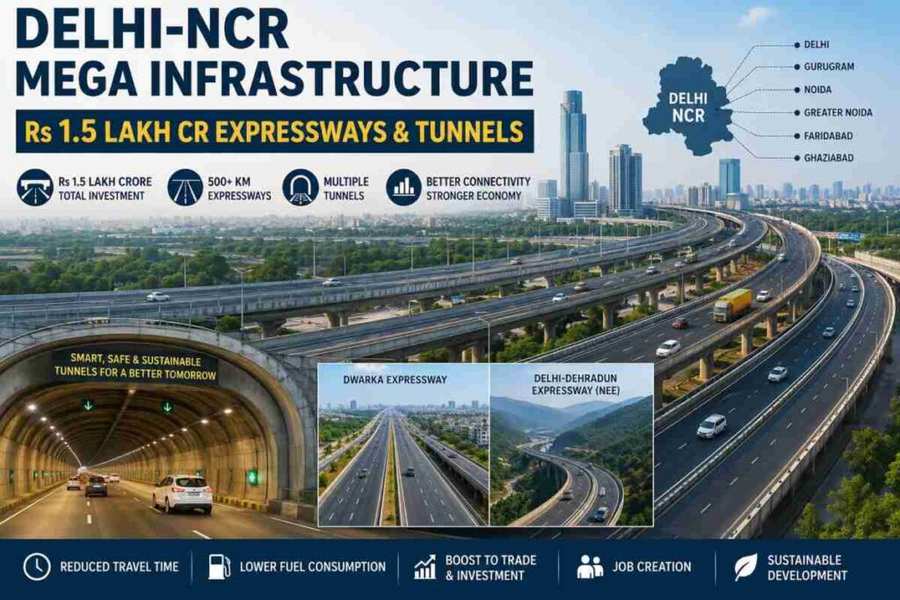
But a massive shift is underway. A colossal Rs 1.5 lakh crore mega infrastructure push is actively rewriting the geography of Delhi-NCR. We are not talking about minor road repairs or cosmetic upgrades. This is a sweeping, interconnected network of high-speed expressways, multi-lane ring roads, and underground bypass tunnels designed with a singular, radical objective: to ensure you spend less time trapped behind a steering wheel and more time living your life.
Whether you are an investor looking to capture early real estate gains, a business owner optimizing a supply chain, or a daily commuter tired of the chaos, this multi-billion-crore master plan is set to alter your property values, your business efficiency, and your daily peace of mind.
What is the Delhi-NCR Mega Infrastructure Drive?
Simple Explanation
At its core, this mega infrastructure drive is an aggressive, centrally backed financial and engineering blueprint worth Rs 1.5 lakh crore ($18-20 Billion USD). The project aims to build an uninterrupted web of transit corridors wrapping around and slicing directly through Delhi, Noida, Ghaziabad, Faridabad, and Gurugram.
Instead of forcing all regional and interstate freight traffic to clog the internal arteries of Delhi, this master plan creates massive peripheral loops and deep urban bypass tunnels. By separating heavy commercial logistics from daily passenger vehicles, the system decongests the entire metropolitan area simultaneously.
Why It Matters in 2026 and Beyond
We have reached a critical tipping point. The traditional borders dividing Delhi from its satellite cities have entirely melted away. Gurugram and Noida are no longer just “suburbs”—they are global economic engines housing Fortune 500 headquarters, massive manufacturing plants, and millions of residents.
With vehicular density growing exponentially, the old network was on the verge of total gridlock. This multi-phase infrastructure rollout provides the breathing room necessary for the region to expand sustainably over the next decade, transforming how seamlessly people and goods move across state lines.
Key Features and Engineering Highlights
High-Speed Expressways and Elevated Corridors
The backbone of this transformation relies heavily on wide, access-controlled expressways designed for optimal speed and safety. These corridors feature automated tolling systems, intelligent traffic management systems, and dedicated lanes for heavy transport. Elevated structures are strategically deployed over previously congested state highways, allowing local neighborhood traffic to move freely underneath while high-speed commuters breeze past overhead.
Smart Orbital Ring Roads
To stop interstate trucks from paralyzing local city streets, a series of strategic ring roads are being completed and synchronized. These orbital corridors encircle the capital, allowing a traveler moving from Punjab or Haryana toward Uttar Pradesh to completely bypass the core city center of Delhi. This single shift drastically reduces local urban congestion and cuts down travel times for heavy logistics by hours.
Deep Urban Bypass Tunnels
In areas where surface land acquisition is physically impossible or prohibitively expensive, engineers are digging downward. Advanced underground tunnel networks are being introduced to connect critical zones seamlessly. These tunnels are equipped with cutting-edge ventilation systems, fire suppression tech, and real-time monitoring, creating direct, rapid escape routes right beneath some of the most densely populated real estate pockets in the country.
Benefits of the Delhi-NCR Mega Infrastructure Projects
Financial Benefits
Time is money, and the economic drain of traffic congestion is incredibly real. By slashing travel times between major economic zones by half, businesses will see an immediate drop in fuel consumption and vehicle wear-and-tear. For logistics, e-commerce, and supply-chain operations, this predictability means faster turnaround times, lower operational overhead, and highly optimized fleet management across state lines.
Lifestyle and Health Benefits
Beyond the balance sheet, the human impact is profound. Shorter commutes mean less time breathing in exhaust fumes and more time spent with family. Reduced idling at major bottlenecks directly translates to lower micro-level emission hotspots, contributing to improved air quality across the NCR. A predictable commute takes a massive mental load off professionals, lowering daily stress levels significantly.
H3: Long-Term Value Creation
Infrastructure is the ultimate driver of real estate and commercial value. Areas that were once considered isolated or inconvenient are suddenly being pulled into prime accessibility zones. This massive injection of capital creates a powerful economic multiplier effect, generating thousands of jobs in construction, engineering, and maintenance, while permanently raising the economic baseline of the entire region.
H2: Location and Market Analysis
H3: Connectivity Matrix
The primary beneficiaries of this Rs 1.5 lakh crore investment are the critical connecting corridors linking Gurugram, Noida, and Greater Noida to Delhi and international transit hubs. The upcoming projects bridge the geographic gaps between the eastern and western ends of the NCR, establishing a highly integrated transit matrix where cross-region travel becomes genuinely effortless.
[Western NCR: Gurugram] <---> [Central: Delhi / Tunnels] <---> [Eastern NCR: Noida / Greater Noida]
                                      ^
                                      |
                         [Southern Hub: Jewar Airport]
Infrastructure Growth Points
We are seeing major real estate and commercial growth explosions along the perimeters of these new expressways. Regions bordering the upcoming bypass routes and ring roads are transitioning rapidly from rural outposts to master-planned smart cities. Data centers, logistics parks, and premium residential townships are pulling back from over-saturated city centers to cluster tightly around these high-speed access nodes.
Future Potential
As these transit lines integrate with secondary infrastructure—like regional rapid rail links and new metro extensions—the economic density of the region will shift outward. This decentralized growth ensures that property appreciation is not limited to premium zip codes, allowing emerging micro-markets to enjoy sustained capital growth over the next five to ten years.
Investment Potential and Use Cases
ROI Opportunities for Real Estate
For property investors, infrastructure developments offer the most reliable indicators of future capital appreciation. Residential and commercial zones positioned within a 10 to 15-minute radius of the new expressway entry and exit ramps are primed for significant valuation jumps. Rental yields in these well-connected pockets are expected to climb steadily as corporate workforces relocate to areas that promise a genuinely stress-free daily commute.
H3: Risk Factors to Watch
While the upside is undeniable, smart investors must remain grounded. Infrastructure projects of this scale naturally run into execution risks:
- Potential land acquisition hurdles that can delay specific phases.
- Short-term environmental and construction disruptions, including localized dust and detours.
- Temporary liquidity bottlenecks for specific project developers.
It is absolutely crucial to verify the exact completion timelines and state clearances of a specific corridor before committing capital to the surrounding land.
Who Should Invest?
This changing landscape offers distinct opportunities for different profiles:
- Long-Term Investors: Individuals seeking steady capital appreciation by acquiring residential plots or commercial spaces in emerging peripheral nodes.
- Corporate Enterprises: Logistics providers and manufacturing units that can leverage the new ring roads to set up highly efficient distribution hubs.
- End-Users: Homebuyers looking for premium, spacious lifestyles further out, confident that high-speed expressways will keep their commute to major business districts smooth and manageable.
Comparison: The Old Congested Corridors vs. The New Integrated Network
Understanding the impact of a Rs 1.5 lakh crore upgrade requires looking at how the new system fundamentally alters traffic patterns compared to historical bottlenecks.
| Factor | The Old Congested Corridors | The New Integrated Network |
| Transit Model | Directing mixed interstate and local traffic through narrow city centers. | Access-controlled bypass tracks that segment local and commercial vehicles. |
| Average Commute Speed | 20–30 km/h during peak morning and evening rush hours. | 60–80 km/h via continuous elevated and underground lanes. |
| Environmental Impact | Extreme localized emissions from thousands of vehicles idling at bottlenecks. | Smooth, continuous traffic flow that drastically lowers fuel burn. |
| Logistics Efficiency | Heavy entry restrictions for freight carriers during daytime hours. | Unhindered, round-the-clock orbital freight movement via peripheral ring loops. |
Step-by-Step Guide to Navigating the Changing NCR Property Market
If you want to capitalize on this massive infrastructure shift, you need a structured approach to evaluate the market.
Step 1: Identify the Precise Transit Alignment
Do not rely on vague marketing brochures. Study official development authority maps to pinpoint exactly where the new expressways, tunnels, and interchanges are being built. Look for properties that offer quick, direct access to entry and exit loops without being so close that you suffer from direct roadside noise and pollution.
Step 2: Verify the Execution Status of the Infrastructure
Infrastructure goes through multiple phases: planning, land acquisition, clearing, active construction, and final commissioning. Property prices typically jump at the start of construction and right before completion. Identify these sweet spots to maximize your investment entry timing.
Step 3: Assess the Legal and Environmental Compliances
Ensure the developers working along these new corridors possess clear land titles, RERA registrations, and environmental clearances. Large infrastructure pushes can sometimes result in zoning updates; double-check that your target property sits safely within an officially designated residential or commercial zone.
Expert Tips for Navigating the Real Estate Transition
- Look for Interchanges, Not Just Roads: The highest value appreciation always happens near major highway interchanges and exit loops, as these points become natural commercial hubs.
- Prioritize Developer Track Records: When buying in newly opened corridors, only trust developers with proven histories of delivering large-scale projects without extended delays.
- Analyze the Industrial Anchor Links: Check if the nearby expressways connect directly to major industrial zones, data centers, or upcoming cargo hubs, as these anchors guarantee long-term rental demand.
- Do Not Ignore First-Mile and Last-Mile Connectivity: A high-speed expressway is great, but ensure the local feeder roads leading from the highway to your specific property are wide and well-planned.
- Factor in a Multi-Year Horizon: Infrastructure completely transforms landscapes, but true commercial ecosystems take a few years to mature fully. Invest with a patient, long-term mindset.
Common Mistakes to Avoid
A frequent pitfall for buyers is falling for speculative hype. Simply because a grand project is announced does not mean the surrounding area will transform overnight. Avoid over-leveraging yourself on raw land that lacks confirmed water, electricity, and sewage master plans from local authorities.
Another major mistake is ignoring localized construction disruptions. If you buy a home right next to an active mega-project site, be prepared for a few years of detours, construction noise, and dust before you reap the long-term rewards of premium connectivity.
Future Trends (2026–2030)
Over the next few years, we will see these physical roads evolve into truly intelligent transit corridors. Expect the widespread rollout of real-time AI traffic routing, dynamic tolling models that adjust based on current congestion levels, and a comprehensive network of EV charging super-stations built into every major highway rest stop.
As these expressways shorten the psychological distance between cities, the traditional concept of “prime Delhi real estate” will continue to expand outward, giving rise to an integrated, hyper-connected mega-metropolis.
Conclusion
The Rs 1.5 lakh crore investment in Delhi-NCR’s expressways, ring roads, and tunnels is a massive leap forward for the region’s urban layout. By directly targeting long-standing transit bottlenecks, this historic modernization initiative is breathing new life into daily commutes, unlocking isolated land parcels, and laying a solid foundation for decades of clean, sustainable economic growth.
For residents and businesses across Gurugram, Noida, and Delhi, the message is clear: the days of being hopelessly stuck in traffic are winding down. for Cutting out traffic Govt has launched Delhi katra Expressway It is time to look forward, adapt to these emerging corridors, and position your investments to ride the wave of this historic infrastructure transformation. You will see a city built for the next generation. Knowledge Park 5 is not just about real estate. It is about the quality of life you deserve. It represents a smart choice for your family and your finances. Take a drive through the sector and see the progress yourself. You will see a city built for the next generation. Sector 4 Greater Noida, is more than just a destination on a map; it represents the modern Indian dream of affordable luxury and planned growth. Knowing the Sector 4 Greater Noida pin code is just the beginning of your journey. Whether you are moving here for work, family, or investment, the area offers a robust foundation for a high-quality life. With its strategic location, improving infrastructure, and vibrant community, Sector 4 is undoubtedly one of the best places to plant your roots in the NCR. for more doubts get a On call free session by Real Estate Advisory or Visit byviveksingh.in to book a direct strategy consultation. Are you a Business Owner ? than For business owners, the primary benefit is the guaranteed footfall. Book your Commercial Shop in Mahagun Metro Mall Today as Being located right near the Vaishali Metro Station means a constant stream of commuters is funnelled toward the mall. High visibility leads to lower customer acquisition costs for retail tenants.
Frequently Asked Questions
How will the Rs 1.5 lakh crore infrastructure project reduce travel times between Noida and Gurugram?
The mega project introduces access-controlled expressways and dedicated bypass tunnels that completely avoid central Delhi’s local bottlenecks. By separating regional freight from daily commuters, drivers can maintain steady speeds, cutting cross-city travel times nearly in half during peak hours.
Which real estate markets will benefit most from these Delhi-NCR mega infrastructure projects?
The greatest real estate value growth is occurring along the emerging peripheral corridors, highway interchanges, and developing sectors in Noida, Greater Noida, and outer Gurugram. These strategic access points are quickly transforming into major hubs for premium residential projects and commercial business parks.
Are these infrastructure updates designed to accommodate electric vehicles and smart transit systems?
Yes, these modern corridors are being built with smart mobility infrastructure. This comprehensive design includes automated toll gates, real-time digital traffic management systems, and dedicated right-of-way provisions for electric vehicle charging stations along major transit routes.
Noida Airport Investment Takeoff: 3 Top Areas
The orbital ring roads provide a seamless path around the capital for heavy interstate commercial trucks. By diverting thousands of idle, diesel-burning freight carriers away from internal city streets, the system directly lowers emission hotspots and improves air quality across the core metropolitan area.
What should investors check before purchasing property near the new expressways?
Investors should carefully verify the official alignment maps, current land acquisition status, RERA approvals, and the specific location of highway exit loops. Prioritizing projects near confirmed interchanges ensures maximum long-term capital appreciation and strong rental yields.