
Imagine stepping out for a morning stroll in Noida, expecting clean air and manicured landscapes, only to stumble upon a 10-acre open graveyard of twisted metal, flat tires, and rusted hoods. This isn’t a dystopian scene from a film; it is the concrete reality of Noida’s “carbage” problem. Across the city’s premium sectors, industrial areas, and administrative zones, public spaces are rapidly being choked out.
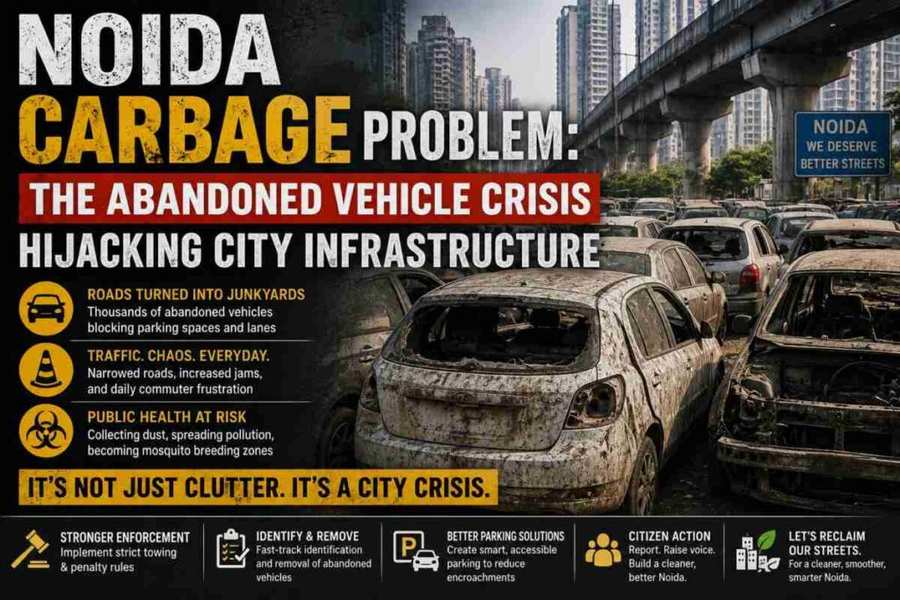
From the busy park-and-ride spots in Sector 62 to the congested premises of local police stations, thousands of abandoned and seized vehicles are silently taking over valuable real estate. Urban lands that command skyrocketing real estate valuations are serving as accidental, zero-revenue junkyards. This investigative guide uncovers the operational, administrative, and legal choke points that created Noida’s carbage problem, and explores what must be done to reclaim the city’s infrastructure.
What is the Noida Carbage Problem?
Simple Explanation
The term “carbage”—a blend of “car” and “garbage”—describes the thousands of abandoned, unclaimed, and law-enforcement-seized vehicles left to rot in public spaces. These vehicles consist of cars involved in road accidents, luxury sedans seized for lack of documentation, commercial tempos impounded during traffic crackdowns, and vehicles abandoned by owners who find paying municipal towing penalties more expensive than the depreciated scrap value of the car itself.
Why It Matters in 2026+
As we move through 2026, Noida is solidifying its position as Uttar Pradesh’s premier corporate hub and commercial “crown jewel.” However, while modern high-rises sprout across the landscape, the ground-level infrastructure is struggling against mechanical decay. The sheer volume of incoming population and vehicular density means that city space is at an absolute premium. Leaving public medians, open parks, and police compounds buried under un-auctioned junk is no longer just an eyesore—it is an infrastructure crisis that devalues adjacent properties, damages the environment, and compromises public safety.
Key Features & Highlights of the Crisis
Lack of Long-Term Storage Infrastructure
The primary driver of the visual clutter is the absence of dedicated, high-capacity holding yards. While an official yard exists in Sector 62, it has long exceeded its operational capacity. With nowhere else to send incoming impounded vehicles, city agencies default to using local police station boundaries and public road shoulders.
Severe Exposure and Rapid Depreciation
Vehicles are parked out in the open without any protective canopies or weather barriers. Under the intense North Indian climate—ranging from 44°C summer heatwaves to heavy monsoon downpours—fully functional, multi-lakh vehicles rapidly turn into valueless scrap. Within a couple of seasons, tires deflate, mechanical components seize, and electrical systems are destroyed.
Cannibalization of Auto Parts
Because these informal yards are poorly guarded and overflow onto public streets, they become prime targets for local thieves. Components like audio systems, tires, catalytic converters, batteries, and premium interior trim pieces vanish over time. By the time a vehicle clears its legal hurdles, it is often reduced to a hollow, stripped shell.
Impacts & Consequences of the Urban Clutter
Environmental and Health Hazards
The environmental impact of this unchecked vehicular storage is severe. The closely packed arrangements of rotting vehicles create ideal conditions for urban hazards:
- Vector-Borne Diseases: Stagnant water pooling inside dented roofs, broken headlights, and upturned commercial trailers creates breeding grounds for mosquitoes, escalating dengue and chikungunya risks in nearby sectors.
- Rodent Infestations: Abandoned interiors become nesting sites for rats and mice, which eventually migrate into surrounding residential areas and office complexes.
- Fire Hazards: Accumulated dry leaves mixed with leaking engine fluids, exposed wiring, and dried upholstery turn these clusters into literal tinderboxes during peak summer months.
Public Space Devaluation and Civic Friction
Public parks and green belts meant for community wellness are increasingly being clipped at the edges by expanding rows of rusted metal. Roadside medians, designed to facilitate smooth traffic flow and aesthetic planting, are instead lined with old commercial tempos balancing precariously over broken hatchbacks. This transition from green city to junk town creates significant friction between resident welfare associations (RWAs) and municipal enforcement bodies.
Location & Structural Breakdown: Where the Junk Piles Up
The spatial distribution of Noida’s carbage crisis highlights how deeply integrated it has become within the city’s everyday geography.
1. Police Station Compounds (The Primary Choke Points)
A visit to almost any major police facility in Noida—such as the Knowledge Park police station or stations across central sectors—reveals a chaotic storage layout. Police parking lots are heavily congested with vehicles stacked door-to-door. In some locations, local autos are balanced on top of white commercial cabs, and vehicles are tightly wedged between mature trees just to maximize available ground space.
2. Public Road Medians and Sidewalks
When police station interiors hit their absolute limits, the overflow spills out directly onto public assets. Long lines of unclaimed vehicles form along road shoulders and within central medians, reducing the effective width of driving lanes, blocking pedestrian sightlines, and increasing the risk of secondary traffic accidents.
3. Residential Basements and Gated Societies
The issue has even migrated into private residential developments. Data highlights a rising trend where stolen vehicles or cars linked to NCR-wide chain-snatching and robbery networks are deliberately abandoned within the sprawling basement parkings of high-rise societies. Criminal groups use the anonymity of large gated communities with patchy parking updates to shield vehicles from police eyes.
Administrative Bottlenecks: Why Can’t We Just Clear Them?
The primary reason these vehicles sit unmoved for years is a combination of complex legal protocols and administrative delays.
The Case Property Dilemma
A significant portion of the stored vehicles are classified as “case property” (evidence linked to active criminal investigations like hit-and-runs, kidnappings, or financial fraud). Under Indian legal statutes, these vehicles cannot be modified, dismantled, or auctioned off without explicit clearance from the presiding court. Given judicial backlogs, a vehicle can easily sit exposed to the elements for five to ten years before its associated case moves to resolution.
Low Buyer Interest at Auctions
When the administration finally clears an assortment of vehicles for public auction, the financial returns are often remarkably low. Because the vehicles have spent years rusting in the open, stripped of key parts and suffering from seized engines, commercial scrap buyers and second-hand dealers show very little interest. The cost to tow and restore the vehicle often exceeds its market value.
Complex Inter-State Ownership Tracking
Noida’s positioning within the National Capital Region means thousands of impounded vehicles bear registration plates from Delhi, Haryana, or peripheral Uttar Pradesh districts. Verifying vehicle identification numbers (VIN) and engine numbers across different state databases, tracking down missing owners, and serving official legal notices within statutory deadlines adds months of administrative paperwork to every single file.
Comparative View: Storage Scenarios Across Public Areas
To better understand how different zones are impacted by the crisis, consider this breakdown of the structural challenges across Noida:
| Facility Type | Core Cause of Accumulation | Primary Operational Risk | Asset Status |
| Police Stations | Active criminal case property, impounded vehicles without documentation. | Severely restricts movement of emergency vehicles; disrupts routine precinct operations. | Evidence / High Legal Protection |
| Sector Medians | Overflow parking from filled yards; vehicles abandoned by owners avoiding fines. | Blocks civilian traffic sightlines; causes road narrowing and pedestrian hazards. | Encroached Public Property |
| Public Green Parks | Lack of regional authority yard space; illegal commercial dumping. | Destroys local flora; increases mosquito breeding and vector-borne illness risks. | Ruined Civic Green Space |
| Gated Society Basements | Criminal elements exploiting unmonitored visitor parking zones. | Creates security blind spots; compromises residential safety frameworks. | Encroached Private Property |
Step-by-Step Clearing Procedure: How a Vehicle Enters the System
Reclaiming a vehicle or clearing it out requires moving through a structured, multi-departmental pipeline. Here is how the workflow is meant to function from initial seizure to eventual disposal:
1.Vehicle Seizure & Field Documentation:Day 1.
Traffic police or local precinct officers impound the vehicle due to a traffic violation, accident involvement, or abandonment on a public road. A formal seizure memo detailing the vehicle’s condition is logged into the station diary.
2.Ownership Identification & Database Search:Weeks 1–2.
Enforcement officers run chassis and engine numbers through national databases like VAHAN to identify the registered owner and verify if the vehicle is linked to any active theft or crime reports across the NCR.
3.Issuance of Statutory Legal Notices:Month 1.
A formal legal notice is dispatched to the registered address of the owner. The individual is given a fixed window to pay outstanding fines, present valid documentation, and claim their property.
4.The Judicial Fork: Case vs. Unclaimed Property:Months 2–12+.
If the vehicle is linked to a serious crime, it is locked into court custody as evidence. If it is a simple traffic violation or abandoned vehicle and remains unclaimed past the deadline, it enters the administrative pool for disposal clearance.
5.Decentralized Auction & Scrap Processing:Variable Timeline.
Once judicial or administrative approval is granted, the vehicle is cataloged for public auction. Licensed scrap processors bid on the lot, the vehicle is towed away, and the earned revenue is deposited into the state treasury.
Expert Tips for Residents and Vehicle Owners
Navigating Noida’s strict vehicle enforcement landscape requires practical diligence. Local legal and transport experts share key advice to avoid having your vehicle caught up in this administrative backlog:
- Maintain Up-to-Date Digital Documentation: Always ensure your vehicle’s registration, insurance, and pollution certificates are updated on digital platforms like DigiLocker or mParivahan. Missing physical paperwork is one of the leading reasons minor traffic stops escalate into full vehicle seizures.
- Report Long-Term Idle Vehicles Early: If you notice an unfamiliar car or two-wheeler sitting caked in dust with flat tires in your residential sector or society basement for more than three weeks, report it to your RWA and the local police beat constable immediately. Early intervention prevents residential spaces from turning into dumping grounds for stolen vehicles.
- Address Traffic Seizures Promptly: If your vehicle is impounded for a minor offense, resolve the legal formalities and pay the required fines immediately. Letting your car sit in an open police compound for even a month can cause deep mechanical depreciation and expose it to part cannibalization.
- Formalize Secondary Vehicle Sales: When selling a car to a third party, ensure the ownership transfer forms (Form 29 and 30) are fully processed by the Regional Transport Office (RTO). If the buyer abandons the vehicle or gets involved in an accident, the legal liability and notices will target the original registered owner.
Common Mistakes Made by Vehicle Owners
Many property and vehicle owners inadvertently make errors that lengthen legal disputes and leave assets trapped in municipal yards:
- Ignoring Municipal Notices: Assuming that ignoring a structural or traffic violation notice will make the issue go away often backfires. Unanswered notices lead directly to unilateral vehicle disposal or auction sequencing by the state.
- Neglecting Comprehensive Insurance Coverage: Owners of older vehicles often switch to basic third-party insurance policies. If an older car gets severely damaged in an accident, the owner may choose to abandon it in a police compound because the out-of-pocket repair costs exceed the remaining value of the car.
- Failing to Track Stolen Vehicle Cases: Once an insurance payout is settled for a stolen car, owners often stop monitoring police tracking updates. If the car is later recovered and left unclaimed in a station lot, the original owner may still face administrative hassles regarding its removal.
Future Outlook (2026–2030): Solutions on the Horizon
To protect Noida’s urban infrastructure over the next few years, changes must be made to how vehicle disposal is handled:
Decentralization of the Auction Pipeline
The police department has begun decentralizing the auction process, empowering local station house officers (SHOs) and regional ACP-rank officials to clear out older, non-litigated vehicle backlogs via periodic, rapid-clearance drives rather than waiting for centralized state approvals.
Dedicated Automated Scrapping Centers
In alignment with national vehicle scrappage policies, plans are underway to build dedicated, automated vehicle scrapping facilities outside central commercial zones. This shift will ensure that vehicles cleared of legal disputes can be recycled immediately, keeping public spaces clear.
Integration of Smart Surveillance Infrastructure
With projects like the Safe City initiative bringing nearly 2,000 smart CCTV cameras online across hundreds of Noida intersections, traffic tracking will shift toward automated, digital license plate recognition. This modernization allows authorities to penalize violators digitally via e-challans, reducing the need for physical vehicle impoundments and saving valuable station yard space.
Conclusion
Noida’s “carbage” problem serves as a clear warning of what happens when urban infrastructure planning lags behind rapid vehicular growth and rigid legal processes. Leaving thousands of vehicles to rust along public medians, neighborhood parks, and administrative compounds harms city aesthetics, strains police station operations, and creates real environmental and health concerns.
Resolving this crisis requires a coordinated effort: modernizing judicial review processes for case property, running faster decentralized public auctions, and creating dedicated parking infrastructure away from public spaces. Reclaiming Noida’s green spaces and public roads is essential to preserving the city’s standing as a clean, safe, and livable modern hub.
Frequently Asked Questions
Why are so many seized vehicles kept in the open at Noida police stations?
Vehicles are stored in the open due to a severe shortage of dedicated, covered holding yards across the city. When local police stations or traffic teams impound cars or commercial vehicles, they have no choice but to store them within their immediate compound walls or on nearby road shoulders, exposing the assets to harsh weather and rapid deterioration.
Can the Noida Authority auction off any abandoned car it finds?
No, the authority cannot immediately auction these vehicles. If a vehicle is tied to an active court case or criminal investigation, it is classified as case property and must be preserved as evidence until a judge issues an explicit disposal order. Unclaimed vehicles not involved in crimes can be auctioned, but only after rigorous verification steps and public notices are completed.
How does the vehicle scrapping policy help resolve Noida’s carbage problem?
Far far away, behind the word mountains, far from the countries Vokalia and Consonantia, there live the blind texts. Separated they live in Bookmarksgrove right at the coast of the Semantics, a large language ocean.
What should I do if an unknown vehicle is abandoned outside my house in Noida?
If an unfamiliar vehicle is left abandoned on your sector road or near your residence for an extended period, you should note down its license plate number, color, and model, and report it to your local Resident Welfare Association (RWA) or submit a tip to the local precinct station. This helps authorities check if the vehicle is connected to recent NCR theft cases.
Why do vehicle owners choose not to claim their impounded cars from police yards?
In many cases, the accumulated court fines, towing charges, and municipal storage fees eventually exceed the fair market value of an older or accident-damaged vehicle. Owners often decide that abandoning the asset completely is more financially practical than paying the penalties to reclaim a heavily depreciated car.