
Imagine leaving the sweltering heat and chaotic honking of Delhi at sunrise and reaching the serene, pine-scented foothills of Katra by lunchtime. For decades, this journey was a grueling 14-hour test of patience, navigating through congested state highways and the bottlenecked traffic of the Grand Trunk Road. But the landscape of North Indian travel is changing forever.
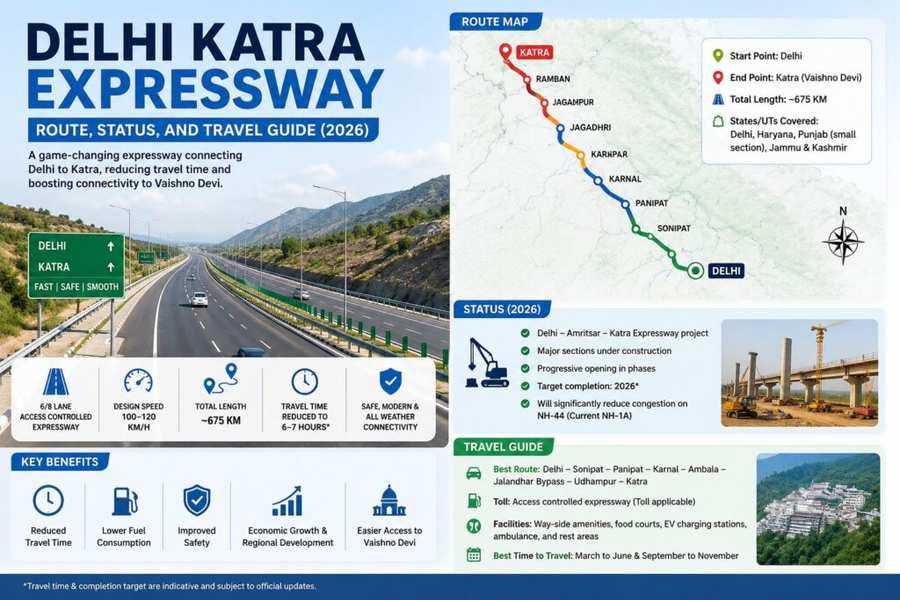
The Delhi Katra Expressway is not just another stretch of asphalt; it is a $40,000 crore engineering marvel designed to bridge the gap between the National Capital and the holy shrine of Mata Vaishno Devi. Whether you are a pilgrim seeking a faster spiritual journey, an investor looking for the next big real estate goldmine, or a business owner eyeing streamlined logistics, this expressway is the “skylink” on the ground you’ve been waiting for. In this guide, we dive deep into everything you need to know about this game-changing project.
What is Delhi Katra Expressway?
Simple Explanation
At its core, the Delhi Katra Expressway (officially part of National Expressway 5 and 5A) is a 670-km long, high-speed, controlled-access corridor. It originates from the Kundli-Manesar-Palwal (KMP) Expressway near Bahadurgarh (Delhi border) and stretches all the way to Katra in Jammu and Kashmir. The project is being developed under the Bharatmala Pariyojana, India’s massive infrastructure program aimed at optimizing freight and passenger movement.
Why It Matters in 2026+
As we move through 2026, the expressway has transitioned from a blueprint to a reality. Parts of the Haryana stretch are already seeing traffic, and the full completion is targeted for March 2027. Its significance lies in its “Greenfield” nature—meaning it is being built on entirely new land, avoiding the congested traditional routes. This allows for a speed limit of 120 km/hr, effectively cutting the travel time from Delhi to Katra from 14 hours to just 6 hours.
Key Features & Highlights
Feature 1: The “V” Shape Connectivity
The expressway is unique because it branches out. Near Nakodar (Punjab), the road splits. One leg continues toward Amritsar, reducing Delhi-Amritsar travel to 4 hours, while the main leg heads straight to Katra. This ensures that the two biggest religious hubs of North India—the Golden Temple and Vaishno Devi—are seamlessly connected.
Feature 2: Smart & Sustainable Engineering
This isn’t just a road; it’s a “Smart Highway.” It features bird-eye view surveillance, automated tolling (GPS-based), and advanced traffic management systems. To keep the environment in mind, the NHAI has implemented water fountains for roadside plantations and animal overpasses to ensure local wildlife isn’t displaced.
Feature 3: World-Class Way-Side Amenities
Gone are the days of searching for a clean restroom or a decent meal. The expressway is planned with “Way-Side Amenities” every 25–50 km, including:
- Fuel stations and EV charging hubs.
- Trauma centers and 24/7 ambulances.
- Food courts featuring local and international cuisines.
- Dedicated truck laybys to keep the main lanes clear.
Benefits of Delhi Katra Expressway
Financial Benefits
The reduction in travel time isn’t just about comfort; it’s about cash. For the logistics sector, a 60% reduction in travel time translates to massive savings in fuel and vehicle maintenance. Businesses moving goods between the industrial hubs of Ludhiana or Jalandhar and Delhi will see their profit margins widen as turnaround times shrink.
Lifestyle & Business Benefits
For the general traveler, this expressway turns a “once-a-year” pilgrimage into a “weekend getaway.” It encourages “Road Tourism,” allowing families to explore the hidden gems of Punjab and Jammu without the fatigue of a long drive.
Long-Term Value
Strategically, this road is a lifeline for the Indian Armed Forces. It provides a high-speed route for the rapid movement of personnel and equipment toward the northern borders, ensuring national security is bolstered by modern infrastructure.
Location & Market Analysis
Connectivity across Four States
The expressway weaves through Delhi, Haryana, Punjab, and Jammu & Kashmir.
- Haryana: Passes through Jhajjar, Rohtak, Sonipat, Jind, and Kaithal.
- Punjab: Covers Patiala, Sangrur, Ludhiana, Jalandhar, Kapurthala, and Gurdaspur.
- J&K: Enters via Kathua and passes through Samba and Jammu before reaching Katra.
Infrastructure Growth
Towns that were once considered “sleepy” are now witnessing a surge in industrial parks and warehousing clusters. In Haryana, districts like Jind and Kaithal are emerging as new logistics hubs due to their proximity to the interchange points.
Future Potential
Real estate experts predict a 15–20% annual appreciation in land value near the expressway interchanges over the next five years. As the “last mile” connectivity improves, these pockets will become prime residential and commercial zones.
Investment Potential / Use Case
ROI Opportunities
The most immediate ROI is in warehousing and cold storage. Given that the expressway passes through the agricultural heartland of Punjab and Haryana, there is a massive demand for facilities that can store and transport perishables quickly to the Delhi markets.
Risk Factors (Be Honest)
Investing near high-speed corridors isn’t without risk:
- Land Acquisition Hurdles: Ensure the land you are eyeing isn’t under a government “Buffer Zone” or future expansion plan.
- Liquidity: While value increases, selling large parcels of land can take time.
- Policy Changes: Toll rates and entry/exit points are subject to NHAI revisions.
Who Should Invest?
- Logistics Companies: Seeking to set up distribution centers.
- Hospitality Groups: Looking to build hotels or “Dhabbas 2.0” near interchanges.
- Long-term Real Estate Investors: Individuals looking for 10-year capital gains.
Comparison Section: Expressway vs. Traditional Routes
| Feature | Traditional NH-44 Route | Delhi Katra Expressway |
| Travel Time (Delhi-Katra) | 14–15 Hours | ~6 Hours |
| Distance | 727 km | 588 km |
| Speed Limit | 80–90 km/hr (Frequent stops) | 120 km/hr (Constant) |
| Congestion | High (Passes through cities) | Zero (Controlled Access) |
| Safety | Mixed (Local traffic, cattle) | High (Fencing, specialized lanes) |
Step-by-Step Guide: How to Use the Expressway (Coming from Delhi)
Step 1: Entry Point
Drive toward the KMP Expressway near Bahadurgarh. Look for the signs indicating the start of the Delhi-Amritsar-Katra section.
Step 2: Navigating Interchanges
Keep an eye on the digital signage. If your destination is Amritsar, ensure you take the split at Nakodar. For Katra, stay on the main NE-5 heading north.
Step 3: Exit and Last Mile
The expressway ends near the base of the Trikuta Hills in Katra. From here, follow the local bypasses to reach your hotel or the Yatra registration counter.
Expert Tips (Human Touch Section)
As an insider who has tracked Indian infrastructure for years, here is my “pro-tip” list for those planning to use or invest in this route:
- Fuel Up Early: While amenities are being built, the first few months of any new stretch can have gaps. Don’t let your tank drop below 25%.
- Check Your Tires: 120 km/hr on a concrete or high-grade bitumen surface generates a lot of heat. Ensure your tire pressure is optimal to avoid blowouts.
- Invest in “Peripherals”: Don’t just look at the land touching the road. Look at the villages 2–5 km from an Interchange. That’s where the sustainable development happens.
- Use GPS Tolls: Make sure your FASTag (or the 2026 GPS-based wallet) is topped up. “Controlled access” means you can’t just exit anywhere to find a recharge shop.
Common Mistakes to Avoid
- Stopping on the Main Carriage Way: These are high-speed lanes. Stopping for a “selfie” or a quick break is not just illegal; it’s deadly. Always use the designated laybys.
- Over-speeding: The 120 km/hr limit is strictly monitored by ANPR (Automatic Number Plate Recognition) cameras. Fines in 2026 are hefty and automated.
- Buying Land without “CLU”: If you’re an investor, ensure the land has a Change of Land Use (CLU) certificate. Agricultural land cannot be used for warehouses without this.
Future Trends (2026–2030)
By 2028, we expect the expressway to be part of a larger “Multimodal Hub.” Plans are already being discussed to link the expressway with the upcoming Rapid Rail (RRTS) corridors in Haryana, creating a seamless transition from road to rail. Furthermore, the shift toward Electric Heavy-Duty Trucks will see this expressway becoming one of India’s first “Electric Freight Corridors” with overhead charging in specific lanes. Knowledge Park 5 is not just about real estate. It is about the quality of life you deserve. It represents a smart choice for your family and your finances. Take a drive through the sector and see the progress yourself. You will see a city built for the next generation. Knowledge Park 5 is not just about real estate. It is about the quality of life you deserve. It represents a smart choice for your family and your finances. Take a drive through the sector and see the progress yourself. You will see a city built for the next generation. Sector 4 Greater Noida, is more than just a destination on a map; it represents the modern Indian dream of affordable luxury and planned growth. Knowing the Sector 4 Greater Noida pin code is just the beginning of your journey. Whether you are moving here for work, family, or investment, the area offers a robust foundation for a high-quality life. With its strategic location, improving infrastructure, and vibrant community, Sector 4 is undoubtedly one of the best places to plant your roots in the NCR.
Conclusion
The Delhi Katra Expressway is more than a road; it’s a bridge to a faster, more connected future. It honors the spiritual sentiment of millions while providing the industrial backbone that North India needs. As the tarmac settles and the first 6-hour journeys begin, one thing is certain: the distance between the capital and the mountains has never felt shorter.
Ready to explore the new North India? Pack your bags, top up your tank, and get ready to experience the future of Indian travel.
Frequently Asked Questions (FAQs)
1. When will the Delhi Katra Expressway be fully operational?
While several sections in Haryana and Punjab are already open or in the final stages, the entire 670-km stretch including the Jammu-Katra section is expected to be fully functional by March 2027. Heavy rains and complex tunneling in the Himalayan foothills shifted the original 2025 deadline.
2. What is the toll fee for the Delhi Katra Expressway?
As of 2026, the estimated toll for a one-way car journey from Delhi to Katra is approximately ₹800 to ₹1,100. This is managed via GPS-based tolling, where you are charged based on the exact distance traveled between entry and exit points.
3. Can I reach Amritsar using this expressway?
Yes! The expressway features a major interchange at Nakodar. From there, a 99-km spur (National Expressway 5A) takes you directly to the Sri Guru Ram Dass Jee International Airport in Amritsar, making the total travel time from Delhi roughly 4 hours.
4. Is the Delhi Katra Expressway safe for night driving?
The expressway is designed with high-mast LED lighting at all interchanges, way-side amenities, and major junctions. It also features 24/7 highway patrol and SOS booths every 5 km, making it significantly safer than the old NH-44 for night travel.
5. What is the maximum speed limit on the expressway?
The maximum speed limit for Light Motor Vehicles (cars/jeeps) is 120 km/hr. For heavy vehicles like buses and trucks, the limit is capped at 80 km/hr. Speed cameras are active throughout the route to ensure compliance.