
Imagine a single, sprawling economic zone where you can source high-end electronics from one corridor, custom-tailored textiles from the next, and artisanal furniture from across the lane—all under one roof, just minutes away from a global aviation gateway. This is no longer a blueprint reserved for global trading giants like China or Dubai. The Uttar Pradesh government, spearheaded by Chief Minister Yogi Adityanath, has officially unveiled a mega infrastructure development plan that is set to rewrite the economic destiny of Northern India.
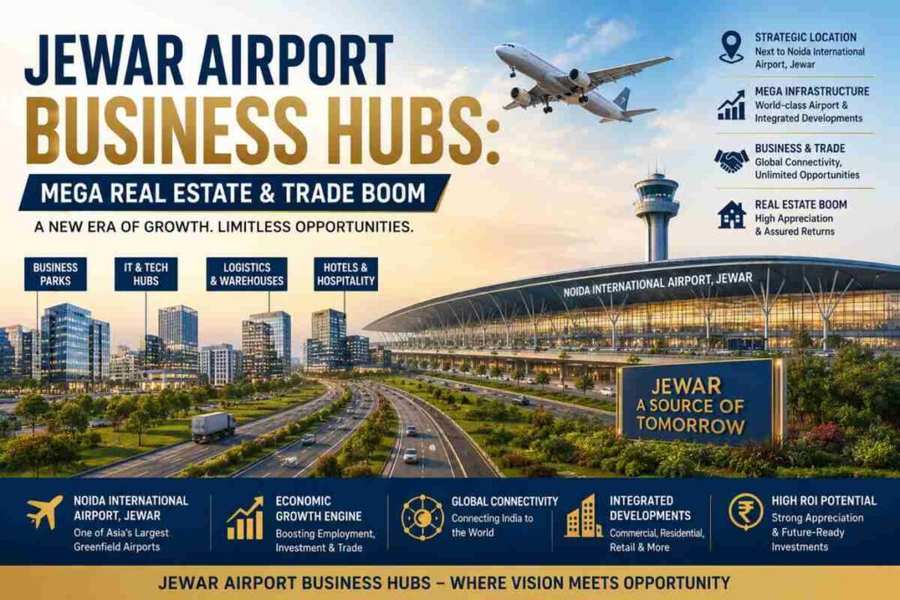
The cornerstone of this vision? The establishment of massive international business hubs near Jewar Airport, specifically structured to consolidate India’s fragmented wholesale markets into a highly organized, world-class commerce ecosystem. For investors, corporate buyers, and business owners across the Delhi-NCR landscape, this masterstroke by the Yamuna Expressway Industrial Development Authority (YEIDA) represents a seismic shift.
As passenger flight operations at Noida International Airport scale up rapidly, these upcoming commercial sectors are transforming from peripheral farmlands into India’s most lucrative investment goldmine. If you have been looking for an entry point into the next decade’s biggest growth story, understanding this master plan is your ultimate first step.
What is the International Business Hubs Near Jewar Airport Project?
+-----------------------------------------------------------------------------+
|                              PROJECT AT A GLANCE                            |
+----------------------+------------------------------------------------------+
| Location Focus       | YEIDA Sectors 7, 8, and 8A                           |
| Structural Blueprint | Inspired by China's Yiwu International Trade City    |
| Operational Model    | Rental-only allotments by YEIDA for peak flexibility |
| Scale per Hub        | ~20 Acres per dedicated commercial zone              |
| Key Consultant       | Ernst & Young (Feasibility report submitted)         |
+----------------------+------------------------------------------------------+
Simple Explanation
At its core, the project involves building three massive international business and trade centers in close proximity to the newly operational Noida International Airport at Jewar. Developed directly by YEIDA across Sectors 7, 8, and 8A, these hubs are designed as unified wholesale mega-complexes.
Instead of traditional, chaotic wholesale bazaars where traders must travel to opposite corners of Delhi—such as heading to Nehru Place for IT hardware and Chandni Chowk for apparel—these trade centers will bring every imaginable product category together into an ultra-modern, hyper-connected facility.
Why It Matters in 2026+
The year 2026 marks a historic turning point for Uttar Pradesh. With the formal inauguration of Jewar Airport’s first phase and passenger flights commencing operations, the surrounding region is shifting from speculative land trading to actual, cash-flowing commercial execution.
The global supply chain is looking for alternatives to traditional manufacturing models, and India is moving fast to fill that void. By launching these commercial hubs right now, the government is ensuring that international buyers can land at Jewar, conduct multimillion-dollar trade deals at the adjacent business centers, and fly back out—all within a single day.
Key Features and Highlights of the Mega Plan
Inspired by China’s Yiwu Market
The ultimate inspiration behind this project is China’s famous Yiwu International Trade City, recognized globally as one of the largest commodity wholesale markets on earth. The Yogi government is replicating this high-efficiency framework to build an ecosystem where international and domestic bulk buyers can interact with manufacturers without intermediaries, driving transaction costs down significantly.
A Unified One-Roof Commodity Marketplace
The business hubs will feature dedicated wings for specialized market segments. The structural layout is designed to accommodate a diverse array of industries, ensuring comprehensive coverage under one roof:
- Electronics & Telecom Equipment: Modern tech corridors for hardware, accessories, and consumer appliances.
- Garments & Textiles: Massive wholesale arenas for apparel, fabrics, and ready-made clothing.
- Heavy Commodities: Specialized zones for furniture, automotive components, and kitchenware.
- Lifestyle Goods: Dedicated pavilions for jewelry, footwear, stationery, and sports merchandise.
The YEIDA Rental-Only Operational Strategy
In a brilliant departure from conventional government land sales, YEIDA will not sell these commercial spaces permanently. Instead, the spaces will be offered exclusively on a lease/rental model. This allows the authority to dynamically adjust product categories based on evolving global market demands, preventing the real estate from falling into stagnation or speculative hoarding.
Tangible Benefits of the Business Hubs
Financial Benefits for Traders and Brands
By operating within a specialized economic cluster, businesses can leverage shared logistics infrastructure, centralized warehousing, and massive bulk-freight discounts. Eliminating middle-tier distributors means direct-to-retailer margins, significantly enhancing profitability for MSMEs and corporate exporters alike.
Corporate Lifestyle and Business Conveniences
The trade hubs will feature fully integrated support facilities, including:
- International convention halls and B2B meeting lounges.
- Seamless on-site custom clearance desks and banking terminals.
- Premium business hotels, food courts, and transit lounges tailored for international corporate delegates.
Long-Term Value Creation
As these hubs evolve, the influx of global trade capital will transform the entire Yamuna Expressway corridor. Properties within a 15-kilometer radius of Sectors 7, 8, and 8A are positioned to see sustained rental yields and capital appreciation, turning early investments into highly resilient, multi-generational wealth assets.
Location and Market Architecture Analysis
                      [ Delhi / NCR Main Cities ]
                                  │
                                  ▼ (DND Flyway / Noida-Gr. Noida Exp.)
                         [ Yamuna Expressway ]
                                  │
      ┌───────────────────────────┴───────────────────────────┐
      ▼                                                       ▼
[ Noida International Airport ] <───(Hyper-Connected)───> [ YEIDA Sectors 7, 8, 8A ]
      ▲                                                   (International Business Hubs)
      │
      ▼ (74 km Link Road)
[ Ganga Expressway Connection ]
Hyper-Connectivity Framework
The strategic placement of Sectors 7, 8, and 8A places these hubs right at the intersection of India’s most advanced logistics networks. Businesses operating here enjoy an unparalleled multi-modal transit system:
- Aviation: Immediate proximity to Jewar Airport, allowing effortless international freight and executive travel.
- Expressways: Direct access to the Yamuna Expressway, coupled with the newly accelerated 74 km Jewar Airport Link Road that connects the airport straight to the Ganga Expressway.
- Rail Freight: Integrated access to the Eastern Dedicated Freight Corridor (EDFC), ensuring bulk raw materials can move in and out of the hubs with minimal transit delay.
Infrastructure Growth Matrix
The region is backed by comprehensive structural planning via the YEIDA Master Plan 2041. The broader master plan features massive allocations for specialized industrial clusters, including the high-tech Semiconductor Assembly plant (the HCL-Foxconn joint venture in Sector 28), a dedicated Medical Device Park, and adjacent Japanese and Korean industrial townships. This builds a powerful localized manufacturing base that feeds finished goods directly into the business hubs.
Future Economic Potential
The surrounding geography is rapidly transitioning into a massive megalopolis. With major urban projects like the New Agra Urban Center moving forward, the entire ecosystem is projected to support a thriving, high-income population, creating a continuous supply of skilled talent and consumer demand.
Investment Potential and Real-World Use Cases
ROI Opportunities for Savvy Investors
With Ernst & Young already having submitted the project’s comprehensive feasibility report to YEIDA, the path to commercial execution is completely clear. Investors can secure massive returns by targeting properties and commercial spaces directly feeding into these sectors. The high volume of daily business travelers guarantees consistent demand for premium service apartments, executive corporate offices, and private logistics facilities.
Risk Factors to Keep in Mind
While the macro outlook is incredibly strong, realistic investors must carefully evaluate a few key variables:
- Project Timelines: Mega infrastructure developments of this scale involve multi-phase execution; patience is required for full operational maturity.
- Evolving Rental Policies: Since YEIDA is maintaining strict rental control over the primary trade spaces, surrounding private developments must adapt to dynamic zoning laws and competitive rental pricing models.
Who Should Invest Immediately?
- Global Trade Exporters & B2B Wholesalers: Businesses wanting to set up primary product display showrooms to catch global foot traffic directly from the airport.
- Commercial Real Estate Developers: Entities looking to acquire surrounding mixed-use land for premium corporate hotels, high-end retail extensions, and private warehousing facilities.
- Institutional Fund Managers: Portfolios seeking stable, long-term yields tied directly to national logistics and aviation growth indexes.
Strategic Comparison: Jewar Hubs vs. Traditional Wholesale Markets
To truly appreciate the transformative nature of these international business hubs near Jewar Airport, it is helpful to contrast them with the legacy commercial centers currently serving the Delhi-NCR region:
| Feature/Metric | Legacy NCR Wholesale Hubs (e.g., Chandni Chowk, Sadar Bazar, Nehru Place) | Upcoming Jewar International Business Hubs |
| Spatial Layout | Extremely congested, fragmented by individual product categories across distant cities. | Unified under one roof, organized into ultra-modern, 20-acre sector-specific trade blocks. |
| Logistics & Access | Severely restricted commercial vehicle entry, narrow lanes, and acute parking shortages. | Multi-lane heavy vehicle docking, dedicated freight corridors, and massive parking zones. |
| Global Air Proximity | 2 to 3-hour transit through dense urban traffic from Delhi’s IGI Airport. | Direct, traffic-free access located within minutes of Noida International Airport. |
| Allotment Model | Fragmented private ownership, prone to structural stagnation and speculative pricing. | Strictly managed YEIDA rental model, allowing fast adjustments to global market demands. |
| Support Ecosystem | Minimal integrated hospitality, requiring off-site hotel and conference arrangements. | Fully integrated with luxury business hotels, B2B meeting lounges, and automated customs hubs. |
Step-by-Step Guide for Businesses Planning an Expansion
If you are a manufacturer, wholesale trader, or commercial investor looking to capitalize on this landmark project, here is the exact roadmap to position your business ahead of the curve:
Step 1: Evaluate Your Industry Fit
Analyze your product portfolio against the primary focus categories of the YEIDA trade hub blueprint (Electronics, Textiles, Automotive parts, or Premium consumer goods). Ensure your supply chain can handle bulk B2B fulfillment.
Step 2: Track YEIDA Rental Applications and Tender Rollouts
Since the spaces will be leased out on a rental basis rather than sold outright, keep a close watch on the official YEIDA portal for the upcoming allocation rounds following the Ernst & Young feasibility presentations. Prepare your corporate compliance and financial sheets early to qualify for these premium allotments.
Step 3: Establish Your Local Footprint Early
Secure secondary commercial or logistics spaces in adjacent sectors (such as Sectors 28, 29, or surrounding mixed-use zones) to anchor your storage, corporate staff housing, and ancillary business needs before land valuations reach their peak.
Expert Tips for Navigating the Yamuna Expressway Real Estate Boom
Pro Tip from Industry Insiders: “Do not put all your capital into speculative residential plots hoping for sudden wealth. The real, sustainable goldmine along the Yamuna Expressway is commercial and industrial alignment. Look for developments that offer direct utility to the massive influx of business travelers and logistics operations coming to the region.”
To get the most out of your investments, keep these core principles in mind:
- Prioritize Sector Connectivity Over Distance: A plot that is slightly further away but features direct, uninterrupted access to an expressway interchange will consistently outperform closer options that are stuck behind local bottleneck routes.
- Focus Heavily on Yield-Based Real Estate: Given the high concentration of working professionals, multinational engineers, and corporate buyers moving to the region, focus your capital on assets designed for steady rental income, such as premium serviced apartments and co-working corporate hubs.
- Verify RERA and YEIDA Approvals Scrupulously: The region’s fast growth can attract unreliable private developers. Ensure that any project you back is fully certified by RERA and explicitly matches the latest revisions of the YEIDA Master Plan 2041.
Common Pitfalls to Avoid in Mega-Infrastructure Investing
- Over-Leveraging on Speculative Timelines: Infrastructure projects of this immense scale require structured development phases. Never stretch your liquid capital so thin that you cannot comfortably hold your investments through the initial construction and early operational phases.
- Ignoring the Unique Rental Mechanics of the Hubs: Remember that YEIDA’s direct trade hubs will be strictly rental-driven. If you are buying private commercial real estate nearby, ensure your business model offers unique value—such as premium personalization, larger storage spaces, or specialized hospitality—so you don’t find yourself competing directly with government-leased facilities.
- Miscalculating Local Logistic Zoning Laws: The areas surrounding Jewar Airport are strictly zoned under precise environmental guidelines, particularly because sections of the broader master plan border eco-sensitive development boundaries like the Taj Trapezium Zone. Always verify that your specific commercial use case is fully compliant with the local non-polluting industrial regulations.
Visionary Insights: What the Corridor Looks Like Leading into 2030
As we project forward towards 2030, the Yamuna Expressway belt is firmly on track to evolve from a high-speed transit highway into one of the most economically dense industrial zones in Asia.
Once the initial phases of the international trade centers stabilize, expect to see direct, high-speed automated cargo transit lines carrying finished products directly from the manufacturing sectors right into the cargo holds of outbound planes at Jewar Airport.
With the added benefit of high-speed rail lines and integrated commuter links connecting Delhi-NCR to vibrant new economic hubs like the New Agra Urban Center, this region will function as a self-sustaining economic powerhouse. This transformation will create millions of highly skilled jobs and shift India’s primary export center directly into the heart of Western Uttar Pradesh.
Conclusion
The Yogi government’s mega plan to establish international business hubs near Jewar Airport is far more than a routine real estate announcement; it is a profound reimagining of how India intends to conduct global commerce in the modern era. By pairing the unmatched logistics power of the newly operational Noida International Airport with an innovative, highly flexible commodity market structure inspired by global benchmarks, the state is laying down a solid foundation for long-term economic leadership.
For forward-thinking business owners, wholesale distributors, and corporate investors, the message is unmistakably clear: the window for early, high-leverage positioning along this hyper-growth corridor is open right now. By taking action today, you ensure your business is perfectly positioned to catch the massive wave of global trade capital about to sweep through Delhi-NCR.
You will see a city built for the next generation. Knowledge Park 5 is not just about real estate. It is about the quality of life you deserve. It represents a smart choice for your family and your finances. Take a drive through the sector and see the progress yourself. You will see a city built for the next generation. Sector 4 Greater Noida, is more than just a destination on a map; it represents the modern Indian dream of affordable luxury and planned growth. Knowing the Sector 4 Greater Noida pin code is just the beginning of your journey. Whether you are moving here for work, family, or investment, the area offers a robust foundation for a high-quality life. With its strategic location, improving infrastructure, and vibrant community, Sector 4 is undoubtedly one of the best places to plant your roots in the NCR.
Ready to build your legacy? Don’t just look at the price tag today; look at the potential of the neighborhood tomorrow. The best time to buy was twenty years ago; the second best time is today—but only if you know the numbers.
Frequently Asked Questions
What exactly are the proposed international business hubs near Jewar Airport?
The project consists of three massive international trade and business centers being built by YEIDA across Sectors 7, 8, and 8A. They are designed to bring multiple wholesale product lines together into one highly organized, ultra-modern marketplace cluster right next to the airport.
How does China’s Yiwu market inspire this project?
China’s Yiwu market is world-renowned for hosting thousands of diverse wholesale product categories under one roof. The Yogi government is adopting this exact layout near Jewar, letting global buyers source everything from electronics to textiles efficiently in a single destination.
Can private individuals buy commercial shops within these business hubs?
No, YEIDA is intentionally retaining full ownership and will offer these trade spaces exclusively on a flexible rental and lease basis. This allows the authority to regularly update the product mixes based on shifting global market demands.
What major infrastructure links will support these trade centers?
The business hubs are backed by exceptional multi-modal transit networks, including direct proximity to Jewar Airport, the Yamuna Expressway, and the new 74 km Link Road connecting the airport directly to the expanding Ganga Expressway network.
How will this development affect the surrounding real estate market?
The continuous influx of international corporate visitors and trade professionals will create massive, long-term demand for surrounding private commercial properties, high-end business hotels, serviced executive suites, and advanced third-party logistics facilities.