
Imagine spending your twenties grinding for an engineering degree, surviving cutthroat campus placements, and pulling 70-hour workweeks in a plush tech park in Bengaluru or Gurgaon. You finally land that coveted cabin, a comfortable six-figure salary, and the quiet dignity of a white-collar career. You think you’ve made it.
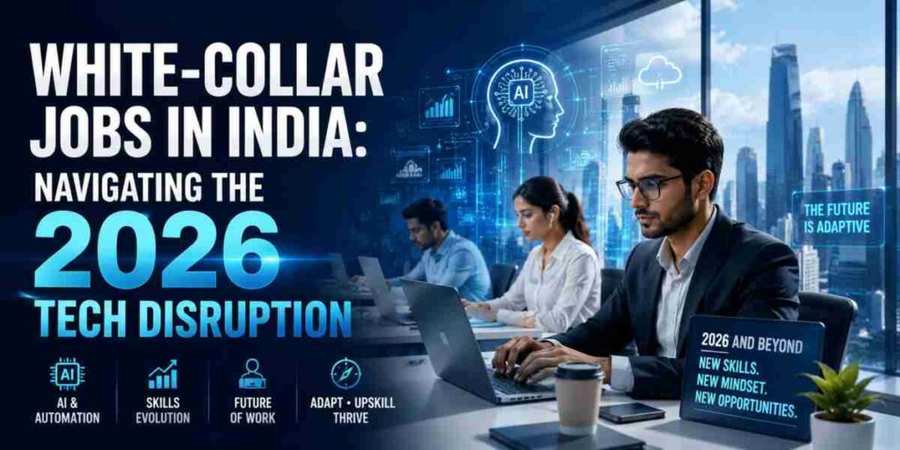
Then, a premier market voice drops a chilling public warning: “Abhi toh yeh trailer hai” (This is just the teaser).
The phrase sent shockwaves across India’s corporate corridors. It wasn’t spoken by a fringe doomsayer, but by Saurabh Mukherjea, one of the country’s most respected market analysts and investment minds. This warning points directly at an unspoken, terrifying reality: the safety net underneath India’s professional class is tearing apart. We are no longer talking about distant automation taking over factory floors. The disruption is hitting desks, laptops, and management suites. If you rely on a white-collar salary in India, the rulebook of career longevity is being rewritten in real-time. This guide breaks down what is actually happening behind closed boardroom doors, why the traditional career ladder is breaking, and how you can avoid becoming a footnote in the corporate shift.
What is the Crisis Facing White-Collar Jobs in India?
Simple Explanation
To put it simply, a “white-collar job” refers to professional, managerial, or administrative work typically performed in an office environment. For three decades, India’s economic growth story was driven by these very roles—software engineers, data analysts, HR managers, legal consultants, and financial accountants.
The current crisis stems from a sudden mismatch between human supply and technological capability. For years, Indian corporations scaled by throwing human capital at problems. If a global bank needed its back-office operations managed, an Indian service provider hired 2,000 fresh graduates. Today, that entire operational model is shifting. Companies are realizing they can achieve identical, if not superior, output using advanced software architectures, leaving millions of traditional professionals vulnerable to structural unemployment.
Why It Matters in 2026+
As we navigate 2026, this structural shift has moved from a theoretical corporate roadmap into a disruptive reality. The massive surge in corporate tech adoption over the last few years has completely changed structural expectations. Companies are no longer using technology merely to help their staff work faster; they are designing workflows where technology operates autonomously, requiring human intervention only for final approvals.
According to an EY survey cited by prominent market analysts, an astonishing 58% of Global Capability Centers (GCCs) in India are already actively investing in Agentic AI, while over 80% are heavily funding Generative AI integration. This marks a massive turning point. We are moving away from software that requires human commands and moving toward software that operates independently to solve complex corporate tasks.
Key Features of the White-Collar Disruption
Feature 1: The Emergence of Agentic AI
The primary catalyst behind this shift is the evolution from basic automation to “Agentic AI.” Unlike standard chatbots or simple programming scripts that follow strict, rigid pathways, agentic systems can reason, plan, adapt, and execute multi-step workflows entirely on their own. For example, instead of a human accountant reviewing invoices, cross-checking tax compliance, and generating reports, an agentic system manages the entire cycle end-to-end, raising a flag for human review only when it detects an anomaly.
Feature 2: High Contraction in Global Capability Centers (GCCs)
For a long time, India was viewed as the “back office of the world.” Global financial institutions, retail giants, and pharmaceutical conglomerates established massive GCCs in Tier-1 Indian cities to tap into cost-effective talent. However, because these centers handle massive volumes of repetitive digital tasks, they are prime targets for algorithmic optimization. The high-volume, lower-complexity data and software tasks that used to require massive teams are being consolidated into highly streamlined, technology-driven hubs.
Feature 3: The Broken Pipeline for Fresh Graduates
The entry-level job market is feeling the heaviest immediate impact. Historically, large IT service firms and consulting companies absorbed tens of thousands of fresh graduates annually through campus placements. With entry-level tasks like code debugging, basic legal research, documentation, and customer support becoming automated, corporate recruitment pipelines are narrowing significantly. This leaves thousands of young professionals struggling to find that vital first foothold on the corporate ladder.
Benefits of Shifting to a New Economic Model
Financial Benefits
While the transition is disruptive for employees, it represents an incredible leap forward for enterprise efficiency and profitability. Companies that successfully transition to an AI-augmented workforce experience a significant drop in operational overhead.
Traditional Model: High Labor Cost + Linear Scalability
Modern Model: High Capital/Tech Investment + Exponential Scalability
This drastic reduction in operational costs frees up capital that businesses can reinvest into core research, product development, and market expansion, ultimately driving corporate earnings and shareholder value higher.
Lifestyle / Business Benefits
For professionals who successfully adapt and position themselves alongside these technologies, the daily workflow becomes much less tedious. When software handles repetitive data entry, basic report compilation, and administrative cross-checking, human professionals can dedicate their time to creative problem-solving, strategic negotiation, and high-level client relationships. It shifts the value of work from sheer hours spent at a desk to the actual strategic impact delivered.
Long-Term Value
In the grander scheme, this disruption forces India’s economic ecosystem to mature. For decades, our primary competitive advantage was labor arbitrage—offering smart people at a lower global price point. This shift forces the ecosystem to pivot toward high-value innovation, IP creation, and deep tech development, transforming India from an execution hub into a global strategic leader.
Location and Market Analysis: The Changing IT Hubs
Connectivity and Real Estate Cooling
The cooling demand for massive, sprawling physical offices is reshaping real estate dynamics across major technology hubs like Bengaluru (Outer Ring Road, Whitefield), Hyderabad (HITEC City), and Pune (Hinjewadi). As companies downsize operational teams and lean into leaner, technology-driven frameworks, the relentless demand for commercial office space is stabilizing. This cooling trend offers long-overdue relief to urban infrastructure and presents an opportunity for suburban tech parks to attract boutique, specialized firms.
Infrastructure Growth Outside Tier-1 Cities
A fascinating side effect of this white-collar evolution is the rise of Tier-2 and Tier-3 cities as specialized hubs. Because high-end professional work requires specialized skills rather than massive physical campuses, smaller cities like Coimbatore, Kochi, Indore, and Bhubaneswar are seeing significant growth. These locations offer excellent digital infrastructure and lower living costs, making them highly attractive to top-tier professionals who no longer want to endure the daily grind of hyper-congested metro areas.
Future Potential of Specialized Zones
The concept of the generic “software park” is evolving. The future belongs to highly specialized, collaborative innovation zones. We are seeing a shift toward micro-hubs built around specific technological focus areas, such as advanced robotics, clean energy architectures, and custom enterprise AI deployment. These zones don’t look like massive call centers; they operate as high-density clusters of specialized engineers, ethicists, and business strategists.
Investment Potential and Real-World Use Cases
ROI Opportunities in Specialized Upskilling
From a career perspective, the return on investment (ROI) has completely shifted away from traditional, generic certifications. The real financial gains are now concentrated in deep, specialized domain expertise. Professionals who invest time and capital into mastering complex systemic architectures, algorithmic design, and human-machine collaboration are commanding incredible salary premiums, even as general hiring slows down.
Risk Factors (An Honest Assessment)
It is crucial to look at the realities of today’s market without sugarcoating things. The risk of skill obsolescence has never been higher. A career roadmap built on routine tasks—whether that’s writing basic software scripts, compiling financial spreadsheets, or managing standard corporate communications—carries a high risk of disruption over the next three to five years.
Furthermore, as noted by valuation experts like Aswath Damodaran, global macroeconomic pressures mean corporate organizations are prioritizing immediate operational resilience over speculative, long-term hiring. If an employee’s daily output cannot be directly tied to revenue generation or structural optimization, their role faces ongoing risk during corporate restructuring.
Who Should Pivot Immediately
The professional profiles that need to take immediate, proactive steps to pivot include:
- Mid-level project managers whose primary responsibility is tracking team updates and relaying statuses.
- Junior developers focused entirely on writing repetitive boilerplates or basic code debugging.
- Back-office financial analysts handling manual transaction processing and standard compliance reporting.
- HR and talent acquisition professionals who rely solely on keyword matching and standard resume sorting workflows.
Comparison Section: The Old Career Model vs. The New Dynamic
To understand how fundamentally the landscape is changing, it helps to look at the structural shift side-by-side:
| Strategic Dimension | The Traditional Career Model (Pre-2024) | The Evolving Career Model (2026–2030) |
| Primary Value Asset | Years of experience and familiar corporate execution. | Adaptability, speed, and cross-functional expertise. |
| Team Structure | Large, linear teams with complex, multi-tiered hierarchies. | Lean, agile pods centered around autonomous tech platforms. |
| Core Hiring Focus | Specialized, single-skill proficiency (e.g., specific coding languages). | Systems thinking, problem architecture, and domain knowledge. |
| Career Progression | Linear promotion based on tenure and team size managed. | Value-driven progression based on measurable output and efficiency. |
| Job Security Metric | Company size and long-term tenure within an industry. | Continuous upskilling and a portfolio of technical projects. |
Step-by-Step Guide to Future-Proofing Your Career
If you want to ensure your skills remain highly valued in this changing environment, you need to transition from a traditional executor to a strategic value-creator. Here is your roadmap to navigate this shift:
The Method
1.Audit Your Daily Workflow:Week 1.
Keep a detailed log of your daily professional tasks. Categorize them into “execution tasks” (data entry, basic coding, routine writing) and “strategic tasks” (negotiation, systemic architecture, creative problem-solving). If execution takes up more than 60% of your time, your role is highly vulnerable.
2.Identify a Technical Focus Area:Weeks 2–4.
Choose an emerging technology adjacent to your current domain. If you are in finance, don’t just study accounting; dive deep into automated algorithmic compliance. If you are a developer, pivot from basic application coding toward systemic architecture and agentic AI orchestration.
3.Build a Personal Project Portfolio:Months 2–4.
Theoretical knowledge carries little weight in today’s market. Build tangible, real-world examples that demonstrate your ability to work alongside advanced systems. Create custom workflows, automate a complex manual pipeline in your current domain, and document your process publicly on platforms like GitHub or LinkedIn.
4.Shift toward High-Context Human Roles:Ongoing.
Intentionally steer your career toward responsibilities that software cannot easily replicate. Focus on complex client relationships, cross-departmental alignment, ethical compliance oversight, and deep strategic planning.
Expert Tips for Thriving in a Lean Corporate Market
- Become an “AI Orchestrator,” Not just a User: Don’t just learn how to input basic prompts. Understand how these systems function under the hood, how APIs connect, and how to design automated workflows that connect multiple systems to solve complex business problems.
- Prioritize Deep Domain Knowledge Over Syntactic Skills: Coding languages and software interfaces change constantly. Deep domain knowledge—such as understanding the intricacies of global supply chain logistics, healthcare regulations, or complex financial structures—remains highly valuable and difficult to replace.
- Build a Strong Personal Brand: In a crowded job market, your public professional footprint is your passport. Share your insights, write analytical breakdowns of industry trends, and share your project outcomes to stand out to forward-thinking organizations.
- Develop Cross-Functional Versatility: The future belongs to professionals who can bridge the gap between different worlds. An engineer who understands corporate finance, or a marketer who understands data architecture, is incredibly valuable to an agile, modern team.
- Adopt a Continuous Learning Mindset: Treat your skills like a software product that requires regular updates. Dedicate an hour every single day to reading research papers, exploring new frameworks, and experimenting with emerging tools.
Common Mistakes to Avoid in Today’s Job Market
The Ostrich Approach: Ignoring these systemic shifts and assuming your industry or company is completely immune to change is the fastest path to career disruption.
- Relying Solely on Your Years of Experience: In the modern corporate landscape, having ten years of experience doing a repetitive task can sometimes be viewed as a liability rather than an asset, as it often carries higher salary expectations without a corresponding increase in modern technical adaptability.
- Chasing Outdated Certifications: Spending significant time and money on generic corporate certifications that focus on manual, traditional workflows offers very little return in a technology-forward job market.
- Neglecting Your Soft Skills: Assuming that pure technical capability is all that matters is a major misstep. Exceptional communication, empathy, leadership, and conflict resolution are the exact qualities that systems cannot replicate.
- Waiting for Your Employer to Upskill You: Waiting for a corporate training mandate means you are already falling behind. Take full personal ownership of your professional development and learning path.
Future Trends (2026–2030)
As we look toward the end of the decade, the concept of corporate employment will continue to transform. We will likely see a significant rise in “fractional white-collar work.” Instead of hiring full-time executives for every internal department, companies will increasingly leverage agile networks of elite, specialized consultants who oversee automated systems across multiple organizations simultaneously.
Furthermore, team scales will shift dramatically. The benchmark of a successful corporate division will no longer be managing a massive team of hundreds of professionals. Instead, success will be measured by elite, cross-functional units of five to ten highly skilled strategists managing massive networks of autonomous enterprise software. The focus of work is permanently shifting from the sheer volume of human hours to the architecture of systemic value.
Conclusion
The warning phrase “Abhi toh yeh trailer hai” shouldn’t be cause for panic—it is a wake-up call. The era of comfortable, autopilot white-collar careers in India is drawing to a close, paving the way for a dynamic, high-value professional landscape. The traditional career ladders are giving way to agile, impact-driven trajectories. Surviving and thriving in this new environment requires letting go of the old playbook, actively embracing continuous upskilling, and positioning yourself as a strategic problem solver who works alongside modern technology. The future doesn’t belong to those who compete with automated systems, but to the architects who direct them. Take charge of your career path today, audit your skillset, and ensure you are positioned to lead the next evolution of corporate work.
For residents and businesses across Gurugram, Noida, and Delhi, the message is clear: the days of being hopelessly stuck in traffic are winding down. for Cutting out traffic Govt has launched Delhi katra Expressway It is time to look forward, adapt to these emerging corridors, and position your investments to ride the wave of this historic infrastructure transformation.
You will see a city built for the next generation. Knowledge Park 5 is not just about real estate. It is about the quality of life you deserve. It represents a smart choice for your family and your finances. Take a drive through the sector and see the progress yourself. You will see a city built for the next generation. Sector 4 Greater Noida, is more than just a destination on a map; it represents the modern Indian dream of affordable luxury and planned growth. Knowing the Sector 4 Greater Noida pin code is just the beginning of your journey. Whether you are moving here for work, family, or investment, the area offers a robust foundation for a high-quality life. With its strategic location, improving infrastructure, and vibrant community, Sector 4 is undoubtedly one of the best places to plant your roots in the NCR. for more doubts get a On call free session by Real Estate Advisory or Visit byviveksingh.in to book a direct strategy consultation. Are you a Business Owner ? than For business owners, the primary benefit is the guaranteed footfall. Book your Commercial Shop in Mahagun Metro Mall Today as Being located right near the Vaishali Metro Station means a constant stream of commuters is funnelled toward the mall. High visibility leads to lower customer acquisition costs for retail tenants
Frequently Asked Questions
What did market experts mean by “Abhi toh yeh trailer hai” regarding white-collar jobs?
The phrase emphasizes that the corporate layoffs and hiring slow-downs seen recently are not temporary market fluctuations. Instead, they represent the early stages of a profound, permanent structural shift driven by the rapid enterprise adoption of Agentic AI and automated workflows across corporate sectors.
How is Agentic AI impacting the white-collar job market in India?
Unlike basic automation, Agentic AI can independently reason, execute multi-step processes, and adapt to changing data inputs. This reduces the corporate reliance on large teams for routine tasks like basic software programming, data verification, standard financial accounting, and administrative compliance.
Are Global Capability Centers (GCCs) in India reducing their hiring?
Yes. As GCCs pivot heavily toward automation—with a vast majority investing in agentic and generative software frameworks—they are shifting from high-volume talent acquisition to lean teams of highly specialized professionals, significantly narrowing the entry-level corporate job market.
Which white-collar roles in India face the highest risk of automation?
Roles centered around predictable, repetitive digital tasks are at the highest risk. This includes entry-level software testers, technical documentation writers, backend data processors, basic research analysts, and administrative managers whose primary tasks involve manual data compilation.
How can professional workers future-proof their careers against this technology shift?
Professionals should focus heavily on high-context human skills like complex client relations, strategic systemic design, cross-functional leadership, and deep domain expertise. Shifting your focus from a simple operational executor to an AI-augmented orchestrator ensures your skills remain indispensable to modern organizations.