The relentless expansion of the National Capital Region (NCR) has reached a critical tipping point. For years, the dream of living on the outskirts of Delhi while commuting to the core meant enduring grueling hours gridlocked on bumper-to-bumper highways or packed into over-capacity local trains. Delhi-NCR is officially on track to overtake Tokyo as the world’s most populous urban agglomeration. Facing an influx of over three crore additional residents, urban planners had to make a radical choice: let the capital choke under its own weight, or rewrite the rules of Indian urbanization.
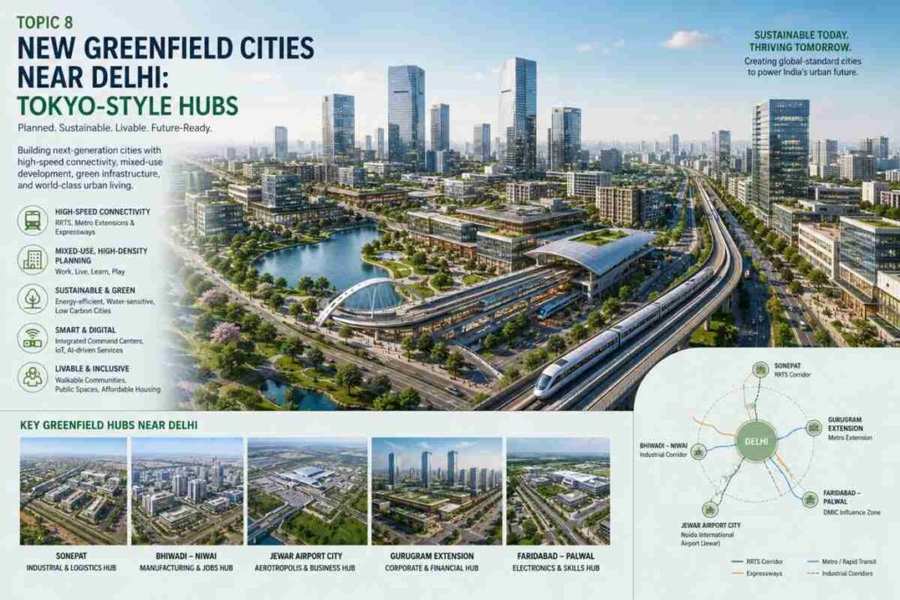
The government chose to rewrite the rules. Under the sweeping directives of the Regional Plan, authorities are establishing up to 8 new greenfield cities near Delhi. These are not just standard real estate extensions or simple residential suburbs; they are being engineered as self-contained, high-tech, Tokyo-style cities built entirely from scratch.
The ultimate goal? A seamless, ultra-fast transit framework that introduces the concept of a “30-Minute NCR.” Imagine living in a pristine, zero-pollution green field layout and reaching central Delhi in less time than it takes to cross south Delhi by car during rush hour. For investors, homebuyers, and business owners, this monumental shift is a generational opportunity. Let’s explore exactly where these future-ready hubs are located, what makes them unique, and why they represent the future of Indian real estate.
What are the 8 New Greenfield Cities Near Delhi?
Simple Explanation
A “greenfield city” is an urban center built completely from scratch on previously undeveloped or agricultural land. Unlike “brownfield” developments, which attempt to fix or retro-fit already crowded, chaotic older cities, greenfield projects give planners a literal blank canvas. This allows for underground utility lines, automated waste management systems, wide multi-lane roads, and dedicated green zones to be mapped out long before the first brick is laid.
When we talk about Tokyo-style development, we are referring to Transit-Oriented Development (TOD). In Tokyo, residential towers, commercial districts, corporate hubs, and schools are clustered densely around ultra-efficient mass transit nodes. You don’t need a car because high-speed trains connect your home to your workplace seamlessly. The proposed new townships across Uttar Pradesh, Haryana, and Rajasthan are adopting this exact architecture.
+-------------------------------------------------------------+
|               THE "30-MINUTE NCR" TEMPLATE                  |
+-------------------------------------------------------------+
|                                                             |
|   [ HIGH-SPEED RAIL ] ------> 30 Mins to Delhi Boundaries   |
|   [ REGIONAL TRAINS ] ------> 60 Mins Across Core NCR       |
|   [ EXPRESSWAYS     ] ------> 2 to 3 Hours Outer Drive      |
|   [ HELI-TAXIS      ] ------> Instant Point-to-Point        |
|                                                             |
+-------------------------------------------------------------+
Why It Matters Now
The urgency behind these new urban nodes stems directly from the rapid growth of the region. Sprawling unplanned developments in older parts of Gurgaon, Noida, and Ghaziabad have strained water tables, overloaded electrical grids, and created massive traffic problems.
By building self-contained economic engines along major infrastructure corridors, the National Capital Region Planning Board (NCRPB) is shifting the pressure away from Delhi’s bursting seams. Backed by a massive planned capital deployment, these locations are transforming into self-sufficient cities where residents can walk to work, enjoy continuous utility supplies, and breathe cleaner air.
Key Features and Architectural Highlights
The planning of these greenfield cities discards outdated 20th-century urban models in favor of smart city infrastructure. The core blueprint draws heavily from the celebrated AURIC (Aurangabad Industrial City) model under the Delhi-Mumbai Industrial Corridor (DMIC) project.
1. Integrated Smart Civic Infrastructure
Every utility line—from high-voltage electricity cables and fiber-optic internet lines to potable water pipelines and sewage networks—is housed in accessible underground trenches. This means no overhead wires, no torn-up roads for routine maintenance, and zero open drains. Automated sensor networks monitor water pressure and grid health in real time, catching leaks and faults before residents even notice them.
2. True Transit-Oriented Layouts (TOD)
Following the Japanese urban model, high-density residential complexes and commercial zones are positioned within a 500-meter walking radius of high-speed rail stations. Walking paths are heavily shaded and segregated from vehicular traffic, encouraging a lifestyle where cars are optional for daily routines.
3. Dedicated Green and Industrial Segregation
To avoid the pollution struggles of older industrial towns, these greenfield projects employ strict spatial zoning. Clean manufacturing, logistics hubs, and tech parks are kept downwind and buffered by thick eco-parks and master-planned urban forests, ensuring residential areas retain clean air.
Concrete Benefits of Moving to Greenfield Townships
                   BENEFITS ARCHITECTURE
                            │
    ┌───────────────────────┼───────────────────────┐
    ▼                       ▼                       ▼
Financial Value         Lifestyle Shift      Long-Term Security
• Sub-50% Entry Cost    • Walk-to-Work       • Climate-Resilient
• Early-Stage Growth    • Dedicated Parks    • Assured Utilities
• Higher Rental Yield   • Low Commute Stress • Smart Governance
Financial Benefits
For buyers priced out of the exorbitant real estate markets of core Gurgaon or New Delhi, these greenfield developments offer an accessible entry point. Land acquisition and initial launching prices sit at a fraction of established city rates. Because these developments are tethered to massive government infrastructure projects, early-stage investors benefit from excellent capital appreciation as transport links go live.
Lifestyle and Business Benefits
The primary luxury offered by these spaces is time. Eliminating a multi-hour daily commute frees up valuable personal hours. Businesses benefit from lower operational costs, cheaper commercial space, and built-in logistics connectivity via nearby expressways and dedicated freight corridors.
Long-Term Value
These townships are engineered for climate resilience. Rainwater harvesting structures, widespread solar integration, and mandatory greywater recycling for lawns and sanitation mean these cities are structured to withstand water scarcity and energy challenges long into the future.
Location and Market Analysis: The 8 Transforming Hubs
The chosen locations for these 8 new greenfield cities are strategically spread across the sub-regions of Uttar Pradesh, Haryana, and Rajasthan, intentionally tracing the paths of mega transport corridors.
                      NCR GREENFIELD SITES
                               │
       ┌───────────────────────┼───────────────────────┐
       ▼                       ▼                       ▼
 Uttar Pradesh              Haryana                Rajasthan
 • Yamuna Expressway     • KMP Expressway       • Shahjahanpur
   (YEIDA Smart City)      (Panchgram Hubs)       Neemrana Corridor
 • Greater Noida-         • Orbital Rail Nodes   • Tapukara Industrial
   Gautam Buddha Nagar     along Sonipat/Jhajjar   Growth Cluster
1. The Yamuna Expressway Industrial Development Area (YEIDA) Hubs (UP)
The most prominent greenfield expansion is taking place along the Yamuna Expressway. Spearheaded by the UP government, this area is designed to house over 20 lakh residents.
- Connectivity: Positioned next to the upcoming Noida International Airport at Jewar, connected via the Eastern Peripheral Expressway and a planned mass transit rail link.
- Infrastructure Growth: Home to upcoming mega projects like Toy City, Textile Hubs, and a massive Medical Device Park.
- Future Potential: The proximity to a major global aviation hub makes this a prime destination for international logistics, hospitality, and corporate offices.
2. The Haryana ‘Panchgram’ Townships (KMP Expressway)
Haryana is executing a brilliant strategy by developing five brand-new townships—dubbed Panchgram—along the Kundli-Manesar-Palwal (KMP) Expressway.
- Connectivity: The KMP acts as a massive outer bypass for Delhi. The upcoming Haryana Orbital Rail Corridor (HORC) runs directly alongside it, providing high-speed rail links that tie back into Delhi’s main metro networks.
- Infrastructure Growth: These towns are structured around key economic impulses like warehousing, heavy manufacturing, and agro-processing industries.
- Future Potential: By capturing traffic and freight before it ever enters the capital, these towns are turning into self-contained logistical powerhouses.
3. The Rajasthan Sub-Region Growth Nodes (Alwar / Neemrana / Shahjahanpur)
The Rajasthan portion of NCR is leveraging its industrial depth along the Delhi-Mumbai Industrial Corridor to create advanced residential and manufacturing townships.
- Connectivity: Positioned along the National Highway 48 (NH-48) corridor, slated for rapid connectivity upgrades via improved semi-high-speed regional rail alignments.
- Infrastructure Growth: Building on the existing foundations of the Neemrana Japanese Zone, these new towns prioritize specialized electronics, auto-components, and sustainable manufacturing.
- Future Potential: These nodes offer an established industrial culture combined with brand-new, modern civic infrastructure, making them ideal for manufacturing professionals.
Investment Potential and Real Use Cases
Investing in early-stage greenfield development requires looking past current empty plots and visualizing the completed infrastructure.
| Metric | Core Established Cities (Delhi/Gurgaon Core) | New Greenfield Townships (NCR Outer Segments) |
| Average Entry Price | Extremely High (Premium Rates) | Low to Moderate (Ground-Floor Rates) |
| 5-Year Growth Outlook | Stable / Saturated (Linear) | Exponential (High-Velocity Acceleration) |
| Primary Commute Mode | Personal Vehicle / Traditional Metro | High-Speed Rail / Orbital Transit / Walkways |
| Infrastructure Age | Aging / Retrofitted | Brand-New / Smart-Grid Integrated |
Honest Risk Factors
While the potential upside is significant, smart investors must balance their optimism with a realistic view of the challenges:
- Execution Timelines: Mega infrastructure projects can face bureaucracy-related delays. A project slated for full completion by a certain date might take a few additional years to realize its true form.
- Initial Habitation Lag: The first 2–4 years can feel isolated before retail markets, multiplexes, major hospitals, and top-tier schools move in fully.
- Dependence on Transport Links: The value appreciation of these cities is fundamentally tied to high-speed rail execution. If a transit line experiences delays, the population influx slows accordingly.
Who Should Buy?
- Forward-Thinking Investors: Individuals looking to deploy capital into land or early-stage residential developments with a clear 7-to-10-year investment horizon.
- Next-Gen Corporate Professionals: Remote workers, tech professionals, and logistics managers who prioritize green living, automated utilities, and proximity to high-speed transit over crowded downtown addresses.
- Industrial and Logistical Entrepreneurs: Business owners who need large, accessible commercial spaces directly connected to national freight expressways without urban entry restrictions.
Step-by-Step Guide to Safely Buying Property in a Greenfield City
Navigating a brand-new real estate market requires strict due diligence. Use this step-by-step roadmap to protect your capital.
1.Verify RERA Compliance and Master Plan Layout:Prerequisite Phase.
Never buy on verbal promises. Ensure the specific plot, villa, or high-rise apartment project is fully registered under the respective state’s Real Estate Regulatory Authority (RERA). Cross-verify the developer’s plot coordinates with the official Government Master Plan map to ensure your property isn’t zoned for future industrial or green belt use.
2.Assess the Distance to the Nearest Transport Node:Location Assessment.
Since the value of Tokyo-style cities depends entirely on transit-oriented layouts, map out the exact distance from the property entrance to the proposed high-speed rail station, orbital rail stop, or expressway exit. Properties within a 1.5-kilometer radius of these hubs will command the highest long-term valuation and rental yields.
3.Audit Developer Pedigree and Financial Health:Financial Screening.
Greenfield developments feature many new entrants alongside established players. Look for developers with a proven track record of timely delivery in older markets. Check if the project is backed by institutional funding or major public-private partnerships, which minimizes the risk of construction stalling due to cash flow constraints.
4.Review Ground Utility Commitments:Final Verification.
Ensure the developer has secured formal water, electricity, and sewage connection clearances from the regional development authority (such as YEIDA or the Haryana sub-regional boards). Confirm that the smart infrastructure promises are explicitly written into your buyer-builder agreement.
Insider Tips from Real Estate Experts
To get ahead in these emerging micro-markets, keep these professional principles in mind:
Focus on Public-Private Partnerships (PPP): Sector plots backed directly by joint ventures between government entities and private developers move twice as fast as purely private layouts.
- Prioritize Commercial Growth Over Hype: Don’t invest where only residential towers are going up. Look for sectors that border upcoming data centers, industrial clusters, or university campuses. True value follows employment hubs.
- Watch the Rail, Not Just the Roads: Expressways are great for trucks and road trips, but high-speed passenger rail lines drive long-term population shifts. Buy along the mass transit corridors.
- Opt for Reputable Consolidated Townships: If buying a plotted development, look for master-townships where the developer controls at least 50+ acres. This ensures internal roads, security, and parks are managed uniformly.
- Lock in Early-Phase Pricing: Developers often increase per-square-foot prices by 15–20% once the initial phase of road leveling and underground piping is completed. Buying during the soft launch maximizes your margins.
Common Pitfalls to Avoid
- Falling for “Unapproved” Border Layouts: Unscrupulous local agents often sell agricultural plots right outside the official greenfield city boundaries, claiming they will soon be integrated. These unauthorized areas will not get access to the smart grids, underground utilities, or fast transit nodes. Stick exclusively within the government-notified development zones.
- Expecting Instant Rental Income: If you need immediate monthly rental yields to pay off a home loan, these early-stage townships are not the right fit. Plan for an initial asset-building phase before the population settles permanently.
- Underestimating Maintenance Costs: Because these cities run on high-end automated infrastructure, internal maintenance fees might run slightly higher than in traditional, unmanaged neighborhoods. Factor these operational expenses into your cash flow sheets from the start.
Future Trends: What These Cities Will Look Like by 2030
As we move closer to 2030, the line between living in Delhi and living in its surrounding greenfield cities will completely disappear.
┌─────────────────────────────────────────────────────────┐
|               THE 2030 URBAN ECOSYSTEM                  |
├─────────────────────────────────────────────────────────┤
| • Clean Energy: Solar micro-grids provide power.        |
| • Smart Mobility: Drone delivery & autonomous shuttles. |
| • Clean Air: Continuous monitoring & heavy green cover. |
| • Economic Independence: Local tech hubs & zero commute. |
└─────────────────────────────────────────────────────────┘
The realization of the Regional Plan transit grid means that boarding a high-speed shuttle or limited-stop train will feel as routine as taking an elevator. We will see the rise of Integrated Micro-Economies, where individuals rarely need to visit the old capital center for work, medical care, or higher education.
Equipped with localized water recycling plants, solar micro-grids, and AI-driven traffic management systems, these locations will set the benchmark for sustainable urban expansion in South Asia, turning the once-congested National Capital Region into a model of modern efficiency.
Conclusion: Securing Your Position in India’s Urban Evolution
The shift toward the 8 new greenfield cities near Delhi is more than just a standard real estate cycle; it is an evolution in how we live, work, and commute. By blending the high-density efficiency of Tokyo-style planning with the natural space of pristine greenfield sites, these townships offer a definitive answer to NCR’s expansion needs. The days of sacrificing your physical health and personal time to long commutes are coming to an end.
Whether you are looking for an affordable home for your family, a high-growth asset for your portfolio, or a modern base for your business, these master-planned corridors warrant your attention. The infrastructure is moving forward, the master plans are set, and the early windows of opportunity are open.
For residents and businesses across Gurugram, Noida, and Delhi, the message is clear: the days of being hopelessly stuck in traffic are winding down. for Cutting out traffic Govt has launched Delhi katra Expressway It is time to look forward, adapt to these emerging corridors, and position your investments to ride the wave of this historic infrastructure transformation.
You will see a city built for the next generation. Knowledge Park 5 is not just about real estate. It is about the quality of life you deserve. It represents a smart choice for your family and your finances. Take a drive through the sector and see the progress yourself. You will see a city built for the next generation. Sector 4 Greater Noida, is more than just a destination on a map; it represents the modern Indian dream of affordable luxury and planned growth. Knowing the Sector 4 Greater Noida pin code is just the beginning of your journey. Whether you are moving here for work, family, or investment, the area offers a robust foundation for a high-quality life. With its strategic location, improving infrastructure, and vibrant community, Sector 4 is undoubtedly one of the best places to plant your roots in the NCR. for more doubts get a On call free session by Real Estate Advisory or Visit byviveksingh.in to book a direct strategy consultation. Are you a Business Owner ? than For business owners, the primary benefit is the guaranteed footfall. Book your Commercial Shop in Mahagun Metro Mall Today as Being located right near the Vaishali Metro Station means a constant stream of commuters is funnelled toward the mall. High visibility leads to lower customer acquisition costs for retail tenants
Frequently Asked Questions
What exactly makes a greenfield city “Tokyo-style”?
A Tokyo-style city focuses on Transit-Oriented Development (TOD). This means residential towers, commercial offices, retail markets, and public services are built right around high-speed transit stations. It prioritizes walking paths and rapid mass transit, minimizing the need for daily car use.
Where are the 8 new greenfield cities near Delhi located?
These planned townships are strategically situated across Uttar Pradesh (along the Yamuna Expressway near the Jewar Airport corridor), Haryana (bordering the KMP Expressway via the Panchgram initiative), and Rajasthan (integrated into the NH-48 and DMIC industrial corridors).
How will the “30-minute commute” to Delhi be achieved?
The regional plan implements a multi-tiered transport framework. It relies on limited-stop mass transit rail systems, superfast regional trains, and upgraded orbital corridors engineered to connect outer boundaries directly to Delhi within half an hour.
Is it safe to invest in these new greenfield locations?
Yes, provided you purchase properties directly within government-notified development authority borders (such as YEIDA zones) and verify that the individual project holds a valid state RERA registration. Stick to developers with strong financial foundations.
When will these greenfield cities be fully operational?
Development is rolled out in sequential phases. Core infrastructure like expressways, main roads, and primary utility grids are already live or actively expanding across multiple hubs. Complete residential population stability and fully realized commercial ecosystems are projected to mature steadily between now and 2030.