
Imagine driving through the swirling mists of Meghalaya, where every blind curve reveals a roaring waterfall or a pristine pine valley. Now, imagine doing that without the teeth-rattling potholes, agonizing urban gridlocks, or hours of being stuck behind slow-moving cargo trucks on treacherous cliff edges. For decades, the spectacular geography of the “Abode of Clouds” has been both its greatest pride and its toughest infrastructural bottleneck.
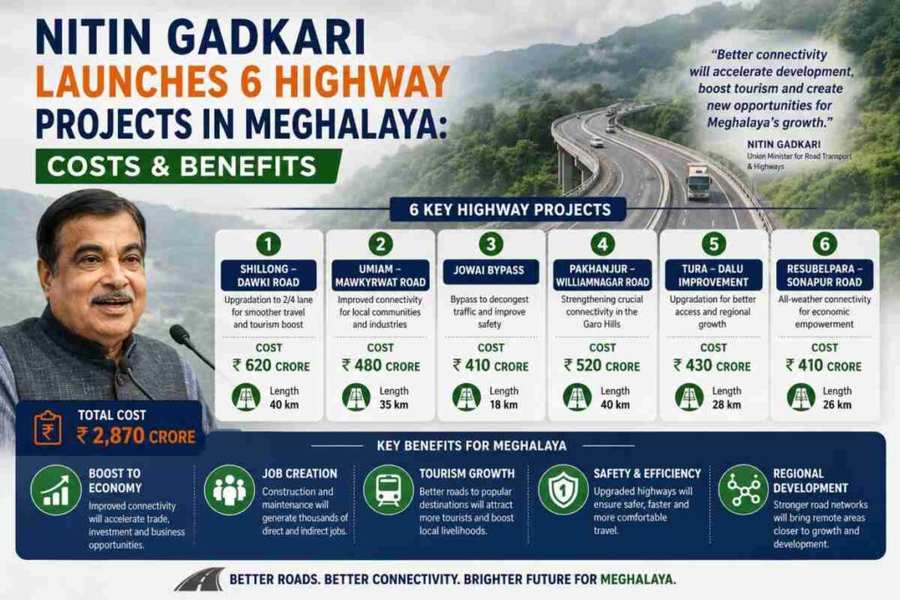
That narrative is changing. In a milestone event at the North East India Infrastructure Summit and Exhibition (NEIINFRA 2026) held in Shillong, Union Minister for Road Transport and Highways Nitin Gadkari officially launched and dedicated six massive National Highway projects in Meghalaya, valued at a staggering ₹3,214 crore. Covering over 117 kilometers, this project package isn’t just about asphalt and concrete. It is a calculated geopolitical and economic masterstroke.
Whether you are an investor looking for the next big land boom, a regional business owner struggling with supply chain logistics, or a traveler eager to explore the untapped corners of the Northeast, these road networks are poised to redefine your relationship with this geography. Let’s peel back the layers of this infrastructural transformation to see exactly what is changing, what it costs, and why it matters to you.
What is the Meghalaya Highway Push?
Simple Explanation
At its core, the newly announced road package consists of the foundation-stone laying for four brand-new National Highway bypasses and corridors, alongside the completion and dedication of two vital road upgrades. These six projects are strategically distributed across East Khasi Hills, West Jaintia Hills, and West Garo Hills. Instead of forcing heavy interstate trucks and commercial trade to snake through dense, suffocating town markets, these new corridors bypass local choke points, seamlessly connecting Meghalaya’s capital to remote borders and neighboring states.
Why It Matters in 2026 and Beyond
We are living in an era where India’s “Act East” policy has transitioned from a political catchphrase to a hard physical reality. In 2026, Meghalaya is recording some of the fastest economic expansions in the country. According to state reports, Meghalaya’s Gross State Domestic Product (GSDP) has literally doubled over the recent years, jumping from ₹29,508 crore in 2018 to an incredible ₹59,626 crore in the 2024-25 fiscal year.
You cannot sustain a booming economy on single-lane colonial mountain trails. As the manufacturing, tourism, and organic farming sectors explode across the state, these highways serve as the vital arteries required to move goods out of the Northeast and into main Indian markets—and across international borders into Bangladesh.
Key Features & Breakdown of the 6 Highway Projects
To understand where the ₹3,214 crore investment is flowing, we must examine the six distinct projects that make up this transformation.
1. The Tura Bypass Project (NH-127B & NH-217)
- The Cost: ₹952 crore
- The Length: ~29 kilometers
- The Goal: Tura is the beating heart of the Garo Hills region. For years, heavy commercial trucks bound for the international border had no choice but to rumble directly through Tura’s congested urban center. This project builds a dedicated 29 km bypass around the city, redirecting heavy freight and slashing local traffic delays overnight.
2. Dhubri-Phulbari Bridge to Selsella Stretch (NH-127B – Package I)
- The Cost: ₹737 crore
- The Length: ~31.5 kilometers
- The Goal: This crucial stretch links directly with the mega-engineering marvel: the upcoming Dhubri-Phulbari Bridge over the Brahmaputra River. By upgrading this section, the government is creating a high-speed, weather-proof transportation spine through the West Garo Hills, dramatically shortening the journey between western Meghalaya and Assam.
3. Pynursla Bypass Project (NH-206)
- The Cost: ₹564 crore
- The Length: ~7.76 kilometers
- The Goal: Pynursla is a major mountain market town positioned along the route to the Bangladesh border. This bypass routes heavy commercial traffic cleanly around the town center, eliminating hours of gridlock for international cargo carriers and daily commuters alike.
4. Selsella to Goeragre Section (NH-127B – Package II)
- The Cost: ₹504 crore
- The Length: ~32 kilometers
- The Goal: Acting as the sequential twin to the Selsella package, this 32-kilometer corridor completes the high-velocity trade loop in West Garo Hills, ensuring heavy industrial freight can move securely without bottlenecking near rural settlements.
5. Shillong-Dawki Road Upgradation (NH-106/206 – Package I)
- The Cost: ₹351 crore
- The Length: ~10.67 kilometers
- The Goal: Already completed and dedicated to the nation during this visit, this finished stretch modernizes the immediate exit out of Shillong toward Dawki. It addresses the notorious bottle-necks of Upper Shillong, dramatically improving safety along steep, mist-heavy terrain.
6. The Jowai Bypass Project (NH-40E & NH-44)
- The Cost: ₹106 crore
- The Length: ~5.44 kilometers
- The Goal: Also completed and declared open, this bypass completely frees the busy town of Jowai from the relentless through-traffic of coal and limestone trucks, making local roads safer and returning quiet streets back to residents.
Strategic Benefits of the New Highway Network
                  ┌──────────────────────────────┐
                  │ ₹3,214 Crore Highway Package │
                  └──────────────┬───────────────┘
          ┌──────────────────────┼──────────────────────┐
          ▼                      ▼                      ▼
┌──────────────────┐   ┌──────────────────┐   ┌──────────────────┐
│  Trade & Export  │   │ Tourism Boom     │   │ Regional Growth  │
│  • Dawki Land    │   │  • Sohra &       │   │  • Agro-logistics│
│    Port link     │   │    Umngot river  │   │    facilities    │
│  • Faster access │   │  • Reduced       │   │  • Six-fold Capex│
│    to Bangladesh │   │    travel times  │   │    multipliers   │
└──────────────────┘   └──────────────────┘   └──────────────────┘
Financial Benefits & Logistics Savings
For transport operators, time is quite literally money. Navigating winding, poorly maintained mountain roads forces trucks to operate in lower gears, accelerating fuel burn and wearing down braking assemblies and suspensions.
By delivering widened layouts, optimal banking, and robust bypass structures, these highway projects slash vehicle operating costs by an estimated 20% to 30%. Freight haulers can complete round trips in half the time, translating directly into cheaper consumer goods for local residents and higher profit margins for regional producers.
Tourism & Lifestyle Enhancements
Meghalaya holds legendary status among world travelers, home to iconic spots like the living root bridges of Cherrapunji (Sohra), the crystal-clear waters of the Umngot River in Dawki, and Asia’s cleanest village, Mawlynnong.
Yet, many tourists actively skip these destinations due to the exhausting road conditions. With the Pynursla Bypass and the Shillong-Dawki upgrades fully functional, transit times from Guwahati airport to the depths of Southern Meghalaya will plummet. Weekend getaways become comfortable, encouraging higher-spending luxury eco-tourists to visit.
Long-Term Value & Border Asset Protection
Geopolitically, Meghalaya shares an expansive international boundary with Bangladesh. The ports at Dawki and Dalu are vital economic escape hatches for landlocked Northeast India. By stabilizing and expanding these specific highway corridors, the Indian government builds reliable defense and economic supply corridors that maintain high productivity even through intense monsoon cycles.
Location & Market Analysis: The New Real Estate Frontier
The unveiling of these six road networks is triggering an immediate, unprecedented wave of interest in Meghalaya’s land market. When connectivity improves, real estate values along the outer rims of these bypasses inevitably pivot upward.
| Region / Corridor | Strategic Connectivity Focus | Real Estate & Commercial Potential |
| New Shillong & Pynursla Rim | Connects capital directly to Dawki Land Port | High demand for premium eco-resorts, homestays, and boutique hotels. |
| West Garo Hills (Tura / Selsella) | Direct feeder to the upcoming Dhubri-Phulbari Brahmaputra Bridge | Prime territory for large cold-storage complexes, agro-processing hubs, and fulfillment centers. |
| Jaintia Hills (Jowai Bypass Axis) | Links core mineral belts directly to Assam corridors | Emergence of industrial service yards, automated fuel stations, and highway truck terminals. |
Infrastructure Growth Realities
Meghalaya’s capital expenditure (Capex) has increased nearly six-fold over the past eight years. When a state government aggressively matches central infrastructure funding, it indicates a high-growth environment. Real estate in regions like New Shillong is moving away from purely residential setups, shifting toward institutional areas, IT zones, and structured sports infrastructure ready for the upcoming National Games.
Investment Potential & Critical Use Cases
ROI Opportunities for Early Moves
For private investors, the most lucrative opportunities lie within agro-logistics and experiential tourism hospitality. Meghalaya produces world-class high-value crops like Lakadong turmeric, ginger, and sweet Khasi mandarin oranges. Historically, up to 30% of these delicate crops spoiled before reaching major markets due to rough transport.
The Opportunity: Investing in cold storage distribution centers and processing units along the newly minted NH-127B or near the Tura Bypass allows you to capture and process pristine produce faster than ever before.
Risk Factors (An Honest Assessment)
Investing in mountain terrains requires a clear understanding of regional challenges:
- The Land Tenure System: Most land in Meghalaya is owned communally by indigenous tribes and managed via Autonomous District Councils (ADCs). Non-tribal individuals cannot simply buy land outright. Navigating long-term lease frameworks requires careful legal steps and deep respect for community customs.
- Monsoon Damage & Landslides: Meghalaya experiences some of the highest rainfall on Earth. Even top-tier National Highways face structural threats from rain-induced landslides, which can trigger unpredictable seasonal blockages.
Who Should Position Themselves Now?
This infrastructure cycle is an ideal match for long-term institutional logistics players, eco-hospitality groups, cold-chain developers, and sustainable high-value organic agriculture brands looking to source directly from farm gates.
Comprehensive Structural Comparison
To fully grasp the scope of what occurred at the NEIINFRA 2026 Summit, we have to look at these six active projects side-by-side with the colossal ₹39,800 crore Greenfield pipeline that Nitin Gadkari announced right alongside them.
Project Breakdown: Active vs Future Pipeline
1.The Active Phase: Overcoming Local Bottlenecks:₹3,214 Crore Investment.
This consists of the 6 highway projects launched immediately. They focus heavily on constructing urban bypasses (Tura, Jowai, Pynursla) and upgrading current high-stress corridors to isolate commercial freight from daily city traffic.
2.The Greenfield Phase: The 4-Lane Shillong-Silchar Corridor:₹23,000 Crore Pipeline.
An upcoming 165 km engineering marvel designed to slash the grueling travel time between Shillong and Silchar by a massive 50%. This creates a high-velocity route feeding directly into Tripura, Mizoram, and Manipur.
3.The High-Speed Connection: The Jorabat-Barapani Corridor:₹8,500 Crore Pipeline.
A proposed 66 km greenfield highway designed to bring travel times between Guwahati and Shillong down to a single hour, laying the groundwork for a broader economic corridor reaching all the way from Siliguri to the Barak Valley.
4.The Border Integration: The Darugiri-Baghmara-Dalu Corridor:₹4,000 Crore Pipeline.
A planned 136 km sweep across the rugged South Garo Hills along the Bangladesh border, aimed at bringing reliable economic access to remote border communities.
Expert Tips for Navigating Meghalaya’s Transforming Economy
If you are looking to tap into this newly unlocked economic landscape, keep these practical insider strategies in mind:
- Focus on the Bypass Intersections: Do not look for commercial property inside old town centers. Look for intersections where the new bypasses meet old state highways. These locations will evolve into the logistics hubs and fuel terminals of tomorrow.
- Build Joint Ventures with Local Landowners: Because out-of-state entities cannot easily purchase tribal land, success lies in building transparent joint-venture models with local landowners, ensuring they receive long-term equity and consistent rental yields.
- Plan Around the Monsoon Cycle: If you are running a logistics or construction business, build your financial models knowing that heavy field operations naturally slow down between June and September. Optimize your supply chains during the high-velocity dry winter months.
- Design for Eco-Conscious Consumers: Meghalaya’s administration values low-impact development. High-volume, concrete-heavy mass tourism projects face local resistance. Focus on sustainable, low-impact luxury cottages and modular eco-resorts that blend into the landscape.
- Leverage the Dhubri-Phulbari Connectivity Multiplier: Look closely at land options in West Garo Hills along NH-127B. Once the Dhubri-Phulbari Bridge goes live, this entire sub-region shifts from an isolated border pocket to a vital transit zone linking West Bengal and Bhutan straight to the ocean trade ports.
Common Mistakes to Avoid
Overlooking Local Community Approvals
Many outside entrepreneurs assume that a clearance from a central or state ministry is enough to break ground. In Meghalaya, local Headmen (Rangbah Shnong) and traditional village councils (Dorbars) hold immense social authority. Proceeding with any commercial development without explicit local community consultation is a fast track to costly project delays.
Expecting Standard Plain-Terrain Construction Timelines
Building a warehouse or processing facility on flat terrain in parts of India can take less than six months. In the Northeast hills, unexpected rock strata, extreme slopes, and heavy rain can extend construction timelines by double. Always build a 40% time and cost buffer into your local project planning.
Looking Ahead: Future Trends (2026–2030)
Over the next four to five years, expect to see three major transformations take shape across the state:
- The Rise of High-Speed Economic Corridors: As active bypasses link up with the upcoming ₹23,000 crore Shillong-Silchar line, Meghalaya will shed its isolated image, transforming into a central logistics turntable connecting Assam, Bangladesh, Mizoram, and Tripura.
- A Shift to Clean, Green Fleet Logistics: Given Nitin Gadkari’s consistent national focus on alternative fuels, expect these new highway networks to feature early integrations of green hydrogen filling infrastructure and fast EV charging docks, catering directly to heavy electric cargo vehicles.
- The Decentralization of Shillong: As city traffic gets diverted outward via bypass networks, the heavy, historic overcrowding inside police bazaars and downtown Shillong will cool off. Economic activity will gracefully spread out toward New Shillong and peripheral satellite towns.
Conclusion
The launch of these 6 National Highway projects represents a permanent shift in how India approaches the development of the Northeast. For too long, the region’s isolated hills were treated as a beautiful but distant periphery. Today, backed by a ₹3,214 crore financial commitment and a massive ₹39,800 crore greenfield pipeline waiting in the wings, Meghalaya is building the foundational concrete infrastructure required to become a dynamic international trade gateway.
The bottlenecks are easing, the travel times are dropping, and the economic potential is plain to see. The only question left is simple: Are you positioned to catch the wave, or will you watch this historic infrastructure boom unfold from the sidelines?
For residents and businesses across Gurugram, Noida, and Delhi, the message is clear: the days of being hopelessly stuck in traffic are winding down. for Cutting out traffic Govt has launched Delhi katra Expressway It is time to look forward, adapt to these emerging corridors, and position your investments to ride the wave of this historic infrastructure transformation.
You will see a city built for the next generation. Knowledge Park 5 is not just about real estate. It is about the quality of life you deserve. It represents a smart choice for your family and your finances. Take a drive through the sector and see the progress yourself. You will see a city built for the next generation. Sector 4 Greater Noida, is more than just a destination on a map; it represents the modern Indian dream of affordable luxury and planned growth. Knowing the Sector 4 Greater Noida pin code is just the beginning of your journey. Whether you are moving here for work, family, or investment, the area offers a robust foundation for a high-quality life. With its strategic location, improving infrastructure, and vibrant community, Sector 4 is undoubtedly one of the best places to plant your roots in the NCR. for more doubts get a On call free session by Real Estate Advisory or Visit byviveksingh.in to book a direct strategy consultation. Are you a Business Owner ? than For business owners, the primary benefit is the guaranteed footfall. Book your Commercial Shop in Mahagun Metro Mall Today as Being located right near the Vaishali Metro Station means a constant stream of commuters is funnelled toward the mall. High visibility leads to lower customer acquisition costs for retail tenants
Frequently Asked Questions
What is the total cost of the new highway projects launched by Nitin Gadkari in Meghalaya?
Union Minister Nitin Gadkari launched and laid foundation stones for a package of six National Highway projects worth a total investment of ₹3,214 crore. This includes four brand-new highway construction projects and two completed road corridor upgrades.
Which areas in Meghalaya will benefit most from these six highway projects?
The projects are strategically spread out to cover the East Khasi Hills, West Jaintia Hills, and West Garo Hills. Major urban centers and trade points—including Tura, Jowai, Pynursla, and the strategic border road leading out toward the Shillong-Dawki axis—will experience immediate relief from heavy cargo congestion.
How do these highway upgrades affect international trade with Bangladesh?
The highway packages specifically target vital border corridors, including the Pynursla Bypass and the Shillong-Dawki route. By bypassing dense town centers and widening high-stress mountain roads, international commercial cargo can move seamlessly to the Dawki and Dalu border land ports, boosting cross-border trade.
What is the massive future greenfield road pipeline planned for Meghalaya?
Alongside the active ₹3,214 crore package, the central government announced a massive future road pipeline worth nearly ₹39,800 crore. This future pipeline features the flagship 4-lane Greenfield Shillong-Silchar Corridor (₹23,000 crore) and the high-speed Jorabat-Barapani Corridor (₹8,500 crore).
How can private real estate investors safely participate in Meghalaya’s infrastructure boom?
Because of traditional land laws, outside investors cannot buy tribal land directly. Instead, the safest approach is entering structured, long-term lease agreements or joint-venture partnerships with local landowners and community members, focusing on eco-tourism hospitality and high-value agro-logistics hubs.