
Imagine a corporate ecosystem that does not just handle back-office operations, but actually designs the core algorithms, manages the global supply chains, and builds the proprietary Artificial Intelligence (AI) platforms for Fortune 500 companies. That is the exact reality unfolding in Haryana right now. For over two decades, Gurugram earned its stripes as India’s “Cyber City”—a glittering expanse of glass towers that became synonymous with the country’s outsourcing boom. But the business world does not stand still, and neither does the National Capital Region (NCR).
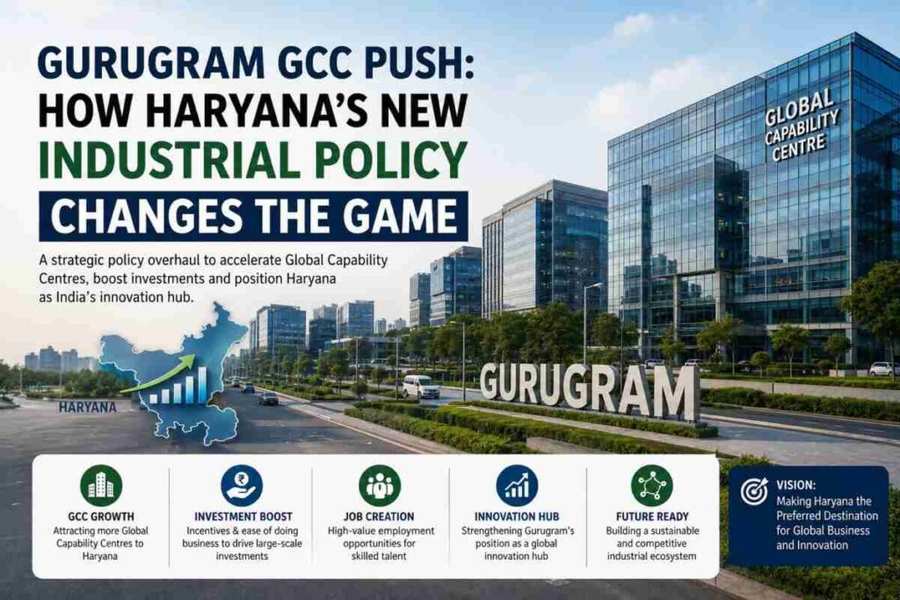
A massive structural shift is taking place across the commercial landscape. The Haryana government recently rolled out its ambitious Make in Haryana Industrial Policy 2026. This is not just a routine bureaucratic update. It is a highly strategic, multi-layered master plan engineered to aggressively accelerate what insiders are calling the Gurugram GCC push. By moving deliberately away from basic cost arbitrage and focusing squarely on high-value intellectual property (IP), research and development (R&D), and advanced digital public infrastructure, this fresh framework is designed to transform Gurugram from a regional corporate base into the undeniable global capability capital of North India.
If you are an institutional investor, a commercial real estate developer, a tech founder, or a corporate leader looking to establish an automated capability hub, this policy framework alters your strategic calculus. This in-depth breakdown analyzes the mechanics of this fresh policy, uncovers why it makes the region an irresistible destination for global capital, and explains how you can capitalize on this transformation.
What is the Gurugram GCC Push?
To understand why this policy is creating shockwaves across the corporate sector, we first need to define what a GCC actually is in the modern context and look at how Gurugram’s position is shifting.
Simple Explanation
A Global Capability Center (GCC)—once widely referred to as a captive center—is a dedicated, in-house facility established by a multinational corporation (MNC) in a strategic location like India. In the early 2000s, these centers were used almost exclusively for transactional, low-cost operations like basic IT support, data entry, and customer service.
Today, the model has completely transformed. Modern GCCs operate as core innovation engines. Instead of answering support tickets, teams at a Gurugram GCC are more likely to be building proprietary neural networks, conducting cybersecurity threat hunting, or running complex predictive analytics for global operations. The Gurugram GCC push represents a deliberate, state-backed movement to turn the city into the densest cluster of these high-value innovation hubs in the country.
Why It Matters in 2026+
The global GCC market in India is projected to exceed a staggering $135 billion valuation by 2030, employing over 1.5 million highly skilled technical professionals. Historically, cities like Bengaluru and Hyderabad captured a massive share of this premium growth.
However, the year 2026 marks a clear inflection point. With southern tech hubs facing acute infrastructural bottlenecks, escalating real estate premiums, and intense talent poaching, international enterprises are actively looking for alternative corridors. The newly launched Haryana Global Capability Centre Policy 2026 addresses this demand head-on. By aligning the state’s regulatory framework with modern technological needs, the government is ensuring that the Gurugram GCC push has the institutional backing required to capture a dominant share of this multi-billion-dollar market over the next decade.
Key Features of the Fresh Industrial Policy
The cornerstone of this economic overhaul is the Make in Haryana Industrial Policy 2026, which officially retires the legacy HEEP 2020 framework. Alongside it, the state cabinet approved a coordinated package of 10 specialized sector policies. On its very first day of launch, the policy generated immense industry confidence, securing MoUs valued at ₹1.10 lakh crore, including a massive ₹30,000 crore in committed Foreign Direct Investment (FDI).
The framework stands out due to several key operational highlights:
                  ┌────────────────────────────────────────┐
                  │   MAKE IN HARYANA INDUSTRIAL POLICY    │
                  └───────────────────┬────────────────────┘
                                      │
         ┌────────────────────────────┼────────────────────────────┐
         ▼                            ▼                            ▼
┌──────────────────┐        ┌──────────────────┐        ┌──────────────────┐
│  INTELLIGENT GOV │        │ FISCAL REFORMS   │        │ MIXED-USE TOWNS  │
│  Single Window   │        │ Up to 70% SGST   │        │ Walk-to-Work     │
│  2.0 AI Portal   │        │ Reimbursement    │        │ Urban Spaces     │
└──────────────────┘        └──────────────────┘        └──────────────────┘
Feature 1: The Shift to “Intelligent Governance”
The government is replacing standard digital portals with an AI-enabled Single Window 2.0 system, known as the Intelligent Investment Facilitation Portal. Instead of forcing corporate executives to manually navigate a maze of disparate municipal and industrial departments, this unified platform integrates everything into a single operational interface. It provides investors with GIS-based land identification, an automated investment blueprint generator, and real-time guidance through complex clearance pathways. The policy introduces a cost-plus-speed model, moving away from classic red tape toward friction-free onboarding.
Feature 2: High-Velocity Fiscal Rails
To protect investor liquidity and minimize structural risk, the state has institutionalized an aggressive financial release timeline. For eligible investments, the government has mandated the release of 50% of approved incentives within 7 working days. To prove their commitment, the policy includes a statutory 8% per annum interest penalty imposed on the state government itself if incentive payments face bureaucratic delays.
Feature 3: Integrated Mixed-Use Townships & Walk-to-Work Models
Recognizing that modern tech talent demands a high-quality lifestyle, the policy aggressively promotes the development of integrated mixed-use townships and “Cyber Cities.” Developers are being given extensive Floor Area Ratio (FAR) relaxations and planning flexibility to blend high-grade commercial office spaces with premium residential units, educational centers, and recreational zones. This design purposefully facilitates a sustainable, urban “walk-to-work” model that appeals directly to global corporate standards.
Multi-Layered Benefits of the Gurugram GCC Push
The policy doesn’t just offer generic subsidies; it delivers highly targeted economic, operational, and long-term advantages for companies looking to expand their footprint.
Financial Benefits
The financial incentives built into the 2026 policy are among the most competitive in the country:
- Net SGST Reimbursement: Companies can claim Net SGST reimbursements ranging from 30% to 70% for a period extending up to 12 years, depending on the scale of the project.
- Capital & Operating Subsidies: For major players, the state offers direct capital investment subsidies of up to 30% for Ultra Mega projects. Dedicated GCC setups can access direct operating aid of up to ₹15 crore per year.
- R&D and Infrastructure Grants: The policy provides specialized R&D infrastructure support reaching up to ₹50 crore per unit, alongside substantial exemptions on electricity duty and stamp duty for land procurement.
Lifestyle and Business Benefits
Beyond the numbers, the Gurugram corporate ecosystem offers an elite operational environment. The region boasts the highest concentration of premium Grade-A office spaces in North India. By legalizing flexible shift frameworks—including clear guidelines permitting women to work night shifts safely with mandated corporate security protocols—the policy ensures that 24/7 global operations run smoothly without hitting legal hurdles.
Long-Term Value
By establishing a node in this corridor, corporations create deep asset valuation. The integration of advanced digital public infrastructure ensures that companies are insulated from future operational friction. Additionally, the government has announced that it will double the incentives offered by central schemes—such as the national Production-Linked Incentive (PLI) programs—by an additional 50%, maximizing long-term capital efficiency.
Market & Infrastructure Analysis: Why Gurugram Wins
A policy is only as good as the physical infrastructure supporting it. The ongoing Gurugram GCC push owes much of its rapid momentum to the dramatic logistical and connectivity upgrades reshaping the National Capital Region.
| Infrastructure Dynamic | Impact on the GCC Ecosystem |
| Dwarka Expressway & Global City | Opens up thousands of acres of smart, sustainable commercial estates; directly linked to the upcoming 150,000-job Global City master development. |
| Dual-Grid Power Commitments | Grants “Essential Service” status to critical tech installations, offering hyper-scale centers (>10 MW) uninterrupted, redundant power networks. |
| Non-TOD Expansion Zones | Prioritizes new commercial real estate corridors outside congested transit nodes, creating highly accessible digital infrastructure zones. |
Connectivity
Gurugram offers unmatched international and domestic connectivity. Situated just a short drive from Delhi’s Indira Gandhi International Airport (DEL), global executives can seamlessly travel from international headquarters directly to their local boardrooms. The extensive expansion of the multi-lane regional expressways, the rapid transit metro networks, and close proximity to the Western Dedicated Freight Corridor make it a hyper-connected logistical nexus.
Infrastructure Growth
The fresh policy actively channels commercial real estate development into strategic areas like IMT Sohna, where a massive 500-acre dedicated electronics and component cluster is being built. Furthermore, by relaxing the Floor Area Ratio (FAR) by up to 500% for data centers and critical digital infrastructure, the state has unlocked vertical expansion capabilities that were previously restricted by local zoning laws.
Future Potential
As the massive Global City project along the Dwarka Expressway nears completion, it will act as a core anchor for next-generation enterprises. This localized ecosystem ensures that any tech company setting up operations today will be surrounded by prime commercial real estate, cutting-edge civic facilities, and a reliable, world-class utilities grid for decades to come.
Investment Potential & Concrete Use Cases
The current momentum behind the Gurugram GCC push opens up highly lucrative entry points for a wide variety of market participants.
ROI Opportunities
For institutional real estate funds and commercial developers, the demand for premium, custom-built Grade-A office spaces, built-to-suit R&D laboratories, and sophisticated Tier-4 data centers is skyrocketing. With the government offering direct capital subsidies and predictable tax rebates, developers can pencil in highly attractive, risk-adjusted yields on commercial projects.
For tech companies, the operational cost savings derived from the state’s lease reimbursements, combined with high-velocity talent output, dramatically compresses the timeframe required to achieve a positive return on investment (ROI) on a new center.
Risk Factors (A Candid Assessment)
While the upside is substantial, any smart investor must evaluate potential challenges honestly:
⚠️ Key Risk Factors to Monitor:
- Localized Infrastructure Strain: While new corridors like the Dwarka Expressway feature advanced planning, older commercial sectors of Gurugram can still experience seasonal waterlogging and localized traffic congestion during peak monsoon months.
- Talent Compensation Inflation: As major Fortune 200 enterprises enter the market simultaneously, competition for elite AI and data engineering professionals will drive up local compensation benchmarks.
- Execution Timelines: While the AI-powered Single Window 2.0 portal dramatically accelerates paper approvals, the physical deployment of power sub-stations and multi-utility lines in newly opened non-TOD zones can occasionally face real-world field delays.
Who Should Invest?
- Fortune 500 and Global 2000 Enterprises: Companies looking to set up high-end Centres of Excellence (CoE) focused on AI research, predictive analytics, and core product engineering.
- Hyper-Scale Data Center Operators: Infrastructure developers looking to leverage the newly granted “Essential Service” status, 500% FAR relaxations, and secure dual-grid power supplies.
- Real Estate Investment Trusts (REITs): Institutional investors looking to acquire high-yield, premium commercial assets backed by blue-chip multinational tenants.
Strategic Comparison: Gurugram vs. Alternative Hubs
When corporate site selectors evaluate locations for an expansive new capability center, they typically compare Gurugram against established heavyweights like Bengaluru or rapidly growing options like Noida. Here is how the location dynamics stack up under the 2026 policy framework.
                      ┌───────────────────────────┐
                      │    SITE SELECTION TEST    │
                      └─────────────┬─────────────┘
                                    │
         ┌──────────────────────────┴──────────────────────────┐
         ▼                                                     ▼
┌─────────────────────────────────┐         ┌─────────────────────────────────┐
│         GURUGRAM (2026)         │         │      BENGALURU / HYDERABAD      │
├─────────────────────────────────┤         ├─────────────────────────────────┤
│ • 50% Incentive Pay in 7 Days   │         │ • High Tech Density             │
│ • Global AI Centre Hub          │   VS    │ • Acute Infrastructure Strain   │
│ • Integrated Mixed-Use Formats  │         │ • Escalating Grade-A Premiums   │
│ • Mandatory 8% Delay Penalty    │         │ • High Local Talent Attrition   │
└─────────────────────────────────┘         └─────────────────────────────────┘
Why Gurugram Stands Out
While Bengaluru retains a massive base of software engineering talent, it struggles under the weight of severe urban congestion and a lack of readily available, cohesive commercial land parcels inside prime business districts. Noida offers competitive land pricing but historically lacks the sheer density of Fortune 500 headquarters and premium corporate culture that Gurugram has cultivated over two decades.
The fresh 2026 policy tilts the scales decisively in Gurugram’s favor by addressing the specific pain points of modern corporate operations. By legally enforcing a 7-day timeline for 50% incentive disbursement and penalizing itself with an 8% interest rate for delays, Haryana offers a level of regulatory predictability and financial security that rival states simply do not match. Combined with the planned setup of a flagship Global AI Centre in Gurugram, the city isn’t just offering real estate—it is offering an unmatchable ecosystem.
Step-by-Step Guide to Establishing a GCC in Gurugram
Navigating the setup process has been streamlined under the fresh 2026 framework. If your enterprise wants to successfully leverage the Gurugram GCC push, follow this structured, sequential path:
1.Initialize Profile on Single Window 2.0:Days 1–5.
Register your corporate entity on the newly launched Intelligent Investment Facilitation Portal. Input your projected capital investment parameters, human resource requirements, and specific technology focus areas to allow the AI engine to generate your customized compliance pathway.
2.Select Your Strategic Zoning Alignment:Days 6–20.
Utilize the portal’s integrated GIS land identification system to evaluate available sites. Decide between setting up within a premium mixed-use “Cyber City” township along the Dwarka Expressway, utilizing an electronics-focused cluster at IMT Sohna, or securing space in a prioritized non-TOD corridor depending on your infrastructure requirements.
3.Submit the Core Fiscal Incentive Application:Days 21–35.
File your formalized development plan to lock in targeted fiscal benefits. Ensure your documentation clearly highlights eligibility for specialized support, such as the maximum ₹15 crore annual operating aid or Net SGST reimbursements, before breaking ground or signing long-term commercial leases.
4.Establish Local Industry-Academia Skilling Partnerships:Parallel Track.
To mitigate long-term talent poaching and ensure operational readiness, align with the state’s tech training mandates. Leverage government-backed talent programs to gain direct access to the 50,000-strong pool of specialized technology professionals being upskilled under the new IT & Emerging Tech Policy.
Insider Tips from Industry Experts
To truly maximize your returns and avoid common onboarding friction, implement these practical, real-world strategies shared by regional corporate consultants:
- Design Around the “Walk-to-Work” Framework: When sourcing your commercial site, prioritize developments that integrate residential and commercial elements. Tech professionals in 2026 value short commutes, and setups inside integrated townships show substantially lower employee attrition rates.
- Leverage Specialised CoE Capital Grants: Do not just build a generic IT office. If you structure a portion of your facility as a dedicated Centre of Excellence (CoE) for Artificial Intelligence, you can unlock up to ₹10 crore in specialized government grants under the new Emerging Tech Policy.
- Secure Dual-Grid Power Allocation Early: If your operations run mission-critical global infrastructure or compute-heavy AI modeling, ensure your engineering team applies for “Essential Service” dual-grid connectivity during the preliminary land allocation phase to guarantee absolute operational uptime.
- Build Micro-Credential Pipelines: Partner directly with regional technical universities in Haryana. The 2026 policy officially recognizes industry-standard micro-credentials, allowing you to co-design university curriculums to train students on your corporate tech stack well before they graduate.
- Track the Statutory 7-Day Incentive Rule: Keep your financial compliance documentation audit-ready. Because the state now faces an 8% interest penalty for delayed incentive disbursements, submitting clean, flawless digital filings through the Intelligent Portal ensures rapid capital return.
Common Real-World Mistakes to Avoid
Even with a supportive policy, international companies frequently stumble over predictable operational hurdles:
- Over-Optimizing Solely for Subsidies: Choosing an industrial zone purely because it offers the absolute highest percentage of tax rebates, while ignoring critical connectivity metrics or immediate talent access, is a classic strategic mistake. Always put ecosystem strength ahead of raw incentives.
- Miscalculating Real Estate Compliance Guidelines: Assuming that older corporate zoning rules apply to fresh 2026 developments can lead to major design errors. Ensure your architects utilize the newly expanded 500% Floor Area Ratio (FAR) parameters for digital infrastructure to optimize your vertical footprint.
- Ignoring Local Infrastructure Connectivity Pitfalls: Signing a long-term lease for an office building without verifying the status of local municipal utility linkages can delay your operational launch by months. Always run independent physical infrastructure audits on your site.
Future Trends: What Lies Ahead (2026–2030)
As the Make in Haryana Industrial Policy executes its five-year mandate, the corporate landscape in Gurugram will see rapid evolution:
- The Proliferation of Sovereign AI Infrastructure: With a flagship Global AI Centre being set up in Gurugram, expect a massive influx of specialized AI research labs. The city will pivot sharply from standard software development to advanced frontier model training and neural architecture design.
- The Rise of Hyper-Scale Green Data Centers: Driven by the new Data Centre Policy, upcoming facilities will increasingly deploy liquid cooling systems and secure green hydrogen power backups to meet strict international environmental, social, and governance (ESG) compliance standards.
- Decentralized Mini-Clusters: While Gurugram remains the primary operational node, escalating space premiums will push secondary, interconnected manufacturing and logistical setups outward into high-growth corridors like Faridabad, Sonepat, and IMT Sohna, creating a massive, integrated tech industrial crescent across North India.
Conclusion
The Gurugram GCC push has crossed a crucial threshold. It is no longer just driven by market forces; it is powered by an aggressive, forward-looking state strategy. The Make in Haryana Industrial Policy 2026 provides corporate leaders with the exact structural foundation required to de-risk investments, accelerate execution speeds, and tap into an elite tech talent ecosystem. By combining high-velocity fiscal rails, AI-powered intelligent governance, and world-class commercial real estate infrastructure, Gurugram is solidifying its status as North India’s ultimate global capability capital.
The corporate blueprint for the next decade is being written right now. Enterprises that move decisively to align their growth strategies with this fresh policy framework will capture a powerful competitive advantage, ensuring their operations remain resilient, innovative, and future-ready for years to come.
For residents and businesses across Gurugram, Noida, and Delhi, the message is clear: the days of being hopelessly stuck in traffic are winding down. for Cutting out traffic Govt has launched Delhi katra Expressway It is time to look forward, adapt to these emerging corridors, and position your investments to ride the wave of this historic infrastructure transformation.
You will see a city built for the next generation. Knowledge Park 5 is not just about real estate. It is about the quality of life you deserve. It represents a smart choice for your family and your finances. Take a drive through the sector and see the progress yourself. You will see a city built for the next generation. Sector 4 Greater Noida, is more than just a destination on a map; it represents the modern Indian dream of affordable luxury and planned growth. Knowing the Sector 4 Greater Noida pin code is just the beginning of your journey. Whether you are moving here for work, family, or investment, the area offers a robust foundation for a high-quality life. With its strategic location, improving infrastructure, and vibrant community, Sector 4 is undoubtedly one of the best places to plant your roots in the NCR. for more doubts get a On call free session by Real Estate Advisory or Visit byviveksingh.in to book a direct strategy consultation. Are you a Business Owner ? than For business owners, the primary benefit is the guaranteed footfall. Book your Commercial Shop in Mahagun Metro Mall Today as Being located right near the Vaishali Metro Station means a constant stream of commuters is funnelled toward the mall. High visibility leads to lower customer acquisition costs for retail tenants
Frequently Asked Questions
What is the primary objective of the fresh Haryana GCC Policy 2026?
The policy aims to position Haryana, specifically Gurugram, as the premier global destination for automated corporate capability hubs. It seeks to move past basic cost arbitrage by attracting high-value operations focused on artificial intelligence, product engineering, and intellectual property development, targeting 100 new large-scale GCCs over the next five years.
How does the fresh policy protect corporate investors from bureaucratic delays?
The framework introduces an AI-enabled Single Window 2.0 system that automates clearances. Crucially, the state has mandated the release of 50% of approved incentives within 7 working days, imposing a statutory 8% per annum interest penalty on the government itself for any bureaucratic delays past the committed timeline.
What financial incentives can an ultra-mega project claim under the 2026 framework?
Ultra-mega projects can leverage massive fiscal levers, including Net SGST reimbursements ranging from 30% to 70% for up to 12 years, direct capital investment subsidies of up to 30%, dedicated operational aid of up to ₹15 crore per year, and extensive R&D infrastructure support reaching up to ₹50 crore.
Why is the policy focusing on integrated mixed-use townships and walk-to-work models?
The state recognizes that global tech professionals demand premium, friction-free lifestyles. By granting major Floor Area Ratio (FAR) relaxations up to 500%, developers can seamlessly blend elite commercial office complexes with high-grade residential, educational, and recreational spaces, drastically lowering local employee attrition rates.
Can existing GCC units in Gurugram claim benefits under the fresh 2026 policy?
Yes, existing operations are among the prime beneficiaries. The framework explicitly states that currently operational GCCs executing expansion or diversification projects are fully eligible for both capital expenditure (CAPEX) and operational expenditure (OPEX) support, provided they fulfill the designated new investment and job creation thresholds.