
The relationship between Indian marketing departments and generative artificial intelligence started out like a whirlwind holiday romance. By late 2024 and throughout 2025, every major enterprise from Mumbai to Bengaluru was eager to show off its new toy. LinkedIn feeds were awash with AI-generated ad creatives, automated thought leadership essays, and pitch decks promising “unprecedented hyper-personalization.” It felt as though the old, slow creative cycles—where market research led to weeks of copy drafts, mechanical design updates, and sluggish sign-offs—had vanished overnight.
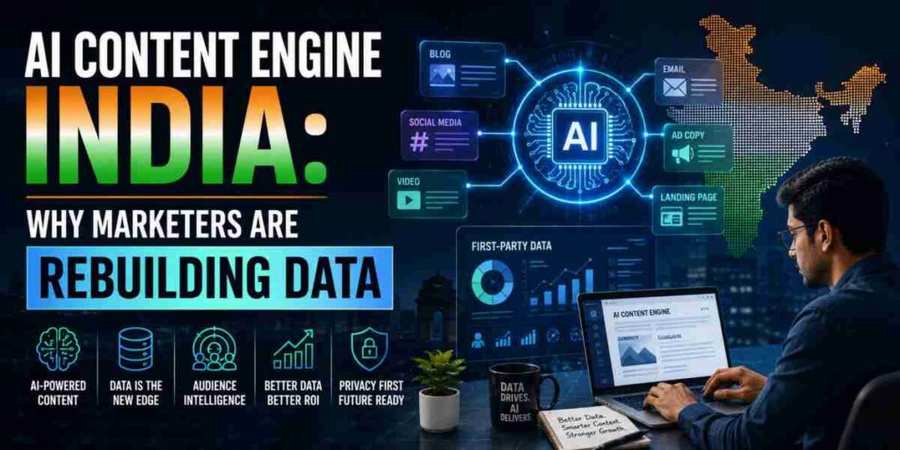
But as we hit the mid-point of 2026, the initial sugar rush of ChatGPT, Midjourney, and basic LLM prompt-engineering has completely worn off. Indian CMOs are facing a cold, hard morning-after reality. The generative algorithms are brilliant; they can draft a seasonal email campaign or translate a social media caption into eight regional languages in three seconds flat. The tools are ready.
The enterprise data architecture sitting behind them, however, is a disjointed mess.
The digital marketing landscape in India has run headfirst into a massive structural bottleneck. When you try to connect an advanced AI content engine to siloed data warehouses, legacy martech stacks, and unmapped customer journeys, the system doesn’t scale. Instead, it breaks down, producing generic copy, tone-deaf recommendations, and embarrassing brand halluncinations. To survive an era where digital advertising commands over 60% of India’s 1.55 lakh crore advertising market, leading brands are realizing they cannot just buy more AI tools. They have to completely tear down and rebuild their internal content infrastructure from the data layer up.
What is an AI Content Engine?
Simple Explanation
At its core, an AI content engine is an integrated operational layer within a business that combines automated generative intelligence with live operational data to plan, create, distribute, and optimize brand assets in near real-time.
Unlike a standalone AI writing tool where an individual employee copies and pastes text into a prompt window, an enterprise content engine acts like a centralized nervous system. It pulls raw signals directly from a company’s data core—such as current inventory levels, local weather shifts, or immediate app behaviors—and instantly feeds them to secure, brand-trained AI models. The system then automatically outputs tailored messaging across thousands of customer touchpoints without requiring a manual human assembly line for every single variation.
[Raw Enterprise Data] ➔ [Centralized Data Layer] ➔ [Brand-Trained AI] ➔ [Real-Time Tailored Content]
Why It Matters in 2026+
In 2026, the sheer velocity of consumer behavior across Tier 1, Tier 2, and Tier 3 markets in India has made traditional static campaigns obsolete. Consumers no longer move along neat, predictable paths; they jump from quick-commerce apps like Blinkit and Zepto to Instagram Reels, WhatsApp business chats, and Google AI Overviews in a matter of minutes.
Because search engines and conversational interfaces now give consumers direct answers right on the results page, brands can no longer rely on simple link-clicking SEO strategies. To win attention, your brand must be present with highly contextual, deeply personalized information exactly when the consumer asks a question. If your operational data is disconnected from your content creation loop, your messaging arrives too late, targeting segments that were relevant last quarter rather than responding to what your customer is doing this second.
Key Features of a Modern Content Engine
1. Unified First-Party Data Integration
The single most critical feature of a functioning AI content engine is its direct pipeline to a unified Customer Data Platform (CDP) or data warehouse. Instead of treating customer information as separate data streams—where website clicks sit in one tool, brick-and-mortar retail transactions live in a legacy ERP, and customer support history is locked in a CRM—the engine unifies these records into a single, real-time identity. This clean data foundation ensures the AI knows exactly who it is talking to before a single line of copy is generated.
2. Guardrailed Brand-Trained Models
An enterprise-grade engine does not use public, open-ended AI models out of the box. It utilizes custom LLMs trained specifically on a company’s historical brand voice, localized terminology, compliance rules, and stylistic guidelines. These internal frameworks act as automated brand managers, checking every piece of machine-generated text against strict legal parameters and brand guidelines before it ever reaches an audience.
3. Automated Asset Adaptation & Assembly
A modern engine handles multi-format, multi-lingual adaptation simultaneously. If a marketing team uploads a single core campaign thesis, the engine automatically breaks it down, creating short-form text notifications for WhatsApp, longer email newsletters, specific localized variations for regional language markets (such as Hindi, Tamil, or Telugu), and contextual product recommendations, adjusting layouts and messaging instantly based on the channel’s constraints.
Benefits of an AI Content Engine
Financial Benefits
The most immediate impact of a data-ready content engine is a massive drop in asset production costs alongside a sharp rise in return on ad spend (ROAS). By automating the mechanical, high-volume tasks of creative adaptation—like resizing banners, generating basic email variations, and translating local ad copies—brands drastically reduce their reliance on expensive, slow production agencies.
Furthermore, because campaigns are backed by real-time behavioral data, conversion rates climb. Marketing teams stop wasting ad budget on generic, broad-bucket audience segments and instead serve highly relevant, dynamic creatives that match exactly what the user is looking for at that specific micro-moment.
Lifestyle / Business Benefits
For internal marketing teams, moving to an integrated content engine eliminates the exhausting grind of day-to-day asset production. Teams no longer spend hours logging data requests, waiting for database administrators to pull lists, or manually QAing hundreds of lookalike ad variations.
Instead, their role shifts from execution to orchestration. Marketers become creative directors and strategic analysts who spend their energy studying consumer insights, refining high-level brand narratives, and tuning the automated system rather than drowning in spreadsheets and copy revisions.
Long-Term Value
Building a resilient, data-backed content architecture provides companies with an enduring defensive moat. As public advertising networks phase out third-party cookies and privacy regulations tighten across the globe, companies that possess a clean, well-governed first-party data core will be the only ones capable of executing precise digital targeting. Over time, the content engine learns from every interaction, making your automated customer engagement loops smarter, more accurate, and harder for competitors to replicate.
Market Analysis: The Bottleneck in India’s Enterprise Ecosystem
Connectivity and the Data Deluge
India’s digital infrastructure has advanced at an incredible pace. Thanks to widespread 5G access and ultra-low data costs, hundreds of millions of consumers across non-metro regions are interacting with digital platforms daily. This has created a massive influx of behavioral data.
However, while Indian enterprises have successfully solved the challenge of collecting data, they are failing miserably at structuring it. Huge data volumes sit completely unorganized inside massive enterprise data lakes. Because the data lacks clean metadata (the descriptive tags that explain what a piece of data actually means), AI systems cannot read it or draw reliable, actionable business conclusions from it.
Infrastructure Growth vs. Martech Decay
There is a massive structural gap between modern cloud data platforms and the legacy martech stacks running inside major Indian enterprises. Over the last decade, many banks, insurance companies, and retail brands built their marketing infrastructure by buying separate, standalone tools for different tasks—one system for push notifications, another for email marketing, and a third for website analytics.
This patchwork approach was never designed to support real-time AI processes. When a generative model tries to pull data out of these fragmented, slow-moving pipelines, the entire process lags, leaving the business unable to deliver cohesive, cross-channel experiences.
Future Potential: Moving Natively to the Data Warehouse
To fix this, the architectural trend in 2026 is shifting away from external, bolt-on marketing software and moving toward building AI applications directly on top of central data platforms like Databricks or Snowflake.
By running AI models natively inside the environment where the enterprise data actually lives, brands eliminate the risky and slow process of moving sensitive customer records back and forth between different vendors. This strategy allows engineering and marketing teams to collaborate seamlessly, enabling rapid decision-making and instant content deployment at a massive corporate scale.
Investment Potential & Use Case Realities
| Industry Sector | Primary Content Engine Use Case | Core Operational Challenge |
| BFSI & Broking | Personalized portfolio updates, hyper-local compliance copy, real-time market insights via WhatsApp. | Highly fragmented legacy backends; strict regulatory audits requiring absolute traceability of AI decisions. |
| Hospitality & Travel | Contextual travel recommendations, dynamic room pricing narratives, personalized pre-stay itineraries. | Disconnected property management systems; siloed loyalty program data blocking real-time updates. |
| E-Commerce & D2C | Auto-generated product descriptions, automated regional ad variations, hyper-targeted quick-commerce offers. | Rapidly shifting inventory data; lack of standardized metadata across complex product catalogs. |
ROI Opportunities
The financial upside for companies that get this integration right is massive. Early adopters in the quick-service restaurant (QSR) and direct-to-consumer (D2C) sectors in India have documented a 40% reduction in campaign turnaround times alongside double-digit increases in customer click-through rates. When your content engine can look at local weather data, realize it is raining heavily in a specific Mumbai neighborhood, check local store inventory, and instantly blast an automated, regional-language push notification for hot comfort food to active app users, conversion rates surge.
Risk Factors & Compliance Realities
However, companies must be honest about the structural risks involved:
- The Transparency Gap: If an enterprise AI model creates a financial or health-related content recommendation, the company must be able to trace exactly which piece of customer data triggered that specific output. In highly regulated spaces like banking or insurance, untraceable AI decisions represent a massive compliance liability.
- The Data Degradation Trap: Feeding poorly cleaned, biased, or outdated data into an expensive generative AI system will simply result in the high-speed production of flawed, off-brand messaging at a massive scale.
Who Should Invest Immediately?
This architectural upgrade is no longer optional for consumer-facing mid-to-large enterprises processing millions of monthly digital transactions. If your business depends on frequent digital touchpoints, operates in multiple regional languages, or manages a constantly changing product catalog, fixing your underlying marketing data infrastructure is the single most important project your technology team can take on this year.
Comparison: Standalone Gen-AI Tools vs. Integrated Content Engines
STANDALONE AI TOOLS (The 2024 Approach)
[Employee] ➔ [Manual Input Prompt] ➔ [Public LLM] ➔ [Manual Copy-Paste] ➔ [Siloed Channel]

INTEGRATED CONTENT ENGINE (The 2026 Approach)
[Unified Data Warehouse] ➔ [Secure Brand-Trained AI] ➔ [Automated Multi-Channel Routing]
Standalone AI Tools
- Data Access: Completely blind to real-time internal business data; relies entirely on manual prompt inputs.
- Workflow: Fragmented and manual; requires workers to manually copy, paste, and edit text across separate browser tabs.
- Brand Governance: High risk of errors, factual hallucinations, and stylistic drift across different team members.
- Scalability: Strictly limited by human working hours; can only create a handful of manual campaign variants at a time.
Integrated Content Engines
- Data Access: Natively integrated into the corporate data core; reacts instantly to live operational signals.
- Workflow: Deeply embedded and automated; hooks directly into internal databases and multi-channel marketing hubs.
- Brand Governance: Secured by built-in brand rules, style guardrails, and compliance tracking layers.
- Scalability: Infinite and real-time; can generate and deploy thousands of hyper-customized, multi-lingual asset variations on the fly.
Step-by-Step Guide to Rebuilding Your Content Infrastructure
Step 1: Clean and Standardize the Metadata Layer
Before buying any new generative software, you must organize your internal data foundation. Audit your enterprise data store and establish a unified, company-wide metadata system. Every customer behavior, product attribute, and content asset must be labeled using identical, clear terms across all departments. If your data engineering team and your creative marketing team use different definitions for basic terms like “active user” or “premium product,” your AI systems will never work correctly.
Step 2: Establish the Brand Governance Layer
Create a dedicated, sandboxed environment for your enterprise language models. Load this system with your corporate style guides, past successful campaigns, approved industry terminology, and lists of restricted phrases or legal disclaimers. Build a clear, dual-layer validation workflow where the AI automatically runs a quality assurance check on its own outputs against these rules before passing the asset to a human marketer for final approval.
Step 3: Connect Live Data Streams to Your Generation Workflows
Tie your newly guardrailed AI models directly to your live operational databases. Start with a straightforward, high-impact project: automate personalized email updates for abandoned shopping carts, or create dynamic loyalty program dashboards that pull live point tallies and behavior history. Once these automated loops are running smoothly and safely, gradually expand the system to handle complex, real-time ad buying and cross-channel campaign adaptation.
Expert Tips for Indian Marketing Leaders
- Treat AI as Infrastructure, Not a Tactic: Stop thinking of AI as a quick tool for writing ad copy. Treat it as a fundamental operating system upgrade that changes how your business processes information, coordinates teams, and communicates with customers.
- Bridge the Chasm Between Data Engineers and CMOs: The single most common failure point in Indian enterprises is the cultural disconnect between technical data teams and creative marketing teams. Break down these walls; embed data engineers directly within your marketing rooms so they can build pipelines optimized for creative output rather than static corporate reporting.
- Focus Heavily on Content Quality and E-A-T: As AI tools flood the internet with cheap, repetitive text, consumers and search engines alike are aggressively tuning out low-value noise. Ensure your content engine is built to surface deep, verified expertise, primary research, and trustworthy insights that align with search engine quality guidelines.
- Design Workflows to Be Human-in-the-Loop by Default: Do not aim for 100% unmonitored automation across your entire marketing stack. Use AI to handle the heavy lifting of data analysis, translation, and structural formatting, but keep experienced human editors in place to handle final quality checks and inject genuine emotional resonance.
- Adopt a Modular Martech Strategy: Avoid getting locked into massive, rigid enterprise software bundles that try to do everything but master nothing. Instead, build a flexible, open marketing ecosystem where specialized AI apps can be easily plugged in or swapped out as technology evolves.
Common Mistakes to Avoid
1. Buying Flashy Tools While Ignoring Messy Data
The fastest way to burn through a modern marketing budget is to purchase expensive, top-tier generative software licenses while leaving your underlying customer data scattered across messy, disconnected legacy spreadsheets. Without clean, accessible data inputs, even the most advanced AI tool will only produce generic, low-converting content.
2. Eliminating Experienced Creative Talent Too Quickly
In a shortsighted rush to cut immediate operating costs, some brands downsized their core creative and copywriting teams, handing the keys entirely to automated text generators. This inevitably backfires. Without skilled human writers to guide the models, refine style voices, and inject authentic storytelling, brand messaging quickly becomes boring, robotic, and identical to every competitor in the market.
3. Ignoring Regulatory and Local Compliance Rules
In fields like banking, health, and insurance, launching unverified AI content loops without strict internal compliance checks can lead to massive legal headaches. If an automated content engine accidentally generates an illegal product claim or misinterprets an interest rate rule due to a data processing bug, the brand faces severe regulatory fines and catastrophic damage to customer trust.
Future Trends: The Road to 2030
Autonomous Multi-Agent Marketing Systems
Between 2026 and 2030, the industry will shift from single-step prompt tools toward networks of specialized AI agents working together. In these setups, one data agent will constantly monitor customer behavior signals, a strategic planning agent will map out campaign concepts, a creative generation agent will produce the required multi-media assets, and a compliance agent will automatically audit the results for safety—all operating within unified corporate parameters with minimal human friction.
[Data Agent] ➔ [Strategy Agent] ➔ [Creative Agent] ➔ [Compliance Agent]
    (Monitors)      (Plans)         (Generates)         (Audits)
Hyper-Localized Voice and Conversational UI Optimization
As voice search and regional conversational commerce become the dominant ways consumers interact with technology across rural and semi-urban India, the demand for text-heavy desktop content will decline. Content engines will be redesigned from the ground up to output short, punchy, conversational audio scripts and localized messaging variants tailored to handle diverse regional accents, dialects, and expressions seamlessly.
Conclusion
The true bottleneck holding back modern marketing in India has nothing to do with the intelligence of artificial models; it lies squarely within the fractured data pipelines of the enterprise. Passing the initial experimental phase of AI adoption requires a commitment to breaking down internal silos, cleaning up messy metadata, and connecting core data infrastructures directly to customer touchpoints.
The companies that choose to tackle these tough structural upgrades today will possess an agile, automated operational engine capable of winning customer attention across any channel. Stop chasing every new generative software fad. Look inside your organization, fix your underlying data foundation, and construct an enterprise content stack built to scale.
For residents and businesses across Gurugram, Noida, and Delhi, the message is clear: the days of being hopelessly stuck in traffic are winding down. for Cutting out traffic Govt has launched Delhi katra Expressway It is time to look forward, adapt to these emerging corridors, and position your investments to ride the wave of this historic infrastructure transformation.
You will see a city built for the next generation. Knowledge Park 5 is not just about real estate. It is about the quality of life you deserve. It represents a smart choice for your family and your finances. Take a drive through the sector and see the progress yourself. You will see a city built for the next generation. Sector 4 Greater Noida, is more than just a destination on a map; it represents the modern Indian dream of affordable luxury and planned growth. Knowing the Sector 4 Greater Noida pin code is just the beginning of your journey. Whether you are moving here for work, family, or investment, the area offers a robust foundation for a high-quality life. With its strategic location, improving infrastructure, and vibrant community, Sector 4 is undoubtedly one of the best places to plant your roots in the NCR. for more doubts get a On call free session by Real Estate Advisory or Visit byviveksingh.in to book a direct strategy consultation. Are you a Business Owner ? than For business owners, the primary benefit is the guaranteed footfall. Book your Commercial Shop in Mahagun Metro Mall Today as Being located right near the Vaishali Metro Station means a constant stream of commuters is funnelled toward the mall. High visibility leads to lower customer acquisition costs for retail tenants
Frequently Asked Questions
Why is data maturity a major hurdle for AI content engines in India?
While Indian enterprises collect massive amounts of customer information, the data usually sits completely unorganized inside isolated departmental tools without clear metadata. Because the data lacks organization, AI models cannot read it accurately, leaving brands unable to scale up real-time personalized campaigns.
How does an integrated content engine differ from standard generative AI tools?
Standard generative tools require employees to manually paste prompts into isolated web browsers to get basic text. An integrated enterprise content engine hooks natively into a company’s live data cores, automatically generating and deploying customized, safe content across thousands of digital channels simultaneously.
What risks do brands face if they automate content without a clean data foundation?
Running automated content systems on top of unorganized, messy data pipelines causes AI models to hallucinate, misinterpret compliance rules, and output generic or misleading messaging. In regulated fields like banking or healthcare, this can trigger severe legal penalties and permanently ruin consumer trust.
Why are modern brands moving their marketing tools directly into data warehouses?
Moving marketing software directly into centralized data spaces like Databricks or Snowflake eliminates the risky and slow process of moving sensitive customer data back and forth to external vendors. This lets companies build highly secure, real-time personalization loops that scale effortlessly.
Will building an enterprise AI content engine completely replace human marketing teams?
No. The shift to an automated content engine removes the repetitive, manual grind of asset formatting, data pulling, and translation. This upgrades the role of human marketers, allowing them to shift from mechanical producers to high-level strategic directors, creative storytellers, and systems managers.