
In the world of wealth building, one phrase carries more weight than almost any other: Real Estate Appreciation Rate. It’s the siren song that lures first-time buyers into 30-year mortgages and the metric that keeps seasoned investors up at night scanning heat maps. But here is the reality: in 2026, the game has changed. Gone are the days when simply “owning dirt” guaranteed a fortune.
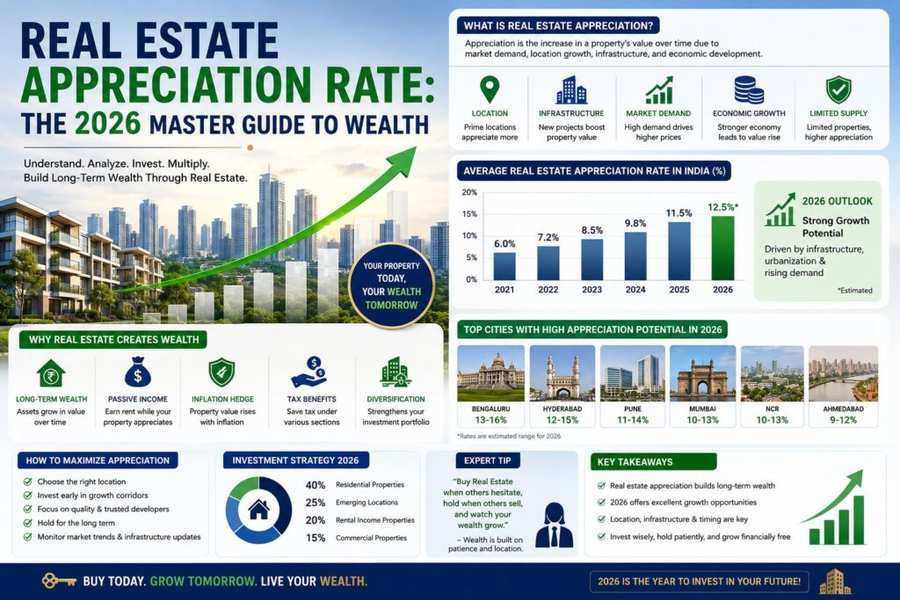
Imagine buying a modest apartment in a rising suburb. You pay your taxes, fix the occasional leaky faucet, and wait. Five years later, the “For Sale” sign goes up. Are you looking at a modest gain that barely covers your inflation-adjusted costs, or have you just hit a financial home run? The difference lies entirely in understanding the mechanics of appreciation.
This guide isn’t just a dry list of statistics. We are going to dive deep into the psychology of market shifts, the “invisible” factors that double property values, and the cold, hard math you need to master to ensure your home is an asset, not a liability. Whether you are an investor looking for the next 10% CAGR or a buyer wondering if now is the time to jump in, you’re about to get the ultimate roadmap to property growth.
What is Real Estate Appreciation Rate?
Simple Explanation
At its core, the real estate appreciation rate is the percentage increase in a property’s value over a specific period. If you bought a home for $500,000 and its market value rises to $550,000 a year later, your annual appreciation rate is 10%. It is the “profit” your property earns while you sleep, driven by market demand, scarcity, and external improvements.
Why It Matters in 2026+
As we navigate 2026, the appreciation rate has become the primary shield against global inflation. With traditional savings accounts often failing to keep pace with the rising cost of living, real estate serves as a “hard asset” hedge. However, the 2026 market is more fragmented than ever. We are seeing “micro-climates” of growth—where one neighborhood might stagnate while the street next to it skyrockets due to a new green-energy hub or a high-speed transit link. Understanding this rate is no longer about generalities; it’s about precision.
Key Features of High-Growth Markets
To predict where the next spike will happen, you have to look for the “DNA” of an appreciating market.
Scarcity and Demand
This is the oldest rule in the book, yet the most ignored. Real estate appreciates fastest where land is limited. Coastal cities or land-locked urban centers naturally have a “supply ceiling.” In 2026, we are seeing a “Reverse Urban Flight,” where people are returning to high-density hubs for culture and connectivity, driving demand back into areas with zero room for new construction.
Infrastructure Catalysts
Infrastructure is the ultimate “value unlock.” The moment a government announces a new metro line, an international airport, or a major highway bypass, the appreciation rate in that radius often doubles overnight. Smart investors buy where the “shovels are in the ground,” not where the ribbon is being cut.
Economic Diversification
A city that relies on a single industry (like a “Steel Town” or a “Tech Only” hub) is a risky bet. High appreciation rates are most sustainable in regions with diverse employment—a mix of healthcare, technology, education, and manufacturing. This ensures that if one sector dips, the housing market doesn’t collapse with it.
Benefits of Real Estate Appreciation
Financial Benefits (The Equity Engine)
The beauty of appreciation is leverage. If you put 20% down on a property and the property appreciates by 5%, your “Return on Equity” is actually much higher because you are gaining value on the bank’s money too. This compounding effect is how the world’s greatest real estate portfolios were built.
Lifestyle / Business Benefits
For homeowners, appreciation isn’t just a number on a screen; it’s a tool. Higher property values lead to increased Home Equity Lines of Credit (HELOCs), which can be used to fund business startups, education, or further investments at lower interest rates than personal loans.
Long-Term Value
Unlike the stock market, which can be volatile and “paper-thin,” real estate offers a tangible utility. Even in a market downturn, your property provides shelter or rental income. Over a 10-to-20-year horizon, real estate appreciation has historically outpaced inflation, preserving your generational wealth.
Market Analysis: The 2026 Landscape
Connectivity and The “15-Minute City”
The biggest trend impacting appreciation rates this year is the “15-Minute City” concept. Properties located in walkable zones where work, groceries, and leisure are within a 15-minute radius are seeing appreciation rates 3-5% higher than traditional sprawling suburbs.
Infrastructure Growth
Keep a close eye on “Green Infrastructure.” Cities investing in massive solar grids, public parks, and electric vehicle (EV) charging networks are attracting the 2026 buyer. Sustainable living is no longer a luxury; it’s a value driver.
Future Potential
Emerging markets in Tier-2 cities are currently the “sweet spot.” While Tier-1 metros offer stability, the “alpha” (excess return) is being found in satellite cities that are absorbing the overflow from major hubs. These areas often show appreciation rates of 12-15% during their initial development phase.
Investment Potential & Use Cases
ROI Opportunities
For a pure investor, the goal is to find a “Value-Add” property. This means buying an undervalued asset in a high-appreciation area. By renovating a dated kitchen or improving the curb appeal, you “force” appreciation on top of the natural market growth.
Risk Factors (The Honest Truth)
Real estate is not a “get rich quick” scheme.
- Liquidity Risk: You cannot sell a house in five minutes if you need cash.
- Interest Rate Sensitivity: If mortgage rates spike, buyer demand cools, and your appreciation rate can flatten or turn negative.
- Maintenance Leakage: If your property appreciates at 5% but your maintenance and taxes cost 4%, your real gain is only 1%.
Who Should Invest?
Real estate appreciation is best suited for the Patient Capitalist. If you have a 7–10 year horizon, the “noise” of yearly market fluctuations matters less than the long-term upward trend of the neighborhood.
Real Estate vs. Alternatives (The 2026 Showdown)
| Feature | Real Estate | Stocks (S&P 500) | Gold |
| Average Return | 4-6% (plus leverage) | 8-10% | 7-9% |
| Volatility | Low | High | Medium |
| Tax Benefits | Excellent (Depreciation) | Moderate | Minimal |
| Utility | You can live in it | None | None |
Why It Stands Out
While stocks might show higher raw numbers, they don’t offer the forced appreciation options that real estate does. You can’t paint a stock’s front door and make it worth more. Real estate gives the owner control.
Step-by-Step Guide to Calculating Your Growth
If you want to know if your investment is actually “winning,” follow these three steps:
Step 1: Establish Your Baseline
Record your total “All-In” cost. This isn’t just the purchase price; it’s the price + stamp duty + legal fees + initial repairs. This is your true starting point.
Step 2: Use the CAGR Formula
To find your Compound Annual Growth Rate (CAGR), use:
(Where $n$ is the number of years held). This gives you a clear percentage to compare against other investments.
Step 3: Factor in the “Net”
Subtract your annual holding costs (property tax, insurance, maintenance) from your appreciation. If the market grew by 7% but your costs were 3%, your Net Appreciation is 4%.
Expert Tips (The Insider’s Playbook)
- Follow the Coffee: It sounds like a cliché, but the “Starbucks Effect” is real. When high-end retail chains move into a “gritty” neighborhood, it’s a leading indicator that the appreciation rate is about to surge.
- Check the “Days on Market”: If houses in an area are selling in under 15 days, demand is outstripping supply. That is your cue to buy.
- School Districts Matter (Even if you don’t have kids): Properties in top-tier school districts hold their value better during recessions and appreciate faster during booms.
- Look for “Zoning Flips”: If an area is being rezoned from industrial to residential/mixed-use, you are looking at a goldmine.
- Avoid the “Best House” on the Block: You want to buy the worst house in the best neighborhood. The neighbors’ high values will pull your appreciation rate up.
H2: Common Mistakes to Avoid
- Emotional Overpayment: Falling in love with a “view” and paying 20% over market value eats your first four years of appreciation.
- Ignoring the “Exit”: Never buy a property without knowing who will buy it from you in ten years.
- Neglecting the Neighborhood: A beautiful house in a declining neighborhood will never appreciate. You are buying the zip code, not just the bricks.
Future Trends (2026–2030)
As we look toward 2030, Climate Resilience will be the #1 factor in appreciation. Properties with high “Flood Scores” or “Heat Scores” will see their appreciation rates plummet as insurance costs become untenable. Conversely, “Climate Havens”—cities with sustainable water sources and temperate weather—will see unprecedented growth.
Conclusion
Real estate appreciation is the closest thing to a “sure bet” in the long-term financial world, provided you do the homework. In 2026, you cannot afford to be a passive observer. You must be a “market architect”—choosing locations with high connectivity, monitoring infrastructure shifts, and managing your property with a business mindset. Knowledge Park 5 is not just about real estate. It is about the quality of life you deserve. It represents a smart choice for your family and your finances. Take a drive through the sector and see the progress yourself. You will see a city built for the next generation. Knowledge Park 5 is not just about real estate. It is about the quality of life you deserve. It represents a smart choice for your family and your finances. Take a drive through the sector and see the progress yourself. You will see a city built for the next generation. Sector 4 Greater Noida, is more than just a destination on a map; it represents the modern Indian dream of affordable luxury and planned growth. Knowing the Sector 4 Greater Noida pin code is just the beginning of your journey. Whether you are moving here for work, family, or investment, the area offers a robust foundation for a high-quality life. With its strategic location, improving infrastructure, and vibrant community, Sector 4 is undoubtedly one of the best places to plant your roots in the NCR.
Ready to build your legacy? Don’t just look at the price tag today; look at the potential of the neighborhood tomorrow. The best time to buy was twenty years ago; the second best time is today—but only if you know the numbers.
Frequently Asked Questions
What is a “good” annual appreciation rate for 2026?
A healthy annual appreciation rate typically falls between 4% and 6%. However, in high-growth “hotspots” or emerging tech hubs, you might see 10% to 15%. Anything below 3% may struggle to beat inflation once you factor in maintenance costs and taxes.
How does inflation affect property appreciation?
Inflation generally pushes property prices up because the cost of building materials and labor increases. Real estate is a “hedged asset,” meaning as the value of currency drops, the nominal value of your home usually rises to compensate, protecting your purchasing power.
Can a property’s value actually go down?
Yes. Negative appreciation (depreciation) happens due to economic recessions, rising interest rates, or local factors like a major employer leaving the area. This is why diversification and choosing locations with “economic moats” (diverse industries) is critical for any long-term investor.
Does renovation always increase the appreciation rate?
Not always. “Maintenance” (fixing a roof) keeps value stable, while “Upgrades” (adding a modern kitchen) can force appreciation. However, over-improving a house beyond the neighborhood’s average can result in a “diminishing return” where you don’t recoup your investment costs.
How often should I calculate my property’s appreciation?
An annual check-in is sufficient for most. Use local “comparable sales” (Comps) from the last six months to get an accurate market value. Frequent checking can lead to emotional decisions; real estate is designed for long-term compounding, not day-trading.