
Imagine walking into a packed room of thousands of people, blindfolded, trying to hand out business cards for a high-end service. You might get lucky and hit a person who needs what you sell, but most of your cards will wind up in the trash. That is exactly what running digital advertising feels like without solid data.
For years, digital marketers relied on third-party tracking pixels to remove that blindfold. But the landscape has shifted underneath our feet. Third-party data has crumbled, consumer privacy regulations have tightened, and the algorithms powering our campaigns require highly specific signals to function.
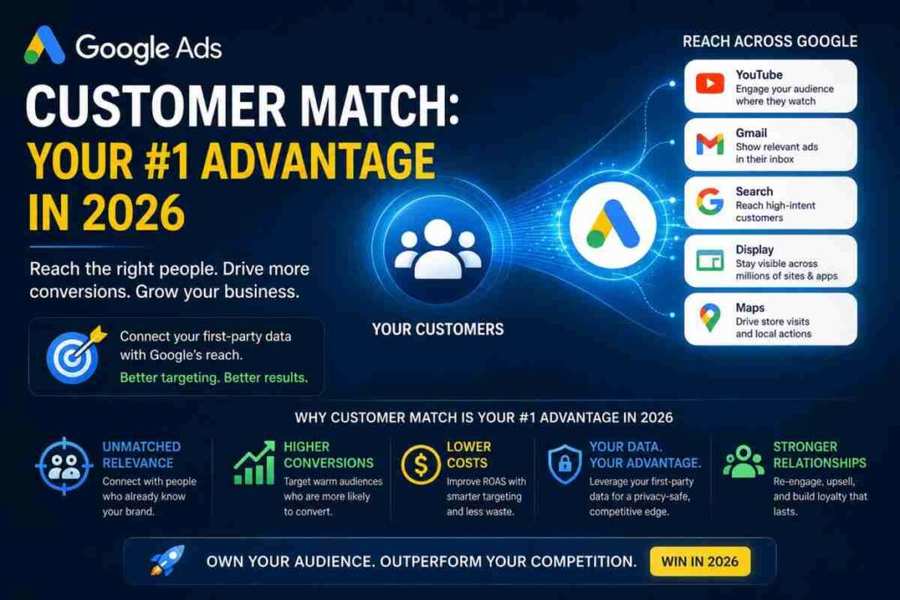
If you want to survive and win in paid search today, you cannot rely on cold, algorithmic guessing. You need a lever that separates your business from every competitor bidding on the same keywords. That lever is Google Ads Customer Match.
By feeding your internal database directly into the machine-learning engine, you transform your advertising from speculative outbound guessing into surgical, high-yield targeting. Let’s explore how to weaponize this asset to secure a permanent competitive edge.
What is Google Ads Customer Match?
At its core, this feature is a system that bridges the gap between your offline business relationships and your online advertising environment. Instead of relying on a user’s transient browsing behavior to guess their identity, you are providing definitive data points to match real individuals within the ecosystem.
Simple Explanation
Think of it as a secure, automated VIP door at a major event. You hand Google a guest list containing pieces of contact information that your customers willingly gave you—such as email addresses, phone numbers, or physical mailing addresses.
[Your Customer Data] ➔ [Cryptographic Hashing (SHA-256)] ➔ [Google Ingestion Engine] ➔ [Targeted Search/PMax Ads]
Google reads that list, matches those details against its billions of signed-in user profiles, and creates a custom audience segment. You can then deliberately target these users, adjust your bids for them, or exclude them entirely across Search, YouTube, Gmail, and the Display Network.
Why It Matters in 2026 and Beyond
We have firmly entered the post-cookie era of digital advertising. Privacy frameworks like GDPR and CCPA, combined with localized data compliance measures, have turned traditional tracking into an unreliable ghost town.
Furthermore, Google’s advertising infrastructure has evolved. Features like Smart Bidding, Performance Max (PMax), and the integrated AI Max system rely less on keyword strings and more on rich consumer “signals.”
Without internal first-party data to seed these automated tools, the platform’s machine learning is flying half-blind. Providing clear audience files gives the algorithm an unfair advantage, showing it exactly what a high-value customer looks like so it can find thousands more just like them.
Key Features & Product Highlights
This tool is not just a passive list upload; it is an active piece of infrastructure that integrates with advanced campaign types.
1. Unified First-Party Data Ingestion via Data Manager API
A massive structural update has centralized how user records are processed. The legacy workflow of pushing audience files through the old Google Ads API has been restricted.
The system now utilizes a unified data ecosystem through the Data Manager API. This framework acts as a single, highly secure pipeline that strips away complex, multi-step developer protocols, allowing systems to ingest first-party records cleanly while enforcing stricter data protection.
2. Confidential Matching Architecture
Data security is the primary barrier preventing enterprise brands and financial institutions from maximizing audience match features. To address this, modern deployments utilize confidential matching protocols.
Before your data ever hits a matching server, it undergoes client-side cryptographic hashing using the SHA-256 algorithm. This process turns sensitive identifiers like customer@email.com into an unreadable, irreversible string of characters. Google handles the matching within an isolated, hardware-encrypted execution environment, meaning your raw database is never exposed or stored in clear text.
3. Native Integration with Algorithmic Bidding
The days of using uploaded lists purely for manual bidding adjustments are gone. Customer lists now directly power Smart Bidding and optimized targeting mechanics.
Even if you don’t explicitly apply a list to a specific ad group, Google’s backend systems analyze the data segments attached to your account. The AI actively learns from the demographic trends, purchasing patterns, and behaviors of your uploaded base, dynamically shifting bids higher when a prospective user matches the profile of your current buyers.
Core Strategic Benefits
                  ┌───────────────────────────────┐
                  │  Google Ads Customer Match    │
                  └───────────────┬───────────────┘
         ┌────────────────────────┼────────────────────────┐
         ▼                        ▼                        ▼
┌─────────────────┐      ┌─────────────────┐      ┌─────────────────┐
│ Financial ROI   │      │ Business Growth │      │ Long-Term Value │
│ • Lower CAC     │      │ • Cross-Selling │      │ • High LTV      │
│ • Higher ROAS   │      │ • Smart Churn   │      │ • Privacy-Safe  │
└─────────────────┘      └─────────────────┘      └─────────────────┘
The businesses that view data lists as a technical setting fail to see the macroeconomic advantage it provides. The real-world benefits span across your balance sheet and your daily business operations.
Financial Benefits
The mathematical reality of modern media buying is that acquisition costs are rising. Bidding on broad, unrefined intent keywords drains capital quickly. Utilizing matched lists introduces two immediate financial efficiencies:
- Drastic Reduction in Customer Acquisition Cost (CAC): By excluding recent buyers from top-of-funnel acquisition campaigns, you stop paying for unnecessary clicks from people who have already converted.
- Amplified Return on Ad Spend (ROAS): Directing ad spend toward historical buyers or high-tier leads yields a fundamentally higher conversion rate than pursuing entirely cold prospects.
Business and Operational Benefits
Beyond pure transactional metrics, first-party matching transforms your marketing agility. It breaks down data silos between your customer relationship management (CRM) software and your media spending.
For instance, if your sales team tags a cohort of leads as “dormant but highly qualified” inside your CRM, that tag can automatically trigger a tailored re-engagement ad on YouTube. It allows you to align your advertising spend with real business priorities rather than vanity digital metrics like click-through rates.
Long-Term Strategic Value
Building an internal repository of clean data forms a protective moat around your brand. Platforms, privacy legislation, and ad formats will inevitably change over time. However, an accurately managed, consent-compliant list of customer data belongs entirely to your business. Feeding this clean data into value-based bidding models instructs the ad networks to hunt specifically for sustained lifetime value (LTV) rather than one-off, cheap conversions.
Market Positioning and Technical Requirements
Deploying this capability requires understanding its barriers to entry. Google limits access to this asset to protect consumer trust and ensure the tool is used responsibly.
| Requirement Metric | Acceptable Threshold | Operational Action Required |
| Account Compliance | Pristine | No historical or active policy violations or ad suspensions. |
| Payment History | Flawless | Clean record of clearing monthly ad invoices without billing failures. |
| List Membership Lifespan | Max 540 Days | Lists must be refreshed dynamically; older user records decay. |
| Minimum List Size | 100 Active Users | The network requires at least 100 matched, active users to serve ads. |
If your account falls short of these baseline performance vectors, match operations will remain unavailable. The absolute floor of 100 active, matched users means your raw list must typically contain at least 300 to 500 records, given that not every email or phone number will successfully map to an active Google account profile.
Investment Realities: Value Cases and Risk Analysis
While the upside of utilizing your own data is massive, implementing it is not a silver bullet without operational effort. A transparent assessment reveals both the high-yield use cases and the practical risks involved.
High-Yield Use Cases
- The Enterprise Subscription Upsell: A B2B enterprise software provider uploads its list of basic-tier users to run targeted Search and YouTube ads highlighting the specific performance benefits of upgrading to the corporate enterprise suite.
- High-Value Lookalike Generation: An e-commerce brand flags the top 10% of its customers based on historical spend, uploads that specific segment, and utilizes optimized targeting to identify new users exhibiting identical online purchasing behaviors.
The Real Risk Factors
- Data Staleness Decay: Audience records break down quickly. People change jobs, update their primary personal emails, and drop phone numbers. If a company relies on static, manual CSV uploads rather than a live API sync, the match accuracy rates plunge within months.
- Compliance Penalties: Mishandling consumer data can lead to serious consequences. If records from users who explicitly opted out of marketing tracking are pushed into a data list, it opens the business up to significant compliance liabilities and risks swift account suspension from Google’s automated policy compliance bots.
Who Should Invest Immediate Effort Here?
If your business operates in an industry with long sales cycles, high repeat-purchase behavior, or high customer lifetime values (such as B2B SaaS, luxury retail, automotive, or real estate), building an automated matching data pipeline is a top priority. If you do not adopt this approach, you will continue to overpay for raw search volume that your competitors are filtering systematically.
Direct Comparison: First-Party Matching vs. Alternatives
To truly understand why this framework reigns supreme, we must compare it directly against legacy tracking and alternative targeting mechanics used across search networks.
Feature Comparison Matrix:
======================================================================
Targeting Method       Privacy Safety     Targeting Accuracy   Setup Effort
----------------------------------------------------------------------
Customer Match         Excellent (High)   Near Perfect         Moderate
Legacy Retargeting     Failing (Low)      Poor / Intermittent  Low
Broad Demographics     High               Vague / Speculative  Zero
======================================================================
Traditional retargeting relies on browser-based code snippets to track users as they move across websites. This approach fails when a user clears their cache, switches from a mobile browser to a desktop application, or uses a browser that blocks third-party cookies by default.
Broad demographic targeting casts a wide net based on loose behavioral assumptions. First-party matching, by contrast, relies on a persistent identity link: a user’s logged-in Google profile. This anchor functions flawlessly across multiple devices, platforms, and locations, ensuring your ad spend connects with an actual human being rather than a digital footprint.
Step-by-Step Practical Implementation Guide
Transitioning to this methodology requires a disciplined, precise technical execution workflow. Follow this sequential blueprint to prepare, clean, and deploy your lists successfully.
Step 1: Data Standardization and Cleaning
Raw CRM extracts are messy. Before performing any upload actions, you must format your customer records to match the specific cryptographic expectations of the system.
- For Email Addresses: Remove all leading and trailing spaces. Convert every character to lowercase. Do not modify the symbols or structural periods in the domain.
- For Phone Numbers: Numbers must be written using the standardized international E.164 format. This means including the leading
+symbol followed immediately by the country code, area code, and phone number with zero spaces or hyphens (e.g.,+15551234567).
Step 2: Ingestion Pipeline Configuration
Because the legacy Google Ads API pipelines reject new automated audience creations unless an active, unbroken historical upload sequence exists, you should configure your connections through the new native interface framework.
- Navigate to your account’s tools panel and locate the unified Audience Manager.
- Select the command to create a new data segment based on customer lists.
- If you are building an automated bridge from tools like HubSpot, Salesforce, or Zapier, configure the connection to route data through the Data Manager API. This ensures an automated, continuous synchronization loop that prevents list degradation.
Step 3: Consent Flag Assignment and Verification
For any audience records tied to users residing within regulated frameworks like the European Economic Area (EEA), you must explicitly define consumer choice parameters within the metadata metadata blocks of your data pipeline.
⚠️ Critical Compliance Failure Point: If your data payload fails to include explicit
ad_user_data=GRANTEDandad_personalization=GRANTEDconsent flags for EEA users, the ingestion engine treats the data as unconsented. The records will be dropped entirely, reducing your match rate to zero for those regions.
Expert-Level Tips for Strategic Dominance
Once your technical pipeline is established, deploy these advanced tactical maneuvers to extract maximum value from your data segments:
- Segment by Historic Profitability, Not Just Revenue: Do not treat all customers equally. Separate your buyers into specific tiers based on net margins. Use your highest-margin tier exclusively to seed lookalike models, steering the bidding automation away from low-margin shoppers.
- The Inverted Exclusion Maneuver: When launching aggressive broad-match keyword testing inside a standard Search campaign, apply your entire master customer database as an exclusion list. This forces the broad-match engine to focus 100% of its budget on finding entirely new prospects rather than pulling in existing users.
- Coordinate Across Content Consumption Formats: Match lists are highly effective for cross-channel narrative building. If a segment of prospects stalls in a mid-funnel sales pipeline stage, trigger a specific, educational video ad layout to serve on their YouTube home feed to build deeper trust.
- Vary Bidding Adjustments by Purchase Frequency: Create an audience list for “One-Time Buyers” and another for “Frequent Repeat Buyers.” Apply separate value-based bidding targets to each. This signals the algorithmic bidding engine to pay premium rates for ad positions when a user matching the frequent-purchaser profile searches for your industry terms.
Common Real-World Mistakes to Avoid
Even seasoned search engine marketers stumble when executing first-party data strategies. Keep an eye out for these critical errors:
- Uploading Static Lists and Forgetting Them: A static list begins decaying the moment it is exported. If you upload a one-off CSV file and leave it untouched for six months, your targeting will target dead email addresses and miss out on your newest buyers.
- Ignoring the 180-Day API Token Rule: If your organization uses custom automated scripts tied to the legacy Google Ads API and those scripts remain inactive without an audience refresh for more than 180 days, your developer token will trigger a
CUSTOMER_NOT_ALLOWLISTEDerror. Transition to the modern unified data manager tools to avoid unexpected pipeline breaks. - Failing to Track List Size Discrepancies: If your exported file contains 10,000 records but your final audience segment shows an active size of only 1,200, your formatting is likely broken. Re-verify your E.164 phone string compliance and lowercase conversions immediately.
Upcoming Data Trends (2026–2030)
Looking down the road, data systems will become increasingly automated and privacy-centric. We can anticipate several clear shifts:
- The Proliferation of Edge Matching Engines: Ad platforms are moving toward processing matches directly within localized web containers and browsers, eliminating the need to transmit large volumes of hashed data files over external networks.
- The Dominance of AI-Generated Predictive Audiences: Instead of simply targeting users based on what they already bought, your customer lists will serve as baseline training sets. The ad network’s AI will use them to predict a user’s future behavior, serving ads days before a prospect explicitly types a search query into a bar.
Conclusion
The evolution of digital media buying has made one thing clear: the brand with the best first-party data wins. Relying on basic keyword matches and generic demographics is a fast track to rising costs and shrinking margins.
By taking control of your data pipelines, structuring clean user segments, and connecting them directly to Google’s bidding engine via modern management tools, you give your accounts a massive structural advantage. Stop treating your database as a passive record-keeping system. Clean your files, set up your sync pipelines, and turn your internal data into a powerful growth engine for your campaigns.
Frequently Asked Questions
How long does it take for an uploaded list to become active?
The system typically takes up to 48 hours to fully process, scrub, hash verify, and map your user data file against existing profiles. To avoid launch delays, ensure your data segments are integrated and syncing at least two full days before your campaigns are set to go live.
Can I share my match lists across multiple sub-accounts?
Yes. If your account structure uses a Manager Account (MCC), you can configure shared data settings. This allows you to upload master data files once at the parent level and seamlessly distribute those segments to multiple child accounts or regional search campaigns.
What causes a low match rate error during upload?
Low match rates are almost always caused by poor formatting, such as mixing uppercase letters in emails or omitting country codes from phone numbers. They can also happen if your customer records are primarily outdated business emails that don’t match the personal profiles users use to log into Google services.
Will using these data lists increase my average cost-per-click?
Not necessarily. While targeting a highly refined, premium audience segment can sometimes carry a higher base cost-per-click due to intense competition for those individuals, your overall conversion rate typically jumps significantly. This brings your total acquisition costs down and improves your bottom line.
Are lookalike segments still available for these lists?
Direct lookalike segments have been replaced by automated optimization frameworks like optimized targeting and Smart Bidding expansion. Instead of manually building a separate lookalike list, you simply apply your primary customer list to a campaign, and the algorithm automatically uses those characteristics to find similar high-converting prospects.