
It is the ultimate inflection point in the history of the internet. For decades, the web was a digital sandbox built by humans, for humans. We wrote articles, built storefronts, and clicked links based on organic curiosity. But a quiet takeover has been brewing behind the scenes, and the scale tipping point has finally arrived.
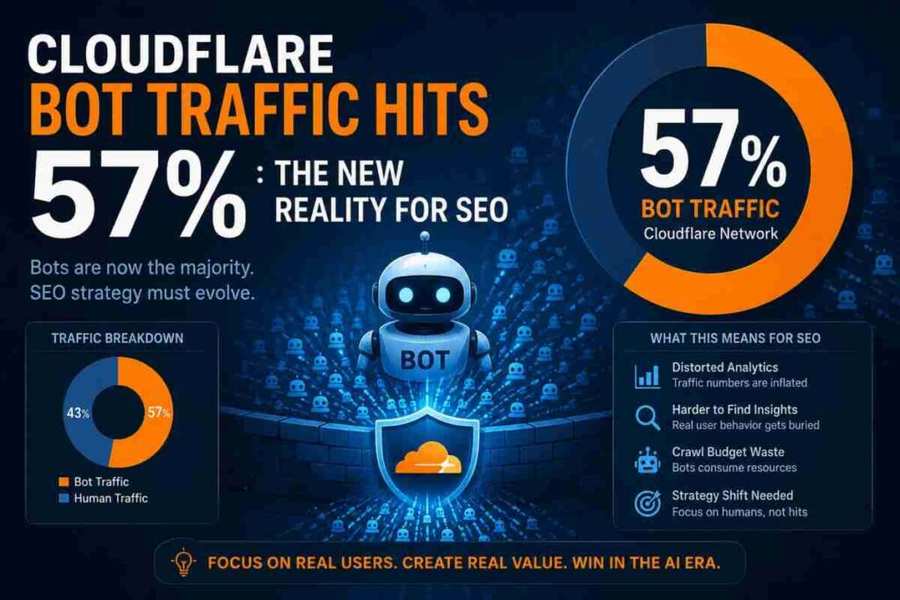
According to groundbreaking global data released by Cloudflare, automated bots now make up 57.4% of all webpage requests online. This means that if you look at the technical architecture of the web today, human visitors are officially in the minority, making up just 42.6% of traffic.
For website owners, digital marketers, and investors, this is an existential alarm bell. The staggering spike in Cloudflare bot traffic isn’t just a minor fluctuation in server logs; it represents a monumental structural shift in how data is consumed. If you’ve noticed your organic click-through rates dipping or your server costs climbing without a corresponding rise in revenue, you are feeling the ripples of this exact phenomenon. This guide unpacks what this means for the future of digital assets and how to survive the automated web.
What is Cloudflare Bot Traffic?
Simple Explanation
To understand what is happening, we have to look at how websites process information. Every time a person clicks on a website link, their browser sends an HTTP request to a server saying, “Show me this page.” Cloudflare bot traffic refers to any automated program or script that sends these exact same requests to web servers protected by Cloudflare’s massive global network. Bots don’t have eyes, and they don’t buy products. They are lines of code designed to scan, index, scrape, or extract data from a webpage at lightning speeds. While some bots are helpful, they all consume server bandwidth.
Why It Matters in 2026+
The crossing of the 50% threshold happened much faster than tech analysts anticipated. Cloudflare CEO Matthew Prince remarked on X that he didn’t expect automated traffic to overtake human presence until late 2027. Yet here we are in 2026, and the “agentic web” is moving at warp speed.
The core driver isn’t traditional search engine scrapers, but the explosion of AI agents and autonomous models. When a human searches for a digital camera, they might visit 4 or 5 sites. An AI shopping agent, however, will systematically query 1,000 websites in a fraction of a second to summarize options for a user. This behavioral shift creates an unprecedented, relentless load on global web infrastructure.
Key Features and Breakdown of the 57% Bot Wave
The architecture of this modern bot wave is entirely distinct from the automated scripts of the early 2000s. To comprehend the data, we must break down what these bots are actually doing when they land on a site.
1. The Domination of AI Training Bots
Within that 57.4% majority of automated traffic, a stunning 50.6% of the total share is made up of training-related bots scraping data to build LLMs (Large Language Models). These are programs like OpenAI’s GPTBot, ClaudeBot, and various open-source data scrapers. They read text, catalog images, and harvest proprietary insights without leaving a traditional footprint of human engagement.
2. The Decline of Traditional Search Crawlers
Remarkably, traditional search-related crawlers (like standard indexers for smaller search engines) make up a mere 10.7% of the automated traffic pie. The imbalance is stark: the web is being crawled exponentially more to train centralized AI engines than to index content for public discoverability.
3. The Caching Sabotage
Recent studies by infrastructure researchers show that AI agent traffic behaves fundamentally differently from human traffic. AI bots aggressively bypass the local caching layers that content delivery networks (CDNs) rely on to keep hosting bills low. They frequently request un-cached, raw HTML data across thousands of variations, putting a direct structural strain on origin servers.
Implications and Cost-Benefits of the Bot Shift
| Metric Area | Impact of AI Bot Traffic | Consequence for Website Owners |
| Server Load | Retail sites experience up to 198x more crawls per visit than standard Googlebots. | Exponentially higher cloud hosting and CDN maintenance bills. |
| Traffic Quality | High volume of HTTP requests that result in zero human ad views or clicks. | Skewed analytics data and inflated vanity metrics. |
| Monetization | Content is extracted and displayed directly inside AI interfaces. | Sharp drops in native ad impressions and affiliate revenue. |
Financial Impact
The financial equation of running a digital business has fundamentally mutated. Historically, more traffic was an inherently good thing. More hits meant more ad views, potential leads, and brand awareness. Today, high Cloudflare bot traffic means you are paying to host data that an AI firm is harvesting for free, while your actual human traffic—and the ad revenue that supports it—stagnates or shrinks.
Business and Operational Challenges
From a management perspective, tracking KPIs has become a logistical nightmare. When web analytics tools log thousands of visits from autonomous agents executing automated user-actions, conversion rates look artificially depressed. Distinguishing a highly motivated human buyer from an aggressive corporate web scraper requires deep technical intervention.
Long-Term Asset Value
The underlying value of digital real estate is shifting away from simple traffic volume and toward data exclusivity. If your content is out in the open, it will be consumed by bots and delivered to users outside your ecosystem. The long-term survivors will be platforms with deeply defensive content strategies.
Market and Technical Infrastructure Analysis
Connectivity and Network Visibility
Cloudflare sits in an unparalleled position of network visibility, routing a massive percentage of all global web traffic. Because it acts as an upstream proxy for millions of websites, this data isn’t a localized sample—it’s a comprehensive diagnostic look at the health of the open web.
Infrastructure Growth vs. Bot Scaling
According to security reports, agentic AI traffic grew by an astronomical 7,851% year-over-year coming into this period. Traditional server capacity planning models are failing because human traffic expands linearly based on population and screen time, whereas bot traffic expands exponentially based on compute availability and programmatic loops.
Future Potential: “Pay-to-Crawl” Ecosystems
Because the economics of the free web are breaking under this load, the technical infrastructure is pivoting toward gatekeeping. Cloudflare’s development of a “Pay-per-Crawl” dashboard allows site operators to explicitly assign a financial cost to automated crawlers. If an AI agent wants to scrape a site’s data to train a model or answer a query, it must programmatically pay a fee at the network layer.
Investment Potential and Core Use Cases
For digital publishers, media conglomerates, and web developers, managing this asymmetric traffic distribution offers both massive risks and strategic opportunities.
ROI Opportunities in the Bot Era
The primary opportunity lies in B2B data licensing. If you own high-authority, proprietary data networks, your asset is more valuable than ever to AI firms desperate for clean, non-derivative training data. By leveraging advanced Cloudflare firewall features, you can lock down your content and force tech firms into licensing agreements.
Honest Risk Factors
Let’s be straightforward: if your business model relies solely on low-effort informational content funded by generic display ads, you are in extreme danger. AI agents will read your page once, store the information, and serve it directly to users via conversational UIs, entirely bypassing your ad slots. Furthermore, fighting off aggressive bots requires specialized security stacks that increase overall operational overhead.
Who Should Pivot?
- E-commerce Brands: Must optimize product feeds for automated shopping agents rather than just human eyeballs.
- Content Publishers: Must pivot heavily toward building direct communities, email list infrastructure, and subscriber-only paywalls.
- SaaS Platforms: Need to implement strict API access endpoints to offload automated scraper bots from their core web applications.
Comparison: Human-Centric SEO vs. Agentic Web Optimization
Traditional SEO Focus
For two decades, search engine optimization followed a highly predictable script. You researched keywords, optimized H2 tags, monitored page-load speeds, and built high-quality backlinks to signal authority to Google’s index. The primary goal was to entice a human to click a blue link.
Agentic Web Optimization (GEO)
Generative Engine Optimization (GEO) accepts that a machine agent is the entity doing the reading. Instead of focusing merely on human click patterns, the priority shifts to entity clarity, structured schema markups, and formatting data so that an LLM can easily extract it and attribute it as a source citation.
Why Differentiating Matters
If you treat bot traffic purely as an attack to be mitigated, you run the risk of blocking “good” bots that can provide visibility. For example, blocking Googlebot entirely to save on server bills will instantly wipe your brand from traditional search engine results, a compromise most businesses cannot afford to make.
Step-by-Step Guide to Managing Mass Bot Traffic
If you want to maintain control of your digital asset while protecting server resources, you must take a systematic approach to network configuration.
Step 1: Audit Your Automated Footprint
Log into your Cloudflare dashboard and navigate to the Analytics & Logs tab, then select Bots. Review your current traffic breakdown. Look closely at your Crawl-to-Referral ratio. If an automated user-agent is crawling your pages thousands of times a day but sending zero referral traffic back to your site, it is a low-value or nuisance bot.
Step 2: Implement Verified Bot Management Rules
Do not use a blunt instrument to block everything. Enable Cloudflare’s Verified Bot allowances. This ensures that essential maintenance utilities, legitimate search crawlers (like Googlebot and Bingbot), and crucial site tools can bypass security challenges smoothly while malicious or unverified scraps face immediate inspection.
Step 3: Set Up Interactive Challenges for AI Scrapers
Create custom firewall rules leveraging Cloudflare’s WAF (Web Application Firewall). For unverified bots or scrapers with low reputation scores, deploy an interactive challenge (like a managed CAPTCHA or JS challenge). This gracefully stops high-speed programmatic scraping loops without completely alienating real human visitors who might have unique browser configurations.
Expert Tips for Surviving the Modern Web
- Prioritize First-Party Data Capture: Popups for email newsletters, community forums, and direct SMS channels are your lifeline. When third-party search distribution is crowded out by bots, an owned audience is an un-killable asset.
- Audit Your Robots.txt Quarterly: Do not treat your crawler directives as a “set-and-forget” document. New AI models launch monthly; ensure your disallow parameters stay up to date with the latest user-agent nomenclature (e.g., GPTBot, PerplexityBot, Anthropic-AI).
- Leverage Advanced Schema Markup: Give AI agents exactly what they want in a highly structured format. Use meticulous JSON-LD schema for products, articles, and organizational data so bots can pull your specs without executing heavy page renders.
- Shift to Client-Side Analytics Monitoring: Standard server logs are easily fooled or overwhelmed by sophisticated scrapers mimicking browsers. Focus your core business KPIs on client-side engagement triggers, authenticated user sessions, and scroll-depth trackers.
- Monitor Your Uncached HTML Overhead: Work closely with your engineering team to monitor how deep bots are reaching into your dynamic database layers. Implement aggressive rate-limiting on search bars and dynamic filtering pages.
Common Mistakes to Avoid in Bot Mitigation
Blindly Blocking Googlebot
Because Google uses its core crawler infrastructure for both traditional search indexing and Gemini training cycles, blocking Google’s bot infrastructure out of frustration will decimate your traditional search presence. You must use granular controls within Google Search Console rather than a global infrastructure firewall block.
Relying Entirely on Robots.txt
The reality of 2026 is that many rogue AI scraping tools and decentralized nodes explicitly ignore robots.txt directives. Treating this file as an impenetrable security barrier is a dangerous misconception; it must be paired with network-layer behavior monitoring.
Ignoring Performance Metrics During Traffic Spikes
When a massive bot wave hits your site, it can look like an organic viral traffic spike in basic dashboards. If you scale up cloud resources automatically to handle the load without analyzing the source, you are effectively subsidizing a tech company’s data scraping costs with your own capital.
Future Trends: What the Web Looks Like (2026–2030)
The Rise of Tokenized Gated Content
As the ratio of bots to humans continues to widen, the concept of a completely open, freely viewable web will contract. We will see a massive acceleration toward token-gated micro-paywalls, authenticated ecosystems, and networks that require user login before any valuable information is rendered to the screen.
The Standardized Pay-to-Crawl Protocol
The current ad-supported web model is fundamentally incompatible with a 60%+ bot ecosystem. Over the next few years, programmatic micro-transactions will likely become standardized. Search engines and AI companies will automatically pass a fraction of a cent via API headers to web servers for every page query executed, formalizing data acquisition.
The Shrinking Search Footprint
Traditional search queries that yield pages of outbound links will continue to condense into zero-click interfaces. As a result, SEO strategies will focus less on optimizing for thousands of long-tail keywords and more on securing definitive brand authority status within foundational AI knowledge bases.
Conclusion
The revelation that bots now control 57% of web requests is not an anomaly—it is our new reality. The internet has officially transformed from a destination for human discovery into a massive engine room powered by automated data exchange. Trying to run a digital business using an outdated playbook is a recipe for escalating infrastructure bills and vanishing margins.
To succeed in this automated landscape, you must actively protect your server infrastructure, aggressively lock down your proprietary data assets, and shift your marketing strategy toward high-value human experiences. The open web isn’t dying; it is simply reorganizing. Stop optimizing purely for clicks that will never come, and start building an authoritative, resilient digital presence that both humans and bots respect.
Frequently Asked Questions
How does high Cloudflare bot traffic affect my website’s server performance?
When automated bots make up the majority of your traffic, they send a massive volume of rapid HTTP requests to your site. Because many AI agents bypass standard caching, they force your origin server to process data repeatedly. This causes high CPU usage, slows down page loading speeds for genuine human visitors, and spikes your hosting bills.
Can I block AI bots without hurting my Google search rankings?
Yes, but it requires precision. Many independent AI crawlers (like GPTBot or ClaudeBot) can be blocked using Cloudflare WAF rules or your robots.txt file without impacting your traditional organic search footprint. However, you must avoid blanket blocks on dual-use crawlers like Googlebot, managing their access through specific search console controls instead.
What is the difference between a verified bot and an unverified bot on Cloudflare?
Verified bots are automated systems explicitly whitelisted by Cloudflare because they provide clear global utility, such as Google search indexers or site health monitoring services. Unverified bots include automated scrapers, self-hosted data mining scripts, and aggressive AI agents that do not follow standardized network identification protocols.
Why are AI agents crawling my website so much more than traditional search engines?
Traditional search engines scan your site periodically to index pages for search queries. AI agents, however, crawl the web to either ingest massive datasets for model training or to research real-time answers for active users. A single agentic user request can trigger automated loops that browse thousands of target sites simultaneously.
What is “Pay-per-Crawl” and should my business implement it?
Pay-per-Crawl is an innovative infrastructure model that allows website operators to set a programmatic price for automated agents accessing their content. If your business creates premium, data-dense publications or highly specialized research, implementing these access parameters forces AI companies to financially compensate you for using your data.