
When the first shovels hit the dirt in Jewar, most people saw a simple narrative: Delhi-NCR was getting a shiny new secondary airport to relieve pressure from Indira Gandhi International (IGI). But if you thought Jewar was just about passenger terminals and commercial flights, you missed the larger strategic chessboard.
Under the statutory framework of the YEIDA Master Plan 2041, the Yamuna Expressway Industrial Development Authority has earmarked approximately 2,000 hectares adjoining Noida International Airport specifically for a dedicated Civil Aviation Ecosystem.We are talking about massive Maintenance, Repair, and Overhaul (MRO) facilities, high-precision aircraft component manufacturing, and specialized aerospace engineering zones.
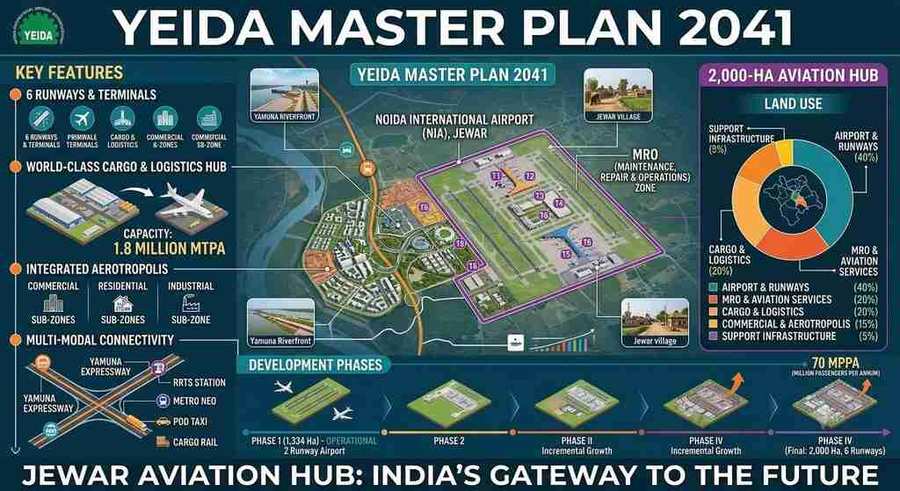
This shifts the entire economic gravity of North India. Jewar is evolving from a transit point into a self-sustaining aerotropolis and industrial powerhouse. Whether you are an institutional investor, a commercial real estate buyer, or a business owner looking for a footprint in India’s next industrial corridor, understanding this 2,000-hectare blueprint isn’t just useful—it is mandatory for capturing long-term value.
What is YEIDA Master Plan 2041 Aviation Hub?
Simple Explanation
At its core, the YEIDA Master Plan 2041 is the official development blueprint approved by the Uttar Pradesh government to guide urbanization, industrial growth, and infrastructure along the 165 km Yamuna Expressway corridor.
Within this master layout, the Aviation Hub refers to a massive 2,000-hectare land parcel reserved right next to the airport.Instead of using this space for standard housing or basic shopping malls, the authority has zoned it specifically for the aviation industry. It provides a dedicated physical site where global aerospace giants can build hangars to service aircraft engines, manufacture precision flight components, train pilots, and manage air cargo logistics.
Why It Matters in 2026+
Historically, Indian airlines sent their commercial aircraft to Singapore, Dubai, or Sri Lanka for heavy maintenance checks (C and D checks), draining billions of dollars in foreign exchange every year.
With Indian carriers expanding their fleet orders to record numbers, bringing MRO and manufacturing operations onshore has become a national priority. The YEIDA aviation hub provides the physical scale, tax structures, and runway proximity required to solve this bottleneck. It transforms Jewar into a complete aviation ecosystem rather than a standard passenger transit node.
Key Features / Highlights
Feature 1: Comprehensive MRO Facilities
The hub reserves extensive land for heavy-maintenance hangars. Aircraft can taxi directly off the runway network into specialized MRO bays for structural repairs, avionics overhauls, engine retrofitting, and line maintenance without ever entering civilian airspace or road traffic.
Feature 2: Aircraft Component Manufacturing Cluster
Instead of relying entirely on imported spare parts, the master plan allocates space for ancillary manufacturers. Companies producing landing gear, interior cabin fit-outs, composite fuselage parts, and specialized wiring harnesses can set up manufacturing units right next to the servicing bays.
Feature 3: Integrated Logistics & Aerotropolis Infrastructure
Directly tied to the airport’s cargo terminals, this zone incorporates automated storage and retrieval systems (ASRS), cold-chain facilities for perishable freight, and bonded warehouses. It bridges the gap between air cargo transit and immediate industrial processing.
Benefits of YEIDA Master Plan 2041 Aviation Hub
Financial Benefits
- Foreign Direct Investment (FDI): The dedicated aviation zone acts as a magnet for international aerospace conglomerates, bringing foreign capital into Yamuna Expressway sectors.
- Massive Foreign Exchange Savings: Servicing Indian-owned aircraft locally saves domestic airlines millions in overseas servicing fees, boosting corporate profitability across the aviation sector.
- Land Value Appreciation: Property values across commercial, industrial, and residential sectors within a 15 km radius of the airport are positioned for sustained capital growth as infrastructure turns into operational yield.
Lifestyle / Business Benefits
- High-Skilled Job Creation: The hub requires aeronautical engineers, certified mechanics, avionics experts, logistics specialists, and corporate management—generating tens of thousands of white-collar and skilled technical jobs.
- Improved Urban Infrastructure: To support high-tech industries, the authority is building wide sector roads, underground utility ducting, uninterrupted power grids, and dedicated water treatment networks.
Long-Term Value
Creating an aerospace ecosystem creates a self-reinforcing economic loop. Once component makers and MRO operators establish bases, research institutions, testing centers, and flight training academies naturally follow. This creates a high-barrier-to-entry industrial moat that protects the region’s economic viability for decades.
Location / Market Analysis
       [ Delhi / IGI Airport ]
                  |
    (Noida-Greater Noida Expressway)
                  |
         [ Greater Noida ]
                  |
       (Yamuna Expressway - 165 km)
                  |
  +---------------+---------------+
  |                               |
[Noida International Airport]  [2,000-Ha Aviation Hub]
  (Phase 1 Active)               (MRO & Component Mfg)
  +---------------+---------------+
                  |
   (Eastern Peripheral / Pod Taxi / RRTS)
Connectivity
- Direct Expressway Access:Situated along the Yamuna Expressway, providing smooth road transport toward Delhi, Greater Noida, and Agra.
- Perimeter Expressways: Integrated with the Eastern Peripheral Expressway (EPE) to bypass Delhi traffic entirely when transporting heavy machinery or freight to neighboring states.
- Next-Gen Transit Links:Planned integration with the Regional Rapid Transit System (RRTS), dedicated Pod Taxi networks connecting Film City to the airport, and direct rail freight corridors.
Infrastructure Growth
The master plan mandates wide internal sector roads (up to 100 meters wide) to accommodate heavy logistics transport. The region is also being developed with smart-city monitoring, integrated drainage systems, and green buffers alongside the Yamuna River to balance rapid urbanization.
Future Potential
As Jewar Airport expands from its initial operational layout toward its multi-runway master design, the surrounding land will shift from purely speculative real estate to high-yielding commercial assets. Early institutional movers in sectors 28, 29, 32, and 33 stand to benefit from proximity to this hub.
Investment Potential / Use Case
ROI Opportunities
Commercial plots, industrial land allotments, and office spaces planned near the aviation zone offer strong yield profiles. Rental demand will be driven not just by speculative traders, but by long-term corporate tenants, aviation service providers, supply chain managers, and flight training organizations.
Risk Factors (Be Honest)
- Execution Timelines:Large-scale infrastructure and industrial land acquisitions often encounter bureaucratic delays or phased deployment timelines.
- Capital Lock-In: Infrastructure-led real estate is a long-horizon asset class. Investors looking for quick 6-month flips may find liquidity lower compared to established metro hubs.
- Regulatory Dependency: Policy shifts surrounding civil aviation taxes, import duties on spare parts, and local zoning permissions directly impact the pace of industrial adoption.
Who Should Invest
- Institutional & Commercial Investors: Looking for long-term lease yields backed by corporate tenants.
- Industrial & Logistics Operators: Businesses needing air-cargo-adjacent warehousing or light assembly spaces.
- End-User Homebuyers:End-users looking to settle in planned, low-density residential sectors around the Yamuna City ecosystem.
Comparison Section
YEIDA Aviation Hub vs Conventional Industrial Zones
| Feature | YEIDA Aviation Hub (Jewar) | Standard Industrial Parks |
| Primary Focus | Aerospace, MRO, High-Value Precision Engineering | General Manufacturing, Textile, FMCG Packaging |
| Logistics Integration | Direct runway/apron taxiway access + air freight terminals | Reliance on standard highway trucking networks |
| Land Allocation | ~2,000 Hectares master-planned reserved area | Fragmented plots across smaller industrial pockets |
| Global Access | Immediate international flight and cargo connectivity | Secondary links to regional ports or distant airports |
| Tenant Profile | Global OEMs, Airlines, Defense & Civil Maintenance firms | Regional suppliers, small-to-midsize workshops |
Why It Stands Out
Unlike standard industrial estates that suffer from retroactive planning, the YEIDA aviation ecosystem was designed from scratch before industrial development began. The alignment of physical space, runway access, dedicated power utilities, and multimodal freight links gives it a distinct advantage over older industrial areas in the National Capital Region.
Step-by-Step Guide to Participating in the YEIDA Growth Corridor
- Verify Land Zoning and Regulatory Approvals
Before allocating capital, cross-reference plot numbers and sector boundaries directly against the official YEIDA Master Plan 2041 maps. Ensure the parcel falls strictly under approved industrial, commercial, or residential zoning. - Evaluate Accessibility & Connectivity Nodes
Prioritize investments in sectors directly connected to major arterial roads (such as the 100-meter sector roads or direct interchanges off the Yamuna Expressway). Proximity to planned Pod Taxi routes or RRTS stations adds long-term rental leverage. - Align Capital with a 5-to-10-Year Horizon
Recognize that while initial phases of the airport are operational, the full 2,000-hectare civil aviation ecosystem will mature in phases alongside airport expansion. Structure your capital for compounding long-term growth rather than short-term speculative exits.
Expert Tips (Human Touch Section)
- Focus on the Ancillary Ecosystem: Don’t just look at airport-adjacent land. Sectors earmarked for mixed-use development, commercial offices, and worker housing will see steady rental demand as engineer and technician populations grow.
- Check the Allotment Scheme Authenticity: Only purchase through official YEIDA property auctions or verified direct-allotment processes to avoid unapproved rural land schemes or unauthorized encroachments.
- Track Infrastructure Milestones over Rumors:Ignore market noise and track concrete progress: physical hangar construction, runway additions, power substation completions, and highway interchange openings.
- Monitor MRO Anchor Tenants: Pay close attention to when major airlines or global aerospace manufacturers sign formal lease agreements for MRO hangars. Anchor tenant commitments usually trigger secondary waves of commercial investment.
- Understand the Aerotropolis Radius: Commercial activity decays with distance. Properties within a 5 to 12 km radius of the airport terminals experience the strongest positive spillovers from aviation logistics.
Common Mistakes to Avoid
- Buying Unnotified Agricultural Land: Purchasing unregulated village land without checking YEIDA notification status often leads to legal disputes or acquisition lock-ups.
- Expecting Instant Liquidity: Industrial real estate tied to mega-projects takes time to reach full operational capacity. Expecting quick resale liquidity during initial development phases is unrealistic.
- Ignoring the Master Plan Sector Overlays: Assuming all land along the expressway shares the same commercial value is a mistake. Land zoned for green belts or public utilities cannot be converted to commercial use. Always inspect official layout maps.
Future Trends (2026–2030)
- Onshoring of Defense & Civil MRO: As India’s fleet size grows, regulatory frameworks will mandate more domestic maintenance checks, driving rapid occupancy of the 2,000-hectare hub.
- Integration of Electric & Cargo Drones: Future phases of the aviation hub will likely incorporate specialized landing pads and maintenance hubs for cargo drones and urban air mobility platforms.
- Aerospace R&D Clusters: Beyond basic servicing, expecting universities and research institutions to partner with aerospace companies to establish training facilities and testing labs right inside Yamuna City.
Conclusion
The 2,000-hectare allocation near Noida International Airport is clear evidence that Jewar is being developed for long-term economic depth, not just passenger transit. By combining heavy maintenance facilities, component manufacturing, and modern air cargo logistics under the YEIDA Master Plan 2041, Uttar Pradesh is laying the foundation for a premier aerospace hub.
For investors, businesses, and developers, the Yamuna Expressway corridor represents a major structural transformation in North India’s real estate and industrial landscape. Aligning your strategy with this master plan today offers a front-row seat to the region’s long-term economic growth.
For investors seeking a balance of consistent rental income and strong future capital appreciation, the Cyber Arch IT Park Studio Apartment Greater Noida offers an undeniable opportunity. Its location is a magnet for the corporate and student population, locking in long-term demand. Now is the opportune moment to conduct final due diligence and secure your stake in the future of Greater Noida West. Invest in a Cyber Arch IT Park Studio Apartment Greater Noida today and position your portfolio for exponential growth.
Frequently Asked Questions
What is the primary purpose of the 2,000-hectare aviation hub in YEIDA Master Plan 2041?
The 2,000-hectare area is designated for a complete civil aviation ecosystem adjacent to Noida International Airport.It focuses on Maintenance, Repair, and Overhaul (MRO) facilities for aircraft, precision aviation component manufacturing, and specialized aerospace logistics hubs.
How does the Jewar Airport MRO hub benefit real estate along the Yamuna Expressway?
The MRO and manufacturing hub brings thousands of high-skilled engineers, technicians, and corporate executives to the region. This influx drives sustainable demand for residential housing, commercial office space, retail centers, and industrial warehousing across nearby YEIDA sectors.
Is the YEIDA 2041 Master Plan officially approved?
Yes, the YEIDA Master Plan 2041 is an approved statutory planning document issued by the Yamuna Expressway Industrial Development Authority and the Uttar Pradesh government to regulate land use and infrastructure development in the region.
Can private companies buy land in the civil aviation zone?
Land allocation within the designated aviation and industrial sectors is managed by YEIDA through structured property schemes, competitive tenders, and institutional allotments aligned with master plan zoning rules.
How does the aviation hub connect to other parts of Delhi-NCR?
The hub benefits from multimodal transport links, including direct access via the Yamuna Expressway, connections to the Eastern Peripheral Expressway, planned RRTS rail extensions, and proposed pod taxi routes.