
The Indian commercial real estate landscape is undergoing its most profound structural shift in decades. What began as a cost-arbitrage strategy for global back-office functions has erupted into a full-scale Global Capability Centre (GCC) boom. Multinationals, Fortune 500 giants, and tech unicorns are no longer just outsourcing routine tasks to India; they are building core innovation hubs, engineering centers, and strategic leadership campuses across the nation.
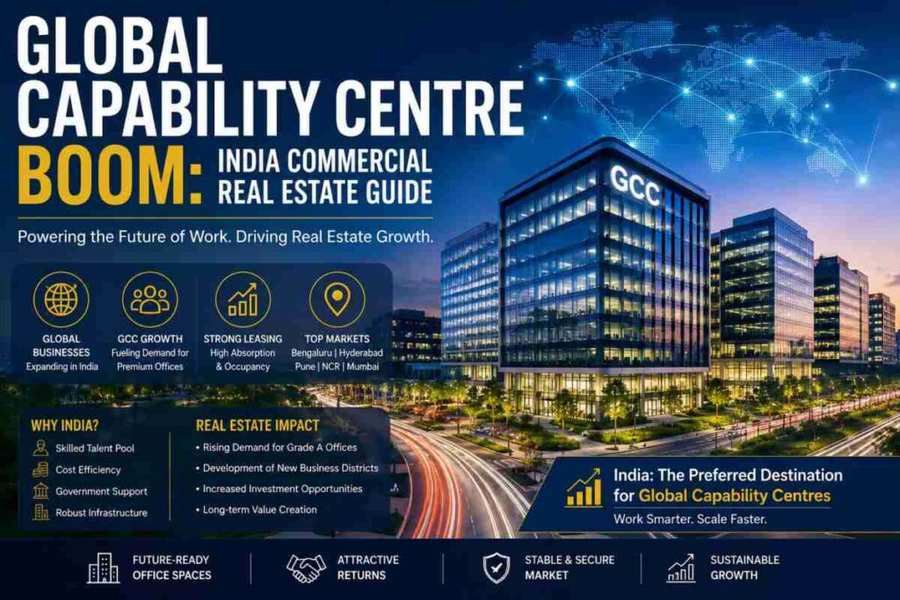
In 2025 alone, gross office leasing across India’s top seven cities reached a staggering, record-breaking peak of over 83 million square feet. GCCs accounted for nearly 38% to 40% of that total space absorption, commanding over 31 million square feet of prime Grade A office stock. This unprecedented surge is redefining demand parameters, driving property capital values, and squeezing office vacancies in primary corporate corridors.
Whether you are an institutional developer, a high-net-worth individual evaluating retail strata sales, or a corporate real estate director planning portfolio expansion, understanding the mechanics of this GCC wave is essential. This comprehensive analysis decodes the catalysts behind the boom, the key geographic beneficiaries, long-term rental trajectories, and actionable investment frameworks for the commercial real estate market through 2030.
What is the GCC Boom in India?
Simple Explanation
A Global Capability Centre (GCC) is an offshore, in-house business unit established by a global corporation to handle critical enterprise functions. Unlike third-party IT outsourcing firms, GCCs are fully owned and operated by parent entities like JPMorgan Chase, Google, Target, or Siemens.
While early-generation GCCs focused primarily on transactional processing and basic software maintenance, today’s GCCs serve as primary enterprise hubs for artificial intelligence, cloud architecture, cyber security, algorithmic trading, and product design. The “GCC boom” refers to the massive wave of international companies entering India to set up these captive hubs, resulting in aggressive leasing of enterprise-scale office space.
+-----------------------------------------------------------------------+
|                       THE GCC EVOLUTION IN INDIA                      |
+-----------------------------------------------------------------------+
|  GCC 1.0 (2000s): Cost Arbitrage & Transactional Processing           |
|  GCC 2.0 (2010s): IT Support, Shared Services & Software Delivery     |
|  GCC 3.0 (2020s+): Core Product R&D, AI Innovation & Global Leadership |
+-----------------------------------------------------------------------+
Why It Matters in 2026+
The nature of global work has fundamentally shifted. Global enterprises face escalating cost pressures, talent shortages in Western economies, and an urgent mandate to digitize using AI and machine learning. India provides an unmatched combination of deep engineering talent, mature infrastructure, and favorable operating dynamics.
For commercial real estate, this transformation means GCCs are no longer leasing single floors on short-term arrangements. They are taking down entire multi-building campuses spanning 500,000 to over 1,000,000 square feet on 9-to-15-year lease horizons. This sticky, institutional-grade demand is insulating Indian commercial property from global economic headwinds and remote-work structural declines seen in Western office markets.
Key Features & Drivers of the GCC CRE Boom
Feature 1: Scale and Campus-Style Enterprise Spaces
GCCs demand institutional Grade A office assets equipped with world-class infrastructure. Rather than dispersed footprint leasing, global firms favor self-contained corporate campuses featuring extensive amenities, integrated wellness facilities, research laboratories, and collaborative zones.
Feature 2: High ESG Standards and Smart Tech Integration
Modern GCCs operate under strict corporate sustainability mandates. Over 75% of new GCC office space absorption occurs in LEED- or IGBC-certified green buildings equipped with IoT-driven energy optimization, indoor air purification systems, and smart facility management platforms. Landlords offering green-certified stock command a 12% to 18% rental premium over non-certified buildings.
Feature 3: Rise of Managed Workspaces and Flex Integration
To minimize initial capital expenditure and accelerate time-to-market, over 30% of entering GCCs deploy a hybrid lease model. They combine long-term core shell-and-core leases with enterprise managed workspaces provided by flexible office operators. This allows rapid scaling from 200 initial seats to 5,000 employees without construction delays.
Benefits of the GCC Boom for Real Estate Markets
Financial Benefits
- Accelerated Rental Growth: High demand for Grade A infrastructure has compressed vacancy rates below 15% in prime micro-markets, driving sustained annual rental growth of 6% to 9%.
- Yield Compression & Valuation Spikes: Institutional investors and REITs benefit from tenant credit stability. Blue-chip corporate occupiers reduce default risk, enabling landlords to secure lower capitalization rates and higher property valuations.
- Capital Appreciation for Strata Units: High-net-worth investors purchasing individual commercial floors or fractional ownership units enjoy stable, inflation-indexed yield income paired with long-term capital appreciation.
Lifestyle & Urban Infrastructure Benefits
- Integrated 18-Hour Urban Precincts: The concentration of high-earning GCC talent accelerates the development of mixed-use precincts combining Grade A offices, luxury retail malls, upscale apartments, and transit hubs.
- Quality Civic Infrastructure: Municipal authorities prioritize roads, metro transit extensions, and utility upgrades in major GCC corridors to support international corporate investments.
Long-Term Market Value
Unlike cyclical IT services demand, captive GCCs are deeply embedded into the core operations of multinational parent companies. Once established, these hubs rarely relocate, providing Indian commercial property markets with decades of durable cash flow resilience.
Location & Market Analysis: Top Cities Benefiting
The GCC footprint is concentrated across key technology and financial corridors in India, while rapidly expanding into emerging secondary hubs.
| City / Hub | Share of GCC Absorption | Primary Sectors | Key Micro-Markets |
| Bengaluru | ~42–44% | Technology, Aerospace, FinTech, Auto R&D | Outer Ring Road, Whitefield, North Bengaluru |
| Hyderabad | ~22–25% | Pharma, Life Sciences, Cloud, Enterprise Software | HITEC City, Gachibowli, Financial District |
| Delhi-NCR | ~13–15% | Telecom, BFSI, Consulting, Auto Engineering | DLF CyberCity (Gurugram), NOIDA Expressway |
| Mumbai Metro | ~8–10% | Investment Banking, Asset Management, FinTech | BKC, Lower Parel, Thane-Belapur Corridor |
| Pune & Chennai | ~10–12% | Automotive, Engineering, SaaS, HealthTech | Hinjewadi, Kharadi (Pune); OMR, Guindy (Chennai) |
+--------------------------------------------------------------------+
|                    GCC LEASING SHARE BY CITY                       |
+--------------------------------------------------------------------+
| [========================] Bengaluru (~44%)                        |
| [============] Hyderabad (~25%)                                    |
| [======] Delhi-NCR (~13%)                                          |
| [====] Pune & Chennai (~10%)                                       |
| [==] Mumbai Metro (~8%)                                            |
+--------------------------------------------------------------------+
Connectivity & Infrastructure Growth
Mega infrastructure developments—including the expansion of metro rail lines in Bengaluru and Hyderabad, the opening of the Noida International Airport (Jewar), and Western Dedicated Freight Corridors—are unlocking new commercial nodes. Developers are racing to deliver mega-scale tech parks along these high-speed transit belts.
Future Potential: Tier-2 Hub Expansion
With rising real estate costs and talent saturation in tier-1 hubs, GCCs are expanding into tier-2 cities such as Ahmedabad, Jaipur, Kochi, Chandigarh, and Coimbatore. These cities offer 25–35% lower real estate overheads and strong regional university talent pipelines.
Investment Potential & Investor Use Cases
ROI Opportunities
- Institutional REIT Investments: Real Estate Investment Trusts (REITs) like Embassy Office Parks, Mindspace Business Parks, Nexus Select, and Brookfield India offer liquid exposure to GCC-leased office portfolios with distribution yields between 6.5% and 8.0%.
- Strata-Title Commercial Ownership: Commercial floor purchases in Grade A parks yield stable rental yields of 8% to 10%, compared to 2.5% to 3.5% in residential property.
- Fractional Real Estate Platforms: Tech-enabled platforms allow retail investors to participate in GCC-leased commercial assets with ticket sizes starting from ₹10 Lakhs ($12,000 USD).
Risk Factors (Honest Assessment)
- Geopolitical & Global Regulatory Risks: Changes in cross-border trade policies, offshore taxation, or strict Western data protection rules could slow new GCC entry rates.
- Execution & Construction Delays: Land assembly disputes and municipal approval lags can extend project completion timelines, delaying tenant fit-outs.
- Concentration Risk: Over-exposure to a single tenant or sector (e.g., US tech) leaves specific micro-markets vulnerable to sector-wide corporate restructurings.
Who Should Invest?
- Institutional Capital & Pension Funds: Seeking long-term, yield-generating core Grade A office assets.
- High-Net-Worth Individuals (HNIs): Looking for strata sales of 5,000–20,000 sq. ft. floors pre-leased to multinational tenants.
- Retail Investors: Allocating capital toward listed REITs and regulated fractional property platforms for stable passive income.
GCC vs. Traditional IT Outsourcing: Office Demand Comparison
| Parameter | Traditional IT Outsourcing (BPO/IT Services) | Global Capability Centres (GCCs) |
| Occupancy Model | High-density desk layouts, standard fit-outs | Low-density, collaborative, R&D labs, premium fit-outs |
| Lease Duration | 3 to 5 years (high churn sensitivity) | 9 to 15 years (high retention and long-term lock-in) |
| Space Requirement | 30,000 – 100,000 sq. ft. | 200,000 – 1,000,000+ sq. ft. campus models |
| Rent Sensitivity | High cost-sensitivity; seeks peripheral low-cost space | Quality-sensitive; willing to pay premium for prime locations |
| ESG Alignment | Basic building code compliance | Strict global ESG, net-zero carbon, and green building requirements |
Step-by-Step Guide for Real Estate Investors
1.Analyze Micro-Market Vacancy & Pipeline:Identify supply-constrained corridors.
Research vacancy rates in target tech belts (e.g., Bengaluru ORR, Hyderabad Financial District). Focus on micro-markets where Grade A vacancies are below 12% and new supply pipeline is controlled.
2.Evaluate Tenant Quality & Lease Lock-in:Prioritize multinational captive occupiers.
Verify that the asset features direct leases with parent MNC entities rather than short-term sub-leases. Look for minimum 5-year remaining lock-in periods with built-in 15% escalation clauses every 3 years.
3.Audit Asset ESG & Smart Building Credentials:Ensure long-term tenant retention.
Select developments with LEED Gold/Platinum or IGBC certifications. Outdated, non-compliant buildings face higher obsolescence risk as global corporates enforce carbon-neutral mandates.
4.Structure the Investment Vehicle:Select between direct, REIT, or fractional route.
Choose the right vehicle based on your capital size. Institutional buyers should pursue direct asset acquisition, mid-scale investors should target strata sales, and retail buyers should utilize listed REITs.
Expert Practical Tips for Commercial Real Estate Success
- Follow the Talent, Not Just the Rents: GCCs set up operations where specialized engineering and leadership talent lives. Focus on commercial hubs connected directly to high-end residential catchments and metro transit.
- Prioritize Floor-Plate Flexibility: Buildings with floor plates of 30,000 to 50,000+ sq. ft. with high ceiling clear heights are preferred by GCC occupiers over narrow, multi-level layouts.
- Inspect Infrastructure Redundancy: Ensure the asset provides 100% dual-grid power backup, high-speed fiber connectivity from multiple providers, and advanced HVAC air filtration systems.
- Leverage Strata Opportunities Wisely: When buying strata-titled floors, ensure the overall building management is retained by a single professional facility operator to preserve asset quality.
- Monitor City Master Plans: Keep track of proposed metro extensions and arterial peripheral ring roads; commercial land values appreciate most rapidly 24–36 months before transit infrastructure completion.
Common Mistakes to Avoid
- Buying Non-Grade A Inventory: Purchasing older, uncertified office space assuming it will benefit from the GCC boom. GCCs almost exclusively lease Grade A stock.
- Ignoring Parking and Ratio Logistics: GCCs employ high-value talent who demand adequate vehicular parking ratios (1 slot per 700–1,000 sq. ft.). Poor parking capacity is a dealbreaker for MNC occupiers.
- Overestimating Tier-2 Speed: Moving too quickly into peripheral tier-2 locations before anchor GCC tenants have established a critical mass of operational hubs.
- Neglecting Lease Rent Escalations: Accepting flat lease terms without standard 15% rent escalations every three years, leaving cash flows unprotected against inflation.
Future Trends (2026–2030)
- Cross-Border GCC Wave from Europe and APAC: While US firms previously accounted for 70% of GCCs, European, Japanese, and Middle Eastern enterprise entrants are rapidly building captive centers in India.
- Emergence of Specialized R&D & AI Hubs: Office space requirements will shift toward specialized infrastructure—including high-density computing server rooms, robotics labs, and advanced testing facilities.
- 100 Million Sq. Ft. Annual Absorption Milestone: Industry analysts project that driven by GCC momentum and flex-space adoption, total commercial office leasing in India could reach 100 million square feet annually before 2028.
- Widespread Institutional Tokenization: Fractional ownership platforms will grow into multi-billion-dollar liquid exchanges, enabling everyday retail investors to trade shares of pre-leased GCC assets seamlessly.
Conclusion
The Global Capability Centre boom is no longer a temporary wave; it is the structural anchor of India’s commercial real estate engine. By bringing high-value enterprise functions, long-term capital, and institutional leasing scale to Indian cities, GCCs are transforming standard office buildings into high-yielding, resilient financial assets.
For developers, corporate landlords, and individual real estate investors, the playbook is clear: prioritize Grade A asset quality, focus on ESG compliance, target prime talent corridors, and capitalize on the long-term income stability generated by the world’s leading global enterprises.
The impact of Gulf War on real estate ultimately highlights the importance of diversification and the need for localized supply chains. As we move through 2026, staying informed about the impact of Gulf War on real estate will be the difference between those who merely survive the market volatility and those who thrive within it. The impact of Gulf War on real estate is a reminder that the world is interconnected, but also that home remains the ultimate safe haven. Now is the time to analyze your portfolio and prepare for the recovery that inevitably follows the impact of Gulf War on real estate. Knowledge Park 5 is not just about real estate. It is about the quality of life you deserve. It represents a smart choice for your family and your finances. Take a drive through the sector and see the progress yourself. You will see a city built for the next generation. Sector 4 Greater Noida, is more than just a destination on a map; it represents the modern Indian dream of affordable luxury and planned growth. Knowing the Sector 4 Greater Noida pin code is just the beginning of your journey. Whether you are moving here for work, family, or investment, the area offers a robust foundation for a high-quality life. With its strategic location, improving infrastructure, and vibrant community, Sector 4 is undoubtedly one of the best places to plant your roots in the NCR.
Frequently Asked Questions
What is driving the GCC boom in India’s real estate sector?
The GCC boom is driven by India’s vast pool of specialized technology talent, favorable operating cost structures, and advanced infrastructure. Global firms are establishing captive hubs for AI, core R&D, and corporate leadership, creating unprecedented demand for large-scale, Grade A office spaces.
Which Indian cities lead in commercial office space absorption by GCCs?
Bengaluru leads the country, capturing roughly 42% to 44% of all GCC leasing activity. Hyderabad ranks second with approximately 25%, followed closely by Delhi-NCR, Pune, Mumbai, and Chennai. Emerging tier-2 cities like Ahmedabad and Kochi are also gaining traction.
How do GCCs impact rental prices and property yields?
GCCs lease vast amounts of premium space on long-term agreements (9–15 years). This sustained demand compresses office vacancies in core business districts, driving 6% to 9% annual rental growth and enhancing capital appreciation and net yields for commercial property owners.
What type of commercial real estate do GCCs prefer?
GCCs almost exclusively prefer campus-style Grade A office parks featuring top-tier ESG green certifications (LEED/IGBC), modern smart-building technology, robust power redundancies, flexible floor plates, and extensive workplace amenities.
How can retail investors capitalize on the GCC real estate boom?
Retail investors can participate through publicly listed Real Estate Investment Trusts (REITs), regulated fractional commercial ownership platforms, or strata-title investments in pre-leased Grade A commercial floors, earning stable distribution yields and capital appreciation.
ee