
1. Beyond the Horizon of Greater Noida
The National Capital Region (NCR) is currently undergoing its most seismic urban expansion in over three decades. As existing development centers like Noida and Greater Noida reach a point of absolute saturation, characterized by acute land scarcity and soaring entry costs for large-scale operations, the Uttar Pradesh government has initiated a massive eastward pivot. This strategic expansion is formally designated as the Dadri-Noida-Ghaziabad Investment Region (DNGIR), colloquially known as “New Noida.”
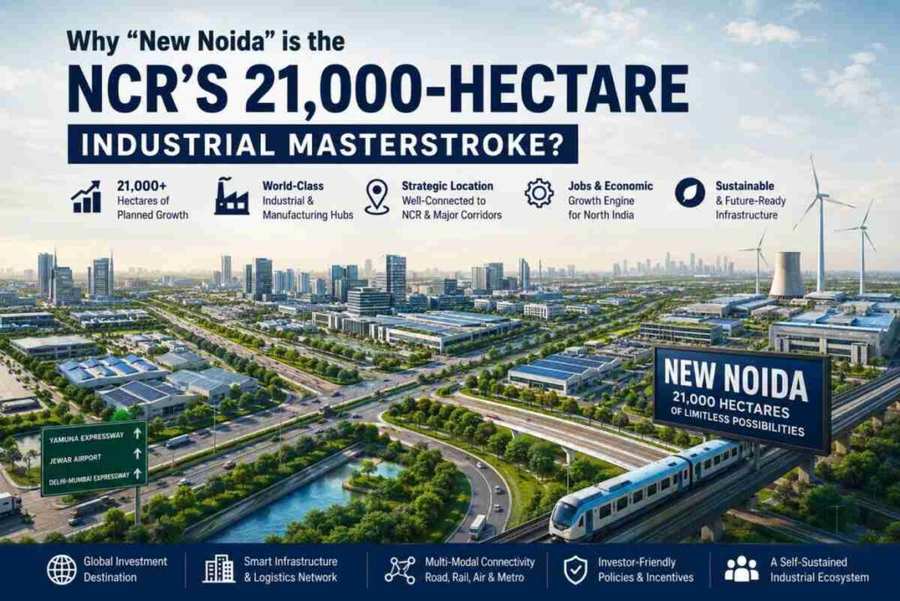
This project is not merely an extension of the current urban sprawl; it represents a calculated response to the “manufacturing overflow” that established satellite cities can no longer accommodate. By opening up thousands of hectares of previously agricultural land, the state is facilitating a fundamental logistics re-rating of the corridor. For the institutional investor or infrastructure strategist, DNGIR is the logical successor to the high-growth trajectories observed in Noida during the 1970s and Greater Noida in the 1990s.
Built under the sophisticated Delhi-Mumbai Industrial Corridor (DMIC) framework, New Noida is designed to leverage India’s largest infrastructure program to create a self-sustaining economic ecosystem. This framework ensures that the city is not just a collection of residential sectors but a multi-modal powerhouse that integrates industrial production directly with global trade routes. Understanding the engineering and financial mechanics of this project is now essential for anyone tracking the shifting economic map of North India.
2. The Scale: A City the Size of Noida and Greater Noida Combined
The physical footprint of New Noida is staggering. Spanning 209.11 square kilometers (approximately 21,000 hectares), the project encompasses 84 villages distributed across the Gautam Buddha Nagar and Bulandshahr districts. To visualize the magnitude: DNGIR is roughly equal in size to the existing Noida and Greater Noida regions combined. This scale is a strategic necessity for the National Capital Region’s “manufacturing overflow,” providing the contiguous land parcels required for modern, large-scale assembly and production facilities.
This project reflects an urban ambition unmatched in contemporary Indian planning. By opening this massive tract of land, authorities are preparing for a projected population of 6 lakh residents by 2041. For a strategist, the sheer size of the DNGIR represents more than just land—it represents a “multi-modal arbitrage” opportunity, where the convergence of industrial, residential, and logistics zones at such a scale creates a new center of gravity for the entire Uttar Pradesh economic belt.
3. The Industrial Backbone: A Manufacturing-First Master Plan
In a departure from traditional metropolitan developments that prioritize speculative residential high-rises, New Noida is built on a “manufacturing-first” philosophy. The land-use mix is heavily weighted toward production: 40% (8,400 hectares) is earmarked for industrial use according to Master Plan 2041. Residential development is strictly limited to 13% for primary sectors, though this can expand up to 22% when including specialized worker housing townships designed to support the local workforce.
This industrial focus is already manifesting in realized demand, not just projections. The zones are backed by state government PLI (Production-Linked Incentive) schemes and multiple MoUs already signed with major manufacturers. The Master Plan 2041 identifies several high-value priority sectors:
- Electronics and Semiconductors: Aligned with the National Semiconductor Mission.
- Electric Vehicles (EVs): Including full-scale assembly and component ecosystems.
- Aerospace and Defense: Leveraging UP’s status as a designated defense manufacturing hub.
- Logistics and Multi-modal Warehousing: Capitalizing on Dedicated Freight Corridor (DFC) integration.
- Pharmaceuticals and Textiles: Tapping into existing regional expertise.
“DNGIR is positioned as North India’s premier multi-modal manufacturing and logistics capital, integrated directly with the Western and Eastern Dedicated Freight Corridors.”
4. The “20-Minute” Airport Connection and Heavy Engineering
Connectivity is the catalyst for the DNGIR’s long-term valuation. The region is anchored by a 16-km dedicated expressway link that connects the city directly to the Noida International Airport at Jewar, reducing transit time for passengers and cargo to a mere 20 minutes. Furthermore, the Uttar Pradesh Cabinet recently approved a 74-km, six-lane link road—strategically designed to be expandable to eight lanes—connecting the airport directly to the Ganga Expressway. This corridor passes through 56 villages, including 8 in Noida and 48 in Bulandshahr.
The “heavy engineering package” for this infrastructure is immense, featuring:
- 3 major bridges and 11 minor bridges.
- 7 underpasses, 4 railroad overbridges (ROBs), and 1 flyover.
- Automated traffic management systems and a centralized control hub for freight logistics.
By sitting at the junction of the Eastern and Western Freight Corridors at Dadri, New Noida enables direct container train transit to major ports in Mumbai and Gujarat within 24 hours. This multi-modal hub status transforms the region into a premier gateway for international trade.
5. The 125% Appreciation Reality Check
The financial performance of the Noida market serves as a powerful indicator for the DNGIR’s potential. According to ANAROCK Research, average residential property prices in Noida surged from ₹4,795 per sq. ft. in 2019 to ₹10,780 per sq. ft. in Q2 2026—a 125% appreciation.
The following table compares Noida’s dominance against other major Indian residential markets:
| City | 2019 Price (per sq. ft.) | Q2 2026 Price (per sq. ft.) | Appreciation (%) |
| Noida (Average Residential) | ₹4,795 | ₹10,780 | 125% |
| Gurugram | ₹6,150 | ₹13,350 | 117% |
| Hyderabad | ₹4,195 | ₹8,090 | 93% |
| Bengaluru | ₹4,975 | ₹9,450 | 90% |
Phase 1 land acquisition is currently underway across 37 priority villages. The Noida Authority has set compensation rates at ₹4,300 per sqm, which translates to a substantial ₹1.75 crore per acre for large-scale land bankers. For those entering the DNGIR market now, this early-stage pricing offers a high-stakes opportunity to capture the regional re-rating before the first phase of infrastructure is delivered.
6. The 20-Year Horizon: A Warning for the Impatient
Despite the significant upside, a strategist must account for the extended holding period. The DNGIR development is structured across a four-phase timeline extending to 2041:
- Phase 1 (2024–2027): 3,165 hectares; focus on industrial clusters and the 16-km airport link.
- Phase 2 (2027–2032): 3,798 hectares; multi-modal logistics hubs and initial residential rollouts.
- Phase 3 (2032–2037): 5,908 hectares; institutional zones and research universities.
- Phase 4 (2037–2041): 8,230 hectares; complete regional buildout connecting to the Eastern Peripheral Expressway.
Investors must navigate severe risks, particularly from illegal private colonizers offering unapproved plots on agricultural land. Due diligence is paramount; analysts recommend utilizing unedited video walkthroughs and “video discovery” to verify ground realities—such as actual road widths and village boundaries—before committing capital. Furthermore, immediate social infrastructure (schools and hospitals) will likely take over a decade to mature.
“DNGIR is a high-potential, high-patience investment. Investors should expect a 10 to 20 year story before the zone feels like a proper city.” — Real Estate Growth Horizon Analysis, Wealth-Clinic
7. Conclusion: The Future of Urban India
New Noida (DNGIR) is poised to fundamentally reshape the economic geography of Northern India. By prioritizing a manufacturing backbone over speculative housing, the project creates a sustainable engine for long-term value. As the heavy engineering links to Jewar Airport and the Dedicated Freight Corridors solidify, the transition of this 21,000-hectare region into a global industrial capital appears inevitable.
The fundamental question for the strategist remains: Is the potential of a manufacturing-first smart city worth a twenty-year wait, or are you looking for the next short-term exit?
FAQ
1. What is New Noida (DNGIR) and how large is it planned to be?
Dadri-Noida-Ghaziabad Investment Region (DNGIR), commonly known as New Noida, is a massive planned urban and industrial smart city located in the Gautam Buddha Nagar and Bulandshahr districts of Uttar Pradesh. Developed under the Delhi-Mumbai Industrial Corridor (DMIC) framework, the city is projected to span approximately 21,000 hectares (209 square kilometers). This massive footprint makes it roughly equal in size to the existing Noida and Greater Noida combined.
2. How is the land utilization distributed under the New Noida Master Plan 2041?
Unlike traditional NCR cities dominated by high-density residential towers, New Noida’s master plan prioritizes industrial growth, logistics, and environmental buffers. Its land-use layout is distributed as follows:
Logistics, Commercial, and Utilities (Remaining ~23%): Focused on corporate business districts, multi-modal warehousing, and university hubs.
Industrial and Manufacturing (40%): Earmarked for electronic assembly, semiconductor components, electric vehicles (EVs), and defense equipment manufacturing.
Residential Development (13% to 22%): Planned as low-density smart sectors and worker housing townships to accommodate an estimated population of 6 lakh residents by 2041.
Green and Open Spaces (15% to 18%): Dedicated to central parks, green buffers, and forest reserves.
3. What is the phase-wise development timeline for the project?
The development of New Noida is structured across four distinct phases leading up to the year 2041:
Phase 4 (2037–2041): Covers 8,230 hectares to complete the regional buildout and establish a connection to the Eastern Peripheral Expressway.
Phase 1 (2024–2027): Focuses on 3,165 hectares across 37 priority villages, establishing initial industrial clusters, road networks, and basic transit corridors.
Phase 2 (2027–2032): Covers 3,798 hectares, focusing on multi-modal logistics hubs, dry port integration, and residential sector rollouts.
Phase 3 (2032–2037): Covers 5,908 hectares to develop university hubs, research institutions, and secondary residential sectors.
4. How will New Noida connect to major transportation networks like the Jewar Airport?
Connectivity is one of the strongest growth drivers of the DNGIR master plan:
Freight Corridors: It sits at the junction of the Eastern and Western Dedicated Freight Corridors (DFC) at Dadri, allowing cargo transit to major container ports in Mumbai and Gujarat within 24 hours.
Airport Proximity: New Noida is located approximately 32 to 40 kilometers from the upcoming Noida International Airport at Jewar.
Dedicated Link Road: The Uttar Pradesh cabinet approved a 74-km six-lane link road (expandable to eight lanes) connecting Jewar Airport directly to the Ganga Expressway, with roughly 20 km of this route traversing New Noida.
5. What are the land acquisition compensation rates for local landowners?
The Noida Authority has officially fixed the land compensation rate at ₹4,300 per square meter for landowners in the 37 priority villages of Gautam Buddha Nagar and Bulandshahr. Under this framework, landowners will receive direct compensation of approximately ₹1.75 crore per acre. This rate is strategically aligned with the revised rates offered for the Noida International Airport project at Jewar to ensure voluntary participation and minimize legal disputes.