
For years, implementing schema markup felt like throwing data into a black box. You added your JSON-LD scripts, checked them against a validator, and crossed your fingers, hoping Google might grant you a coveted rich snippet. But you were fundamentally flying blind. You never truly knew if a schema type was widely adopted by your industry peers or if you were pioneering a dead-end vocabulary track that search engines barely noticed.
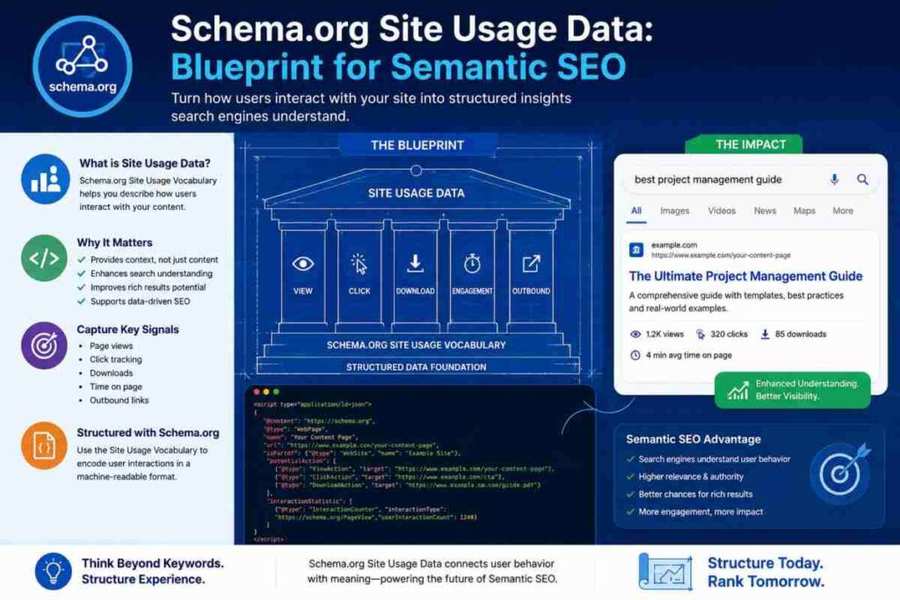
The game has officially changed. Schema.org now natively displays web-scale site usage metrics directly on its vocabulary pages. Thanks to an open data initiative fueled by Google’s crawling infrastructure, we can see exactly how many domains deploy specific structural types.
If you are an SEO professional, developer, or business owner navigating the shifts toward semantic search, this change is monumental. It transitions structured data from a guessing game into a quantifiable, data-backed strategic framework.
What is Schema.org Site Usage Data?
Simple Explanation
Schema.org site usage data is an embedded analytics metric displayed directly on individual schema vocabulary definition pages. When you look up a type (like Product) or a property (like priceCurrency), Schema.org now provides a macro-level metric showing the scale of unique domains utilizing that specific term across the public web.
[ Schema.org Vocabulary Term: Product ]
└── Public Usage Range: 1M - 10M Unique Domains
Instead of showing volatile, exact numbers, the data is grouped into distinct domain count “buckets” (e.g., < 1K, 10K - 100K, 1M+). It counts usage strictly at the domain level, meaning if an e-commerce giant utilizes product schema across ten million individual product URLs, it still only counts as one single domain within the data set.
Why It Matters in 2026+
We have entered the era of the agentic web and Generative Engine Optimization (GEO). Search engines like Google and Answer Engines like Perplexity or ChatGPT no longer just look at keywords—they parse entities and relationships.
AI agents use structured data to verify facts, validate business credibility, and execute transactions on behalf of users. Knowing the exact adoption scale of specific schemas tells us which data formats AI models are trained on most heavily. If a schema type is widely deployed, it is table stakes for search engine viability. If it is rare but relevant, it represents an immediate competitive gap you can exploit.
Key Features of the Schema.org Metrics Update
1. Direct Vocabulary Page Integration
You no longer have to parse through massive, multi-gigabyte database dumps from the Common Crawl or Web Data Commons to check adoption trends. The entry barriers have been completely leveled. The data sits right alongside the technical definition of the types and properties on the canonical Schema.org site, making it accessible during your standard workflow planning.
2. Sourced Directly via Google Infrastructure
The data set isn’t based on a small, biased sample size. It is compiled directly from observations captured within Google’s macro-scale public web crawling pipeline. It filters out sites blocked by standard robots.txt directives, giving you a true look at the search engine indexing footprint.
3. Stability-Focused Range Buckets
By utilizing range buckets instead of raw real-time counts, Schema.org protects site privacy and prevents competitors from reverse-engineering minor daily index updates. More importantly for SEO strategists, it filters out the operational noise caused by temporary server drops, sitewide script errors, or localized indexing lag.
Benefits of Leveraging Site Usage Metrics
Financial Benefits
Structured data implementation consumes expensive development resources. Prior to this update, dev teams frequently wasted billable hours writing highly nested, specialized markups that search engine algorithms didn’t actively support or acknowledge. By cross-referencing usage ranges, engineering teams can prioritize high-impact, universally recognized schema deployments, drastically improving operational ROI and lowering engineering costs.
Strategy & Positioning Benefits
This data acts as a market validator. If you operate an entertainment site and see that your target event schemas sit in the 100K - 1M domain tier, while a specialized sub-property sits below < 1K, you can map your site architecture accordingly. You can secure your baseline visibility with popular terms while systematically building deep contextual authority using niche properties.
Long-Term Value and Future-Proofing
As search queries trend further toward voice interaction and localized AI execution, schemas with high domain adoption become the foundation for machine learning training sets. Aligning your digital entities with these highly validated datasets ensures your content remains indexable and authoritative for future iterations of search technology.
Market and Ecosystem Analysis
The emergence of public web-scale semantic metrics reveals a widening gap between baseline sites and advanced, entity-first web architectures. Let’s look at how macro adoption patterns shape modern web development.
Global Scale Trends
Data indicates that standard e-commerce and local business markers represent the vast majority of web structured data footprints. Core schemas like Product, LocalBusiness, and Organization dominate the top statistical tiers. This tells us that transactional clarity remains the primary motivator for webmasters globally.
Infrastructure Impacts
Because these metrics are updated dynamically every month via GitHub releases, the SEO community can actively track how fast new vocabulary extensions gain traction. This creates a feedback loop: when Schema.org introduces a new property (such as specialized AI or medical tracking terms), the speed at which it moves from the < 1K bucket to higher brackets serves as a direct indicator of industry adoption and search engine utility.
Strategic Implementation: How to Use the Data
This data can be directly applied to competitive analysis and content optimization. Here is how different brackets should inform your technical SEO choices:
High-Volume Brackets (1M+ Domains)
These are your baseline requirements. If your site lacks these, you are essentially invisible to advanced semantic parsing engines.
- Examples:
Organization,WebSite,ImageObject. - Strategy: Automate these across your entire CMS. Ensure zero syntax errors, as search engines expect absolute perfection from such standardized types.
Mid-Tier Brackets (10K - 100K Domains)
This is where sector-specific dominance is established.
- Examples:
Recipe,JobPosting,Course. - Strategy: Build tight data relationships. Do not just use individual types; connect them cleanly into a localized graph structure.
Niche Brackets (< 1K Domains)
Low volume does not equal low value. These terms are often highly specialized medical, legal, or civic types.
- Strategy: Use them to build absolute authority in hyper-specific niches. While broad search engines might not trigger distinct rich features for them, specialized AI crawlers value this highly explicit context.
Schema Strategy: Data-Driven vs. Traditional Guesswork
| Attribute | Traditional Schema Planning | Data-Driven Schema Strategy |
| Prioritization | Guessing priority based on competitor source code sampling. | Sorting implementation roadmaps based on proven global domain ranges. |
| Resource Efficiency | Coding deep, complex nested properties that may lack engine support. | Aligning engineering hours strictly with highly adopted, active vocabularies. |
| Risk Management | Relying on static, outdated documentation guides. | Monitoring monthly adoption shifts via official GitHub dataset releases. |
| AI Readiness | Treating schema purely as a way to win simple star ratings. | Ensuring entity nodes map perfectly to AI training set priorities. |
Step-by-Step Guide to Auditing Your Schema Strategy
Follow this data-backed procedure to refine your site’s structured data profile using Schema.org’s new metrics.
1.Extract Existing Schema Profile:Prerequisite Phase.
Run your core landing URLs through a technical crawler or Google’s Rich Results Test. Document every single @type and property currently active within your source code.
2.Cross-Reference Global Range Brackets:Research Phase.
Visit the official Schema.org pages for each identified term. Document the public usage range tier for your primary types and secondary nested properties to isolate your baseline vs. specialized markups.
3.Map Competitor Gaps:Analysis Phase.
Scrape the schema profiles of your top five direct organic competitors. Identify high-bracket types they use that you have omitted, as well as low-bracket niche types where you can establish unique entity clarity.
4.Restructure Your JSON-LD Architecture:Deployment Phase.
Re-write your schema execution scripts into a unified, site-level entity graph. Prioritize filling gaps in high-volume brackets first to secure basic rich snippet eligibility, then inject targeted niche properties.
5.Validate and Monitor Changes:Quality Assurance Phase.
Deploy the updated scripts using JSON-LD format. Monitor your Search Console performance reports over the next two crawl cycles to track structural indexing and rich snippet acquisition rates.
Critical Strategic Note: Do not confuse usage volume with search engine validation. A schema term resting comfortably in the
< 1Kbucket isn’t broken or ignored; it is often simply waiting for industry scale or represents a hyper-focused professional field. If it fits your entity accurately, deploy it.
Expert Tips for Advanced Schema Architecture
- Prioritize Semantic Depth Over Superficial Coverage: It is vastly better to have an absolute, deeply filled schema graph on your ten most important revenue pages than broken, shallow, or generic markup duplicated blindly across thousands of low-value archive pages.
- Connect Everything Into a Single Graph Structure: Avoid breaking your schema up into disconnected code blocks across your page. Use an
@grapharray to tie yourOrganization,WebSite,WebPage, and main content entity (like aProductorArticle) into a cohesive, readable web of data. - Keep an Eye on the Monthly GitHub Updates: Schema.org updates this information monthly. Set a recurring internal task to monitor major shifts in your industry’s specialized categories to spot emerging search standards early.
- Don’t Let Your CMS Autofill Corrupt Your Data: Many out-of-the-box SEO plugins pull inaccurate fallback data to satisfy required fields. Manually audit your automated outputs to make sure your properties align perfectly with what your pages actually display.
Common Implementation Mistakes to Avoid
Over-nesting Unnecessary Properties
Just because a schema type allows for dozens of optional properties doesn’t mean you should force-feed meaningless data points into your code. Focus on clean data that provides genuine context. Over-nesting low-tier properties without clear data values creates parsing drag for crawlers.
Ignoring Mismatched On-Page Content
Your structured data must strictly mirror what a human reader sees on the page. If your schema claims a product price is $49, but your visible H1 or div text displays $59 due to an un-synced database, you risk search engine penalties for misleading structured data.
Treating Syntax Validation as Strategic Success
Passing the Schema.org Validator or the Rich Results Test simply means your code doesn’t have formatting errors. It does not mean your schema layout makes strategic sense or accurately defines your business entities. Use the new site usage stats to evaluate semantic value, not just code validity.
Future Trends: Semantic Search Expansion (2026–2030)
As we look toward the end of the decade, the integration of usage statistics points toward an open, transparent semantic web structure.
[Traditional Search] ──> Keywords & Links
[Modern AI Search]   ──> Entity Context & Verified Schema Data Graphs
We anticipate search engines will eventually display schema adoption thresholds within webmaster tools directly, flagging missing structural data as an explicit optimization warning. Furthermore, as LLMs increasingly rely on structured data paths to execute complex, multi-step actions, standardizing your schema choices around highly adopted types will become a prerequisite for maintaining real-world visibility.
Conclusion
The addition of domain usage statistics to Schema.org turns technical SEO from a game of intuition into an explicit blueprint. By revealing exactly how the rest of the web organizes its information, this update gives you the data needed to build cleaner, more effective site architectures.
Take a look at your core pages today. Cross-reference your current schema types with their global usage brackets, eliminate your structural blind spots, and build a cohesive entity graph that search engines—and AI agents—can easily understand and trust.
Frequently Asked Questions
Does a low site usage range mean search engines ignore that schema?
No. A low domain count tier (like < 1K) often simply indicates a highly specialized or newly introduced term. Specialized fields like medical, scientific, or local administrative markups naturally have a smaller global footprint, but they remain highly effective for building niche topical authority.
How often are the Schema.org site usage statistics updated?
The underlying public usage dataset is compiled and updated on a monthly basis. The data is pushed directly to the official Schema.org GitHub repository following validation checks to filter out daily crawling anomalies and index instability.
Does the usage count differentiate between JSON-LD and Microdata?
No. The statistics combine all embedded structural data formats—including JSON-LD, Microdata, and RDFa—into a single combined metric. If a domain uses multiple code formats across its pages, it still registers as just one unique domain for those terms.
Can using highly adopted schemas guarantee rich snippets on Google?
No. Perfectly valid schema markup and alignment with high-volume usage brackets serve as an eligibility requirement, not a programmatic guarantee. Google retains independent algorithmic control over when, where, and to which users it displays enhanced search listings.
Why does the data show domain counts instead of total page counts?
Page counts are easily skewed by a handful of massive websites with millions of automated URLs. By calculating usage strictly at the root domain level, the dataset provides a much more accurate, stable picture of true cross-industry web adoption.