
Imagine waking up in the quiet outskirts of Narela or the bustling lanes of Najafgarh, knowing that the heart of Delhi is no longer a grueling two-hour commute away. For millions of Delhiites, this isn’t just a dream anymore—it’s the blueprint of the city’s future. The Delhi Government and DMRC have officially pulled the curtain back on a massive expansion plan that promises to rewrite the geography of the National Capital Region.
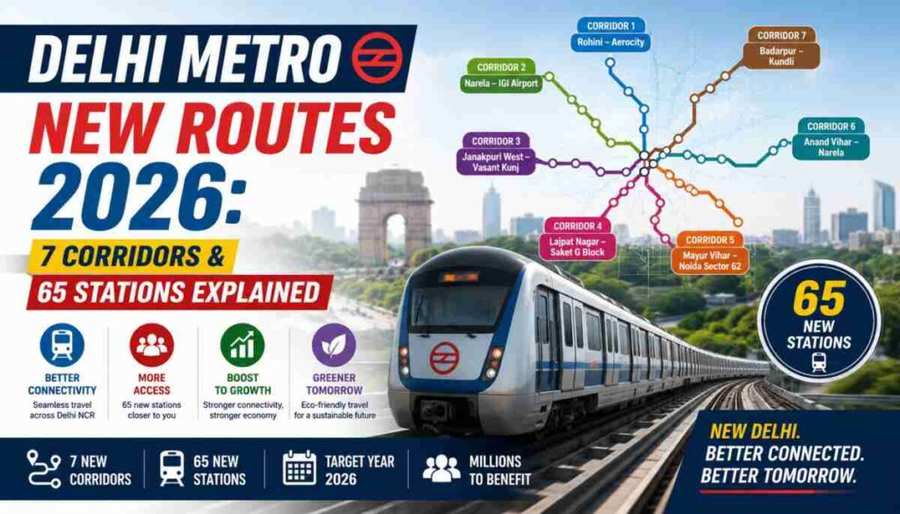
The announcement of 7 new Delhi Metro routes, spanning 97 kilometers and featuring 65 brand-new stations, has sent ripples of excitement through real estate markets and commuter hubs alike. This isn’t just a minor extension; it’s a total overhaul designed to bring “Outer Delhi” into the mainstream. Whether you are an investor looking for the next big appreciation hit, a homebuyer priced out of South Delhi, or a daily traveler tired of the Ring Road traffic, these new corridors are set to change your life.
What is the Delhi Metro Phase 5B Expansion?
Simple Explanation
In simple terms, Phase 5B is the next “growth spurt” for the Delhi Metro. While previous phases focused on connecting the main hubs, this phase is about inclusivity. It targets areas that were previously considered “too far” or “under-connected.” By adding 97 km of track, the DMRC is effectively bridging the gap between the rural-urban fringes (like Narela and Najafgarh) and the administrative and commercial power centers (like Central Secretariat and Jor Bagh).
Why It Matters in 2026+
As we move deeper into 2026, Delhi’s population density is reaching a breaking point. The existing lines are world-class, but the “last-mile” struggle in outer colonies has remained a pain point. This expansion matters because it focuses on multimodal integration. We aren’t just getting tracks; we are getting interchange hubs that connect the Green, Yellow, Violet, and Pink lines in ways that will reduce travel time by up to 45 minutes for long-distance commuters.
Key Features & Highlights of the New Network
The expansion is divided into seven strategic corridors, each serving a unique demographic and geographical need.
Samaypur Badli to Narela (The North Extension)
This 12.89 km fully elevated stretch is a game-changer for North Delhi. With 8 stations including Khera Kalan, Alipur, and Holambi Kalan, it finally brings the sub-city of Narela onto the rapid transit map.
Central Secretariat to Kishangarh (The Heritage-Connect)
Spanning nearly 16 km, this route is largely underground to protect the city’s aesthetic and historical landscape. It connects the power center of Delhi to the southern residential pockets like New Moti Bagh, RK Puram, and JNU, making it a vital link for government employees and students.
Dhansa Bus Stand to Nangloi (The West Link)
A 11.8 km elevated corridor that bridges the gap between the Green Line and the Grey Line. It passes through high-density areas like Bakkarwala and Baprola, providing a lifeline to the industrial and residential clusters of West Delhi.
Benefits of the New Delhi Metro Routes
Financial Benefits
For the average citizen, the metro is a massive money-saver. With fuel prices fluctuating and the cost of vehicle maintenance rising, switching to a ₹40-60 metro token vs. ₹300 in petrol daily is a no-brainer. For the city, the ₹48,204 crore investment is expected to generate thousands of construction jobs and boost the local economy in newly connected neighborhoods.
Lifestyle & Business Benefits
Time is the ultimate luxury. Residents in Najafgarh or Palam will now have “reclaimed time”—hours once spent in traffic can now be spent with family or at work. For businesses, these routes open up a larger talent pool. A company in Central Delhi can now easily hire a specialist living in Narela because the commute is predictable and air-conditioned.
Long-Term Value
Infrastructure is the primary driver of real estate. Historically, areas within 1-2 km of a Delhi Metro station have seen a 20-30% higher appreciation compared to non-metro areas. These new routes ensure that property values in “outer” colonies will remain resilient for decades.
Location & Market Analysis
Connectivity
The hallmark of the 2026 plan is Interchange Efficiency. Stations like Jor Bagh, Lajpat Nagar, and Kirti Nagar will see upgraded infrastructure to handle the influx of passengers from the new corridors. The Kirti Nagar to Palam route, for instance, provides a much-needed diagonal link that bypasses the traditional “hub-and-spoke” delays.
Infrastructure Growth
The arrival of the metro usually triggers “Transit-Oriented Development” (TOD). Expect to see new shopping complexes, organized parking lots, and improved street lighting around the 65 new stations. This “halo effect” improves the safety and livability of the entire neighborhood.
Future Potential
Narela and Rohini Sector 34 are the “ones to watch.” With large tracts of land available for development, these areas are poised to become the next Dwarka. The metro acts as the catalyst that turns “barren” land into “prime” real estate.
Investment Potential: Is it Time to Buy?
ROI Opportunities
If you are looking for high ROI, focus on the Samaypur Badli-Narela and Keshavpuram-Rohini Sector 34 corridors. Prices here are currently lower than in central areas, providing a lower entry barrier for investors with a 5-year horizon.
Risk Factors (Be Honest)
No investment is without risk.
- Construction Delays: Large-scale projects like Phase 5B can face land acquisition hurdles.
- Initial Low Occupancy: Some outer stations may take 2-3 years after opening to become bustling hubs.
- Market Saturation: In some pockets, the “metro news” might already be priced into the property, so do your homework.
Who Should Invest?
- Long-term Investors: Those who can wait 4-6 years for the full network to mature.
- First-time Homebuyers: Families looking for affordable housing in Narela or Najafgarh who want a future-proof commute.
- Commercial Developers: Small-scale developers looking to build “high-street” retail near new station exits.
Comparison: New Routes vs. Existing Infrastructure
| Feature | Existing Network (Phases 1-4) | New Expansion (Phase 5B) |
| Primary Focus | Connectivity between Main Hubs | Last-mile and Outer-Delhi Connectivity |
| Total New KM | ~390 KM | ~97 KM (Additional) |
| Key Advantage | High Frequency | Reaches underserved “Shadow Zones” |
| Technology | Standard Signaling | Advanced Communication-Based Train Control (CBTC) |
Step-by-Step Guide: How to Navigate the New Delhi Metro Changes
Step 1: Study the Map
Don’t rely on old maps. The 2026 DMRC map includes “virtual interchanges” and new color-coded segments. Identify if your daily route can be shortened by switching at new hubs like Mithapur or Kishangarh.
Step 2: Update Your Metro Smart Card
With the new phase, DMRC is pushing for “One Delhi” integration. Ensure your card is linked to the latest mobile apps to take advantage of seamless transfers between the metro and feeder electric buses.
Step 3: Explore the “Last Mile”
The new stations are being built with dedicated e-rickshaw and cycle-sharing zones. Check the station layout (available on the DMRC website) to see which exit is closest to your workplace.
Expert Tips for the “New Delhi” Commuter
- Look for Multi-Modal Hubs: If you’re buying property, prioritize stations that act as interchanges. They hold their value better than “standalone” stations.
- The “500-Meter Rule”: The highest price appreciation happens within 500 meters of a station entrance. If you’re a renter, try to stay within 1 km to save on rickshaw fares.
- Use the Apps: Don’t guess the timing. With 65 new stations, the complexity of the grid increases. Use the official DMRC app for real-time train tracking.
- Off-Peak Perks: New routes often have lower ridership in the first six months. Use this time to explore the city without the “Rajiv Chowk” level of rush.
- Watch the “Priority Corridors”: Four out of the seven lines are being fast-tracked. Keep an eye on the Dhansa-Nangloi and Badli-Narela lines for early gains.
Common Mistakes to Avoid
- Investing Based on Rumors: Always wait for the official DMRC notification before committing to a property purchase based on “proposed” stations.
- Ignoring the “Underground” Factor: Underground stations take longer to build. If you need a metro now, look at the elevated corridors like Keshavpuram-Rohini.
- Forgetting Commercial Utility: Many people only think of the metro for “going to work.” Don’t forget that it also brings customers to your shop.
- Underestimating the “Noise” Factor: If you buy a house too close to an elevated track, the vibration and noise can be a nuisance. Aim for one block away.
Future Trends (2026–2030)
As we look toward 2030, the Delhi Metro will likely transition into a “Driverless First” network. The new corridors are being designed with Grade of Automation 4 (GoA4) capabilities in mind. We also expect to see a massive shift toward Solar-Powered Stations, with Phase 5B aiming to be the greenest expansion yet. The ultimate goal? A Delhi where no citizen is more than 15 minutes away from a metro station.
Conclusion
The announcement of the 7 new Delhi Metro routes is a defining moment for the capital. It’s a bold ₹48,000 crore bet on the future of urban mobility. By connecting the far-flung corners of Narela, Najafgarh, and Palam to the vibrant heart of the city, the DMRC is doing more than just laying tracks—it’s laying the foundation for a more equitable, less congested, and highly connected Delhi.
Are you ready for the change? Whether you’re moving house or moving money, the 2026 metro expansion is your green signal. Stay tuned for further updates as construction begins on these landmark corridors!
Frequently Asked Questions (FAQ)
1. Which areas will the new Delhi Metro routes cover in 2026?
The new expansion focuses on Outer Delhi, including Narela, Najafgarh, Palam, Rohini Sector 34, Mithapur, and Kishangarh. It connects these areas to central hubs like Central Secretariat and Jor Bagh, covering a total of 97 km and 65 new stations across 7 corridors.
2. When will the Samaypur Badli to Narela metro line be operational?
The Samaypur Badli to Narela corridor is one of the priority projects in the Phase 5B plan. While construction timelines can vary, the goal for priority corridors is to begin operations by late 2028 or early 2029, with early phases potentially seeing trials in 2027.
3. How many new stations are being added in this Delhi Metro expansion?
A total of 65 new stations are being added. These will be spread across seven new corridors, providing much-needed connectivity to residential and industrial pockets in North, West, and South Delhi that were previously underserved by the rapid transit system.
4. What is the total cost of the 7 new Delhi Metro corridors?
The total estimated cost for the Phase 5B expansion is ₹48,204.56 crore. This covers the construction of elevated and underground tracks, new station infrastructure, and the procurement of advanced rolling stock (trains) to handle the increased passenger load.
Add your title here
Far far away, behind the word mountains, far from the countries Vokalia and Consonantia, there live the blind texts. Separated they live in Bookmarksgrove right at the coast of the Semantics, a large language ocean.
6. Is it a good idea to invest in real estate near the Narela metro station?
Historically, metro connectivity has led to significant property appreciation. Narela is currently an emerging market with lower entry prices. The new metro link is expected to drive demand for residential and commercial spaces, making it a high-potential zone for long-term investors.
7. How will the Najafgarh to Nangloi route benefit commuters?
This corridor (Dhansa Bus Stand to Nangloi) provides a critical link between the Green Line and the Grey Line. It will significantly reduce travel time for residents of West Delhi colonies like Bakkarwala and Baprola, who currently rely on slow-moving road transport.
8. Which of the new metro lines will be underground?
The Central Secretariat to Kishangarh corridor is planned to be mostly underground to navigate through the densely populated and historically significant areas of South-Central Delhi. Other routes like Jor Bagh to Mithapur will feature a mix of underground and elevated sections.
9. Will the new Delhi Metro routes use driverless train technology?
The DMRC is increasingly adopting driverless (Unattended Train Operation) technology. Many of the new corridors in Phase 5B are being designed to support advanced signaling systems that allow for driverless operations, similar to the Magenta and Pink Lines.
10. How will this expansion reduce Delhi’s pollution levels?
By providing a reliable alternative to private vehicles for 97 km of new territory, the expansion is expected to take thousands of cars and two-wheelers off the road daily. This reduction in vehicular emissions is a key part of Delhi’s long-term environmental strategy.