
Imagine waking up on a Saturday morning in the bustling, humid heart of Delhi, packing a light backpack, and sitting on the banks of the holy Ganges in Haridwar before your morning coffee has completely worn off. No soul-crushing traffic jams on the highway, no endless train delays, and no exhausting five-hour drives. Just pure, high-speed comfort cutting through the plains of Western Uttar Pradesh directly into the spiritual foothills of Uttarakhand.
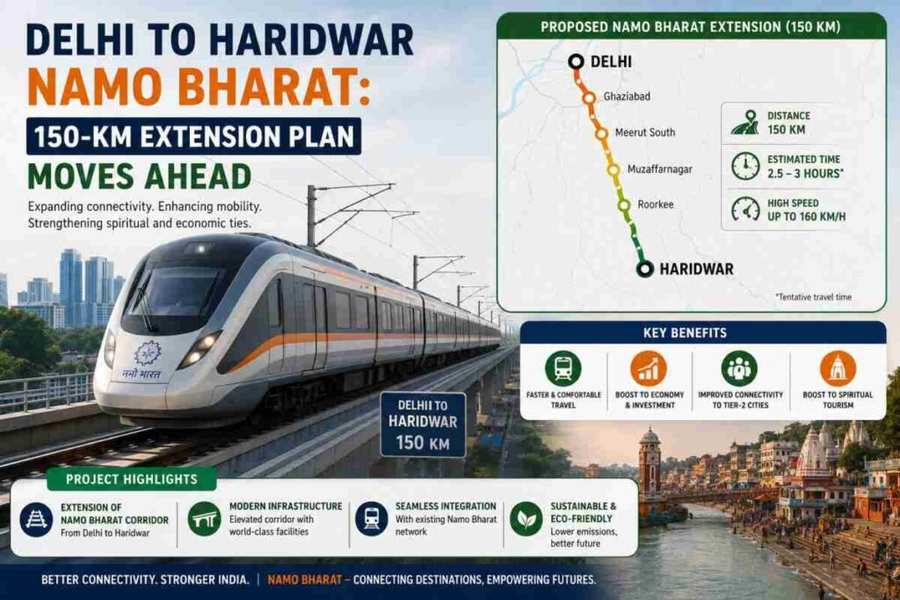
This isn’t a distant futuristic dream. It is the rapidly emerging reality of the Delhi to Haridwar Namo Bharat extension plan.
The National Capital Region Transport Corporation (NCRTC) has officially set its sights northward. Following high-level breakthroughs and an official green light for the Detailed Project Report (DPR) feasibility survey, the existing high-speed transit network is preparing for a massive 150-kilometer leap. By stretching the current terminal from Meerut all the way to Haridwar and Rishikesh, this infrastructural marvel is poised to fundamentally rewrite how millions of tourists, daily commuters, and savvy real estate investors view the connectivity between India’s political capital and its most revered spiritual twin cities.
What is the Delhi to Haridwar Namo Bharat Project?
A Simple Explanation of High-Speed Regional Rail
The Namo Bharat system, technically known as the Regional Rapid Transit System (RRTS), is a completely unique class of rail transport in India. It isn’t a slow-moving traditional train, nor is it a stop-and-start urban metro system. Instead, it is a state-of-the-art, aerodynamic, semi-high-speed rail network designed to cruise comfortably at an operational speed of 160 km/h (with design capacities up to 180 km/h).
While the first phase successfully linked Sarai Kale Khan in Delhi to Modipuram in Meerut, the newly proposed extension plans to pick up the baton right from Modipuram. It will run an additional 150 kilometers parallel to the National Highway 58 (NH-58) alignment, forging a lightning-fast steel spine that bridges the National Capital Region (NCR) directly with the cities of Roorkee, Haridwar, and Rishikesh.
Why It Matters in 2026 and Beyond
As we move through 2026, regional integration has become the primary economic driver for northern India. Urban centers are saturated, and the demand for rapid, sustainable mass transit has reached a boiling point. The newly operational Delhi-Dehradun Expressway has already reduced vehicular travel times, but roads alone cannot handle the astronomical surge in weekend tourism and spiritual migration.
The Namo Bharat extension provides a zero-emission, highly reliable alternative that completely bypasses highway congestion. It transforms a grueling multi-hour journey into a swift, predictable commute, permanently altering the economic, environmental, and spatial dynamics of the entire region.
Key Features and Technological Highlights
Seamless Corridor Interoperability
One of the most impressive engineering highlights of the Namo Bharat ecosystem is its absolute interoperability. The trainsets use advanced European-style signaling systems (ETCS Level 2 over LTE) which allow them to move seamlessly across different lines.
A passenger will be able to board a train in the NCR network and travel directly toward Haridwar without ever having to disembark, change platforms, or switch train systems. The system is built around human convenience, offering a single-ticket fluid journey across state boundaries.
Unmatched Transit Speed and Aerodynamics
Manufactured in India using advanced aerodynamic designs to minimize drag and energy consumption, these trains run on standard-gauge tracks with overhead 25 kV AC electrification.
[Sarai Kale Khan (Delhi)] ──(82 km Operational)──> [Modipuram (Meerut)] ──(150 km Proposed Extension)──> [Haridwar / Rishikesh]
Because it features far fewer stops than a traditional commuter metro and boasts acceleration rates comparable to top-tier global bullet trains, it slashes the transit time between Delhi and the foothills of the Himalayas down to a mere 2.5 to 3 hours.
Robust, Weather-Resistant Climate Infrastructure
Unlike regional highways that frequently suffer from seasonal monsoon waterlogging, thick winter fog delays, or hazardous mountain bottlenecks, the Namo Bharat transit line is engineered for absolute climate resilience.
The planned extension layout features elevated guide-ways for the vast majority of its alignment through Western UP, shifting to critical underground cabling and specialized automated power substations as it enters the eco-sensitive, flood-prone zones of the Kumbh region. This guarantees uncompromised, uninterrupted operations 365 days a year.
Transformative Benefits of the Namo Bharat Extension
Financial Benefits and Regional Economic Uplift
The financial ripples of this 150-km high-speed expansion will be immense. By creating a hyper-connected economic corridor from Delhi through Muzaffarnagar and Roorkee up to Haridwar, the project drastically reduces the logistics and transaction costs of doing business across state borders.
It unlocks decentralization, allowing corporations to set up satellite offices and logistical hubs in tier-2 and tier-3 towns where land capital expenditure is significantly lower, all while keeping their workforce perfectly connected to the capital city.
Lifestyle and Leisure Benefits for Commuters
For the average resident of Delhi-NCR, this project completely redefines the concept of a weekend getaway. Instead of spending an entire Friday night wrestling with heavy truck traffic on the highways, families can step into an air-conditioned, Wi-Fi-enabled premium coach and relax.
The lifestyle transition is immediate:
- True Comfort: Ergonomic seating, overhead luggage racks, wide panoramic windows, and dedicated onboard charging ports.
- Premium Travel Options: A dedicated premium class coach per train with extra legroom and lounge access.
- Inclusivity: Fully accessible layouts with designated spaces for wheelchairs and medical transit.
Long-Term Socio-Environmental Value
From an environmental standpoint, mass high-speed rail is the ultimate weapon against India’s carbon footprint. The existing operational phases of the Namo Bharat network have already successfully averted millions of individual private vehicular trips every single year, preventing thousands of metric tons of toxic carbon dioxide from entering our atmosphere. Extending this green grid to Haridwar ensures that the fragile, pristine environment of the Himalayan foothills is protected from the crushing weight of vehicular pollution and exhaust smog.
Comprehensive Location and Alignment Analysis
The proposed 150-kilometer extension layout is strategically designed to cut cleanly through the heart of western Uttar Pradesh before entering the territorial borders of Uttarakhand. The line is mapped out to run parallel to the highly active NH-58 transit corridor, touching upon critical economic, industrial, and academic nodes.
+--------------------+------------------------------------------------------------+
| Proposed Station   | Strategic Importance / Primary Regional Role               |
+--------------------+------------------------------------------------------------+
| Modipuram (Meerut) | Base Terminus; seamlessly bridges Phase 1 with Extension   |
| Daurala            | Suburban agricultural & residential expansion zone          |
| Khatauli           | Key commercial transit stop & sugar industry center        |
| Muzaffarnagar      | Major industrial hub; massive steel & manufacturing core   |
| Purkazi            | Strategic border town linking Upper UP to Uttarakhand      |
| Roorkee            | Premier academic & engineering hub (IIT Roorkee zone)      |
| Jwalapur           | High-density commercial gateway entering Haridwar urban bounds|
| Haridwar           | Global spiritual destination & massive pilgrimage node      |
| Rishikesh          | World Capital of Yoga; global adventure tourism epicenter  |
+--------------------+------------------------------------------------------------+
Enhancing Connectivity
By laying tracks through these specific nodes, the Namo Bharat train transforms separate, isolated cities into unified, highly collaborative economic boroughs. A professor from IIT Roorkee can comfortably travel to Delhi for a midday conference and return home by evening, while a retail trader from Muzaffarnagar can manage suppliers in the capital with total ease.
Infrastructure Growth
The entry of high-speed rail naturally triggers a massive local infrastructure upgrade. Towns like Khatauli, Purkazi, and Daurala will see a rapid introduction of modern bus terminals, wide feeder roads, commercial retail hubs, and improved localized utilities to support the inevitable influx of transit passengers.
Unlocking Future Regional Potential
By establishing a reliable, high-frequency transit artery, this project lays down the foundation for the next half-century of regional expansion. It effectively expands the borders of the National Capital Region’s economic influence, allowing the smaller cities of Western UP and Uttarakhand to directly ride on the coattails of Delhi’s immense economic power.
Investment Potential and Real Estate Use Cases
The Exploding Demand for Second Homes and Rental Villas
The moment the feasibility survey for the 150-km extension was put into motion, the real estate outlook for Haridwar and Rishikesh shifted dramatically. Historically, property markets in these holy towns were driven almost entirely by retirees or local residents.
Now, top-tier market analysts project a staggering 200% surge in demand for luxury holiday homes, service apartments, retirement villas, and boutique homestays in the Himalayan foothills. With Delhi-NCR brought within a crisp two-and-a-half-hour travel radius, affluent urban families are aggressively looking to secure properties where they can seamlessly blend a remote work lifestyle with tranquil spiritual living.
Commercial ROI Opportunities and Hospitality Boom
The hospitality landscape along the entire alignment is preparing for an unprecedented boom. Land parcels situated within a 3 to 5-kilometer radius of the proposed stations—especially around Roorkee, Jwalapur, and Haridwar—are witnessing intense institutional interest.
Savvy investors are acquiring commercial spaces for:
- Premium budget hotels and spiritual wellness resorts.
- Modern transit retail plazas and food courts near station exits.
- Co-working hubs designed for digital nomads splitting time between Delhi and the mountains.
Risk Factors and Honest Investor Caveats
While the long-term upside is undeniable, any prudent investor must approach this emerging market with an analytical mind.
⚠️ Infrastructural Investment Warning: Large-scale linear rail projects require deep capital allocation and complex multi-state environmental clearances. The proposed alignment passes through highly fertile agricultural belts in Western UP and eco-sensitive, flood-prone zones near the Ganges in Uttarakhand. Investors should brace for potential timeline extensions due to land acquisition negotiations, strict environmental evaluations, and the complex engineering required around the upcoming Kumbh Mela infrastructure upgrades. This is an asset play meant for long-term capital appreciation, not instant short-term flipping.
Who Should Invest?
This corridor is absolutely ideal for long-term value investors, institutional developers looking to establish hospitality footprints early, and individuals looking for high-yielding retirement or second-home assets that will appreciate steadily as the physical infrastructure edges closer to final completion.
Comparative Analysis: Namo Bharat vs. Traditional Alternatives
To truly appreciate why the Delhi to Haridwar Namo Bharat extension is a total game-changer, we must look at how it stacks up directly against the existing modes of transit available to the public.
+------------------+-------------------+--------------------+------------------------+
| Feature / Metric | Private Vehicles  | Traditional Trains | Namo Bharat (Proposed) |
+------------------+-------------------+--------------------+------------------------+
| Travel Time      | 5 to 7 Hours      | 4 to 6 Hours       | 2.5 to 3 Hours         |
| Reliability      | Low (Traffic/Fog) | Medium (Delays)    | Absolute (Fixed Grid)  |
| Carbon Footprint | Extremely High    | Medium             | Zero Direct Emissions  |
| Travel Comfort   | Low (Driver Fat.) | Variable (Crowds)  | Ultra-Modern Premium   |
+------------------+-------------------+--------------------+------------------------+
Why Namo Bharat Stands Out Uncontested
While the modern highway infrastructure has certainly improved road travel, it simply cannot match the pure mathematical predictability of a dedicated, high-speed rail corridor. Traditional trains are heavily bound by the congested tracks of India’s main railway grid, often facing unpredictable delays.
The Namo Bharat system operates entirely on its own isolated, high-tech track system. Free from the interference of freight trains or local passenger traffic, it delivers a level of punctuality and swiftness that leaves automobiles and conventional locomotives completely in the dust.
Step-by-Step Guide: How the Extension Moves from Concept to Reality
Building a massive 150-kilometer semi-high-speed rail system across two separate state jurisdictions is an incredibly detailed, highly regulated process. Here is the exact path this mega-project follows to reach execution:
1.Joint State and Central Sanction:Completed / In Progress.
Uttarakhand Chief Minister Pushkar Singh Dhami officially holds high-level strategy meetings with Union Minister Manohar Lal Khattar, securing mutual policy alignment and requesting crucial infrastructure funds.
2.Comprehensive Feasibility & DPR Survey:Upcoming Immediate Phase.
NCRTC engineers deploy advanced aerial drone surveying, geo-technical soil sampling, and traffic demand mapping to lock down the exact track alignment, station coordinate locations, and land acquisition boundaries.
3.Statutory Land Acquisition & Clearances:Mid-Term Phase.
The governments of Uttar Pradesh and Uttarakhand initiate joint land pool acquisitions parallel to NH-58, while simultaneously securing mandatory environmental clearances from central forestry and river conservation boards.
4.Heavy Civil Engineering & Track Laying:Long-Term Construction.
Construction crews begin erecting massive concrete viaducts, boring specialized underground tunnels for sensitive zones, laying standard-gauge high-speed tracks, and installing overhead catenary electrification lines.
5.Rigorous System Testing & Final Launch:Terminal Pre-Operations.
NCRTC conducts extensive high-speed trial runs using empty Alstom trainsets, gathering real-time telemetry data before securing safety certificates from the Commissioner of Railway Safety (CRS) for commercial launch.
Expert Tips for Savvy Real Estate Buyers and Investors
If you are planning to leverage this massive infrastructure project to build personal wealth, you need to play smarter than the average retail crowd. Here is some insider advice to guide your strategy:
- Target the Edge of Major Academic Hubs: Do not just hunt for hyper-expensive land in main Haridwar or Rishikesh. Look closely at the outskirts of Roorkee. The presence of IIT Roorkee combined with a Namo Bharat station creates a permanent, high-yield rental market comprising students, researchers, and visiting faculty.
- Verify Land Titles Near NH-58 Intensely: Because the proposed route closely hugs the National Highway alignment, many local land parcels will be subject to strict zoning laws or upcoming government acquisitions. Always cross-verify land maps with local development authorities before signing any deal.
- Focus on Modern Parking and Access Infrastructure: If you are investing in commercial or hospitality properties near a proposed station, ensure your asset features ample parking or immediate access to local feeder roads. The most successful properties will be those that offer a seamless transition from the station to the final destination.
- Pivoting Towards Eco-Tourism and Wellness Layouts: The post-2026 traveler values sustainability. When building or buying holiday rentals in the foothills, invest in solar energy, water harvesting, and green architecture. This aligns perfectly with the eco-friendly spirit of both the Namo Bharat project and the state of Uttarakhand.
Common Pitfalls and Mistakes to Avoid
- Buying Property Blindly on Rumored Station Locations: One of the quickest ways to lose capital is buying a plot based on hearsay or unverified WhatsApp forwards about where a station will be built. The alignment is currently entering its formal survey phase. Wait until the final Detailed Project Report (DPR) maps are officially published by the NCRTC before committing serious capital.
- Underestimating the Construction Timeline: Mega-rail projects are massive undertakings. Do not invest capital that you might need back in two to three years. Approach this market with a healthy 5 to 7-year investment horizon so you can comfortably ride out construction phases and reap maximum capital appreciation.
- Ignoring Local Multi-Modal Integration: A high-speed rail station is only as good as the local transit options surrounding it. Avoid investing in remote pockets that lack basic connection options like local e-rickshaws, municipal buses, or accessible road networks.
Future Vision: What the Region Looks Like Between 2026 and 2030
As we look forward toward the end of the decade, the completion of this high-speed line will completely transform the geography of northern India. The traditional dividing lines between Delhi, Western UP, and the state of Uttarakhand will effectively blur into a single, highly synchronized mega-region.
[Delhi-NCR Corporate Hub] ⚡──(Rapid 3-Hour Transit Connection)──⚡ [Uttarakhand Tourism & Wellness Ecosystem]
We will see a massive rise in “hybrid living,” where individuals split their week symmetrically between corporate offices in Delhi and tranquil residential properties in the foothills. Tourism will transition from a seasonal, heavily planned annual journey into a spontaneous, high-frequency weekend habit. This massive infrastructure shift ensures that the entire economic corridor will grow into one of the most productive, sustainable, and highly accessible zones in the nation.
Conclusion and Final Thoughts
The Delhi to Haridwar Namo Bharat extension plan represents a monumental leap forward for India’s regional transit strategy. By bridging a high-speed, zero-emission transportation grid across 150 kilometers of rapidly growing territory, the project offers an unassailable solution to highway congestion while unlocking a goldmine of economic and real estate potential. As the official feasibility and DPR surveys prepare to move onto the ground, early investors, frequent pilgrims, and regular commuters have every reason to keep a close eye on this transformative corridor. The tracks are being laid for a faster, cleaner, and deeply connected future—bringing the majestic Himalayas closer to the capital than ever before.
For residents and businesses across Gurugram, Noida, and Delhi, the message is clear: the days of being hopelessly stuck in traffic are winding down. for Cutting out traffic Govt has launched Delhi katra Expressway It is time to look forward, adapt to these emerging corridors, and position your investments to ride the wave of this historic infrastructure transformation.
You will see a city built for the next generation. Knowledge Park 5 is not just about real estate. It is about the quality of life you deserve. It represents a smart choice for your family and your finances. Take a drive through the sector and see the progress yourself. You will see a city built for the next generation. Sector 4 Greater Noida, is more than just a destination on a map; it represents the modern Indian dream of affordable luxury and planned growth. Knowing the Sector 4 Greater Noida pin code is just the beginning of your journey. Whether you are moving here for work, family, or investment, the area offers a robust foundation for a high-quality life. With its strategic location, improving infrastructure, and vibrant community, Sector 4 is undoubtedly one of the best places to plant your roots in the NCR. for more doubts get a On call free session by Real Estate Advisory or Visit byviveksingh.in to book a direct strategy consultation. Are you a Business Owner ? than For business owners, the primary benefit is the guaranteed footfall. Book your Commercial Shop in Mahagun Metro Mall Today as Being located right near the Vaishali Metro Station means a constant stream of commuters is funnelled toward the mall. High visibility leads to lower customer acquisition costs for retail tenants
Frequently Asked Questions
What is the estimated travel time from Delhi to Haridwar via Namo Bharat?
Once the proposed 150-kilometer extension from Meerut (Modipuram) to Haridwar and Rishikesh is fully operational, the total travel time from Delhi (Sarai Kale Khan) is expected to drop to just 2.5 to 3 hours, shaving nearly half the time off a typical highway road trip.
Which major cities and towns will be covered under this new 150-km extension?
The proposed track extension is planned to pick up from Modipuram in Meerut and run northward parallel to NH-58. It is expected to feature critical regional stops at Daurala, Khatauli, Muzaffarnagar, Purkazi, Roorkee, Jwalapur, Haridwar, and final termination at Rishikesh.
How will the Namo Bharat extension impact real estate markets in Haridwar and Rishikesh?
The corridor is projected to ignite a phenomenal real estate boom, with experts anticipating up to a 200% surge in demand for luxury holiday homes, service apartments, and wellness villas as the entire spiritual zone becomes easily accessible for weekend commuters from Delhi-NCR.
Is the Delhi to Haridwar Namo Bharat route fully approved for immediate construction?
The project is currently moving rapidly through its vital introductory phases. The central government and the state of Uttarakhand have agreed on the plan, and the NCRTC is moving ahead with the formal Detailed Project Report (DPR) feasibility and alignment surveys.
Will the Namo Bharat train connect directly with educational institutions like IIT Roorkee?
Yes, the proposed alignment runs parallel to the highly active NH-58 corridor and is designed to feature a major station node at Roorkee. This will provide direct, lightning-fast mass transit access to students, faculty, and research professionals visiting the premier IIT campus.