Nagpur’s rapid transformation from a prominent regional hub into a sprawling, interconnected metropolitan nexus is moving at an unprecedented pace. For years, commuters traveling along the busy Kamptee Road corridor have battled congested lanes, heavy industrial vehicular traffic, and erratic transit schedules. However, the skyline of North Nagpur is shifting dynamically. Under the ambitious Nagpur Metro Phase 2 expansion framework, civil works are progressing rapidly to connect Automotive Square to the industrial town of Kanhan.
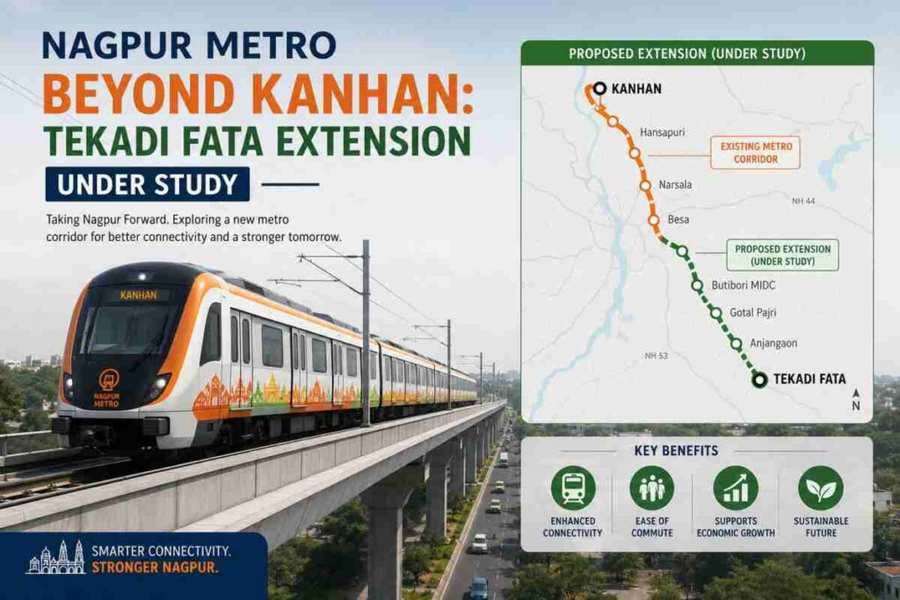
But the transit story doesn’t end there. In a development that has sent ripples of excitement through the real estate, commercial, and local citizen sectors, MahaMetro has officially initiated a study to extend the transit corridor further northeast, pushing past the initial terminal point at Kanhan town up to Tekadi Fata.
Triggered by intense community demand and strategic administrative intervention, this proposed alignment promises to bring thousands of suburban daily wagers, students, and families into the immediate fold of the mass rapid transit system. Whether you are an investor looking for the next micro-market goldmine, a local resident weary of long commutes, or a business owner analyzing logistics growth, this prospective extension represents a monumental shift in the geographic and economic fabric of the Nagpur Metropolitan Region.
What is the Nagpur Metro Kanhan to Tekadi Fata Extension?
Simple Explanation
At its core, the Nagpur Metro is an urban mass rapid transit system (MRTS) designed to offer air-conditioned, rapid, and predictable commuting across the city. Currently, the Orange Line’s northern extension (Reach 2A of Phase 2) spans $13\text{ km}$ from Automotive Square to Kanhan town, crossing the Kanhan River via a massive, specially engineered $500\text{-meter}$ steel viaduct.
The Tekadi Fata extension is a newly proposed corridor stretch under active structural and travel-demand assessment. It aims to push the metro alignment beyond Kanhan town to a crucial transit junction known as Tekadi Fata. This proposed extension moves past the previously designed terminal gates, absorbing heavily populated and rapidly industrializing suburban pockets including Kandri (K), Gondegaon, and Tekadi town into the main rapid transit grid.
Why It Matters in 2026+
As we move through 2026, the traditional boundaries separating Nagpur’s city core from its industrial peripheries have completely blurred. Satellite towns are no longer distant hinterlands—they are the residential backbones and manufacturing hubs of the workforce. Pushing the metro system up to Tekadi Fata matters tremendously right now for several systemic reasons:
- Suburban Decarbonization: It transitions a massive demographic from polluting, shared diesel three-wheelers and crowded public buses to an eco-friendly, solar-supplemented electric rail system.
- Industrial Synergy: It bridges the physical distance between North Nagpur’s residential clusters and neighboring mining and industrial enterprises.
- Overcoming Gridlock: The Kamptee Road corridor has historically been plagued by high accident rates due to heavy commercial trucks. Moving commuter traffic off the asphalt and onto elevated tracks drastically improves regional safety and logistical efficiency.
Key Features & Strategic Highlights
The expansion planning along the Kamptee Road-Kanhan axis is characterized by groundbreaking architectural engineering and forward-thinking mass transit frameworks.
Guinness World Record Double-Decker Viaduct
One of the most defining engineering achievements of the Nagpur Metro network is the iconic $5.62\text{-km}$ double-decker viaduct built along Kamptee Road. Holding the proud distinction of being registered in the Guinness World Records as the longest double-decker structure in the metro category globally, this structural marvel supports the highway flyover on the first tier and the elevated metro tracks directly above on the second tier. This design drastically reduces the requirement for ground-level land acquisition while optimizing vertical space in dense urban conditions.
The Kanhan River Steel Viaduct Bridge
To seamlessly push the tracks into the northern sub-region, Phase 2 engineering layouts feature a specialized $500\text{-meter}$ structural steel viaduct spanning across the wide Kanhan River bed. Unlike conventional concrete spans, this heavy-duty steel bridge structure is optimized to bear high-velocity rail stress while preserving the natural hydrological flow of the river below, setting up a sturdy gateway for future extensions toward Tekadi Fata.
Open-Loop Ticketing & High-Tech Stations
MahaMetro is deploying automated, high-tech infrastructure across its newer Phase 2 stations. Moving away from rigid, proprietary transit tokens, the network relies heavily on an Open-Loop ticketing mechanism. Commuters can tap in and out effortlessly using universal smart cards, digital wallets, or dynamic QR codes. Additionally, stations are designed as micro-renewable power hubs, integrating rooftop solar setups that feed clean energy back into the traction sub-stations.
Benefits of the Extended Corridor
The direct and indirect advantages of expanding the Orange Line beyond the Kanhan terminal touch every aspect of local socioeconomic life.
Financial Benefits
For the average daily commuter traveling from suburban clusters to the commercial areas of Sitabuldi, Indora Square, or Kadbi Square, travel costs can eat up a significant chunk of monthly wages. Currently, a combination of shared autorickshaws and regional state buses costs anywhere between ₹80 to ₹150 daily. The metro extension cuts travel costs significantly, offering safe, predictable transit at a fraction of the price. Furthermore, businesses operating out of North Nagpur will benefit from lower employee transit subsidies and improved punctuality.
Lifestyle & Community Benefits
Time spent in gridlocked traffic is time stolen from families and professional growth. Pushing the metro to Tekadi Fata reduces commuting times significantly. Thousands of industrial workers, mining staff from nearby Western Coalfields Limited (WCL) zones, and university students will be within walking distance of modern, air-conditioned public transit. The physical comfort of a climate-controlled train ride dramatically reduces daily fatigue, boosting overall community well-being and productivity.
Long-Term Real Estate Value
An infrastructure project of this scale fundamentally alters land usage patterns. Historically, regions beyond the Kanhan River were deemed too far for mainstream residential developments. However, with the transit study underway, land parcels near Kandri, Gondegaon, and Tekadi Fata are experiencing an upward valuation adjustment. Affordable housing developers are actively looking at these northern sub-markets, knowing that a completed metro line guarantees premium, high-speed connectivity to the heart of Nagpur city.
Location & Comprehensive Market Analysis
To fully comprehend the investment thesis of the Tekadi Fata extension, it is necessary to examine the physical geographic layout and the underlying economic drivers of this northern corridor.
[Nagpur City Core]
       │
  (Kamptee Road / Guinness Record Double-Decker Viaduct)
       │
[Automotive Square] ───(Phase 2: 13 Km Under Construction)───► [Kanhan Town Terminal]
                                                                      │
                                                             (Extension Under Study)
                                                                      ▼
                                                               [Kandri Habitation]
                                                                      │
                                                               [Gondegaon Pocket]
                                                                      │
                                                               [Tekadi Fata Node]
Connectivity Grid
The Kamptee Road corridor serves as the absolute vital artery connecting Nagpur directly to Madhya Pradesh and northern India via the national highway framework. Tekadi Fata acts as a crucial confluence point, collecting peripheral rural and semi-urban traffic before it funnels down toward the urban core. An elevated metro station at this location would act as a massive multi-modal hub, gathering transit traffic from deep within the surrounding suburban clusters.
Infrastructure Growth Markers
The entire stretch from Automotive Square, past the Cantonment and Kamptee Municipal areas, all the way to Kanhan is witnessing intense infrastructure upgrades. The transition of this zone features:
- The expansion of local arterial roads feeding into the main highway.
- The upgrade of electrical distribution lines, including dedicated $132\text{ kV}$ sub-stations to power the growing regional industrial and transit demand.
- The planned establishment of systematic logistics parks and warehousing facilities along the peripheral ring interfaces.
Future Potential
The regional demographic density around Kandri and Tekadi has scaled past older civic projections. With residential colonies expanding to house workforce populations, the area is ripe for commercial diversification. Retail brands, health clinics, and educational setups are tracking the progress of MahaMetro’s travel-demand assessments, positioning themselves to capture the inevitable surge in pedestrian traffic around future station steps.
Investment Potential & Practical Use Cases
Investing along an infrastructure corridor requires a clear look at macroeconomics, risk allocations, and timeline realities.
Return on Investment (ROI) Opportunities
The primary investment strategy along the proposed Tekadi Fata corridor revolves around the early-entrant advantage. Land values at the outer tip of Phase 2 are still highly competitive compared to the saturated micro-markets of South and West Nagpur (such as Wardha Road or Hingna). Real estate data indicates that upon the final execution and commissioning of metro lines, neighboring property values generally experience a value lift of $20\%$ to $35\%$. Savvy investors are focusing on clear-title agricultural-to-non-agricultural (NA) converted land blocks, residential plotting schemes, and commercial mixed-use spaces within a $1\text{-km}$ to $2\text{-km}$ radius of the proposed alignment path.
Honest Risk Factors
While the project’s upside is substantial, a realistic investor must carefully consider potential challenges:
⚠️ Project Timeline Shifts: The Tekadi Fata extension is currently being evaluated for integration into Nagpur Metro Phase 3. This means ground-level construction will only begin after Phase 2 reaches full operational status around late 2027 or early 2028. Investors must be prepared for a mid-to-long-term capital horizon ($5$ to $7\text{ years}$).
⚠️ Regulatory Approvals: The proposed line must clear meticulous feasibility metrics, travel-demand studies, state cabinet clearances, and final funding approvals from the Ministry of Housing and Urban Affairs (MoHUA). Any bureaucratic slowdown at the state or central level could delay structural execution.
Who Should Invest?
This corridor is highly suited for specific investor profiles:
| Investor Type | Primary Objective | Ideal Asset Choice |
| Long-Term Investors | Steady, multi-year capital compounding | Strategic land plotting layouts near Kandri & Gondegaon |
| Affordable Housing Builders | High-volume, budget-friendly residential sales | Large contiguous land parcels for township developments |
| Commercial Developers | Stable rental yields and high pedestrian traffic | Strategic corner commercial plots near the Tekadi Fata intersection |
Comparison: Tekadi Fata Axis vs. Alternate Growth Corridors
To understand the unique value of the northern extension, it helps to compare it against Nagpur’s other major growth zones under Phase 2.
Tekadi Fata Axis (North Extension)
- Primary Driver: Densely populated workforce settlements, retail hubs, and heavy mining/industrial workers.
- Affordability: Highly accessible entry-level pricing with plenty of room for capital appreciation.
- Transit Timeline: Early-stage study phase; longer runway to full operational launch.
Butibori MIDC Corridor (South Extension)
- Primary Driver: Large-scale manufacturing plants, chemical industries, and established textile sectors.
- Affordability: Moderate-to-high entry costs due to prior development phases along Wardha Road.
- Transit Timeline: Advanced construction phase; faster operational integration.
Hingna Road Corridor (West Extension)
- Primary Driver: Educational complexes, engineering colleges, and established mid-tier residential neighborhoods.
- Affordability: Premium pricing structures with a focus on institutional rentals and student housing.
- Transit Timeline: Under active structural alignment execution.
Why the Tekadi Fata Axis Stands Out
While the South and West corridors are highly localized around specific industrial or student groups, the northern axis beyond Kanhan offers a unique combination of unmet daily commuting demand and highly competitive land pricing. It addresses a critical geographic pain point: a large, daily commuting workforce that is completely dependent on choked highway lanes, making its transformation into an organized transit corridor highly impactful.
Step-by-Step Guide for Smart Property Investment along the New Route
Navigating real estate markets along a proposed metro line requires a systematic approach to protect your capital and maximize returns.
1.Verify Title Deeds and Land Ownership Clearances:Prerequisite Phase.
Before checking pricing, run a thorough legal search on the land title records. Ensure the property has clear, unencumbered status with zero pending ancestral or litigation disputes. Verify the 7/12 extract documents meticulously.
2.Cross-Reference Layouts with NMRDA Approvals:Regulatory Check.
Ensure the layout is completely sanctioned by the Nagpur Metropolitan Region Development Authority (NMRDA). Avoid unapproved layouts that lack institutional infrastructure provisions for water, sewage, and electricity grids.
3.Analyze Physical Proximity to the Proposed Metro Path:Geographic Mapping.
Examine the layout’s physical location relative to Kamptee Road and the proposed Tekadi Fata junction. Properties located between 500 meters to 1.5 kilometers from a proposed station offer the highest long-term valuation gains while remaining shielded from direct commercial noise.
4.Evaluate Available Infrastructure and Access Roads:Ground Assessment.
Visit the site to check for proper access roads (minimum 9 to 12 meters wide). Look for functional drainage networks, electrical sub-station spacing, and public connectivity links that ensure immediate livability when the line goes live.
Expert Tips for Navigating the North Nagpur Real Estate Boom
To secure a highly competitive edge in the North Nagpur micro-market, consider these insider tips from seasoned property specialists:
- Don’t Pay Tomorrow’s Prices Today: Some property brokers might try to price in the complete value of the metro extension right now. Remind them that the project is in a feasibility study phase, and negotiate your entry based on current ground realities.
- Focus on Commuter Hubs: Look for land plots near commercial focal points, retail markets, and established institutions around Kamptee and Kanhan. These areas will experience the highest footfall once multi-modal integration rolls out.
- Prioritize Clear Non-Agricultural (NA) Land Categories: Ensure all agricultural lands have been legally converted to Gunthewari-released or NMRDA-sanctioned residential/commercial plots to avoid bureaucratic delays later on.
- Monitor MahaMetro’s Official Phase 3 Bulletins: Keep a close watch on public announcements regarding the Comprehensive Mobility Plan (CMP) to track exactly where stations will be located, helping you adjust your buying decisions in real time.
Common Pitfalls to Avoid completely
- Buying Property Inside Future Right-of-Way (RoW) Zones: Avoid buying structures right next to the narrowest points of the highway without reviewing official alignment maps. You don’t want your land caught in compulsory land acquisition loops for future station entrances or road-widening work.
- Falling for Unrealistic “Guaranteed ROI” Marketing Clichés: Be skeptical of developers who promise instant double returns within months. Metro transformations are structural developments that take a few years to fully mature.
- Neglecting Last-Mile Connectivity Factors: A plot might look attractive on a map, but if it’s cut off from the main line by unpaved paths or natural barriers, its long-term rental appeal will drop. Ensure clear, direct access to the main road.
Anticipated Future Trends (2026–2030)
As the transit system develops over the next few years, the entire northern periphery of the Nagpur Metropolitan Region is expected to see several key shifts:
High-Density Transit-Oriented Development (TOD) Zones
Expect a shift toward higher Floor Space Index (FSI) allocations along Kamptee Road, extending down toward Kanhan and Tekadi. Regulatory bodies frequently provide extra construction allowances along transit axes, encouraging taller, more efficient mixed-use buildings within a $500\text{-meter}$ band of metro stations.
Systematic Logistics and Green Warehousing Hubs
With high-speed passenger movement handled by the elevated metro lines, the ground-level highway network will become much more efficient for heavy freight movement. This will likely drive the development of modern warehousing centers around outer rings, turning the region into a highly organized logistics node.
A Rapid Shift to Electric Feeder Vehicles
By 2028, expect the complete integration of emission-free, last-mile feeder networks at peripheral stations. Battery-powered e-rickshaws, shared electric micro-shuttles, and app-based scooter rentals will automatically link nearby manufacturing plants and residential pockets directly to the main platforms.
Conclusion
The proposed extension of the Nagpur Metro from Kanhan town to Tekadi Fata marks a major milestone in planning for the city’s future growth. By conducting early feasibility and travel-demand studies for Phase 3, MahaMetro is laying the foundation for a highly integrated, accessible, and economically vibrant northern suburb.
For the thousands of residents across Kandri, Gondegaon, and Tekadi, this project holds the promise of safer, shorter, and far more comfortable daily commutes. For the forward-thinking investor, it provides a unique chance to participate in a major structural growth story right from the ground level. As Nagpur continues to grow, staying informed and taking a disciplined, analytical approach to real estate will help you turn these major infrastructure upgrades into long-term financial success.
For residents and businesses across Gurugram, Noida, and Delhi, the message is clear: the days of being hopelessly stuck in traffic are winding down. for Cutting out traffic Govt has launched Delhi katra Expressway It is time to look forward, adapt to these emerging corridors, and position your investments to ride the wave of this historic infrastructure transformation.
You will see a city built for the next generation. Knowledge Park 5 is not just about real estate. It is about the quality of life you deserve. It represents a smart choice for your family and your finances. Take a drive through the sector and see the progress yourself. You will see a city built for the next generation. Sector 4 Greater Noida, is more than just a destination on a map; it represents the modern Indian dream of affordable luxury and planned growth. Knowing the Sector 4 Greater Noida pin code is just the beginning of your journey. Whether you are moving here for work, family, or investment, the area offers a robust foundation for a high-quality life. With its strategic location, improving infrastructure, and vibrant community, Sector 4 is undoubtedly one of the best places to plant your roots in the NCR. for more doubts get a On call free session by Real Estate Advisory or Visit byviveksingh.in to book a direct strategy consultation. Are you a Business Owner ? than For business owners, the primary benefit is the guaranteed footfall. Book your Commercial Shop in Mahagun Metro Mall Today as Being located right near the Vaishali Metro Station means a constant stream of commuters is funnelled toward the mall. High visibility leads to lower customer acquisition costs for retail tenants
Frequently Asked Questions
What is the current status of the Nagpur Metro extension to Tekadi Fata?
The extension beyond Kanhan town up to Tekadi Fata is currently under official review. MahaMetro has stated that travel-demand assessments and engineering feasibility studies for this specific stretch will be meticulously handled during the comprehensive planning layout of Nagpur Metro Phase 3.
How will the Tekadi Fata extension benefit everyday commuters along Kamptee Road?
The extension will bring highly populated suburban areas like Kandri, Gondegaon, and Tekadi within walking distance of modern public transit. Commuters will get a direct, air-conditioned link to central Nagpur, avoiding the traffic, delays, and safety risks of the busy highway.
When is Nagpur Metro Phase 2 expected to become fully operational?
The targeted timeline for completing and commissioning the main corridors of Nagpur Metro Phase 2 is December 2027. Construction work on key stretches—including foundation pillars, station structures, and power infrastructure—is moving along steadily.
Is it safe to invest in real estate around Kanhan and Tekadi Fata right now?
Yes, provided you do your homework. The area offers great long-term investment potential, but it is essential to verify that layout plans are approved by the NMRDA, confirm the property titles are clear, and plan for a mid-to-long-term investment horizon.
Will the proposed metro line extension cross the Kanhan River?
Yes. The ongoing Phase 2 works include a specialized $500\text{-meter}$ structural steel viaduct bridge designed to carry the metro tracks safely across the Kanhan River, providing a direct link for future extensions toward Tekadi Fata.