
Imagine sitting in a high-tech boardroom, watching an executive team plan their Next-Gen digital marketing strategy. They are mapping out hyper-complex, multi-layered prompt templates. They believe everyday consumers are typing 50-word masterworks into ChatGPT to find things like the best local coffee shop or a reliable software platform. The marketing team is fully convinced that the world has collectively transformed into an army of prompt engineers.
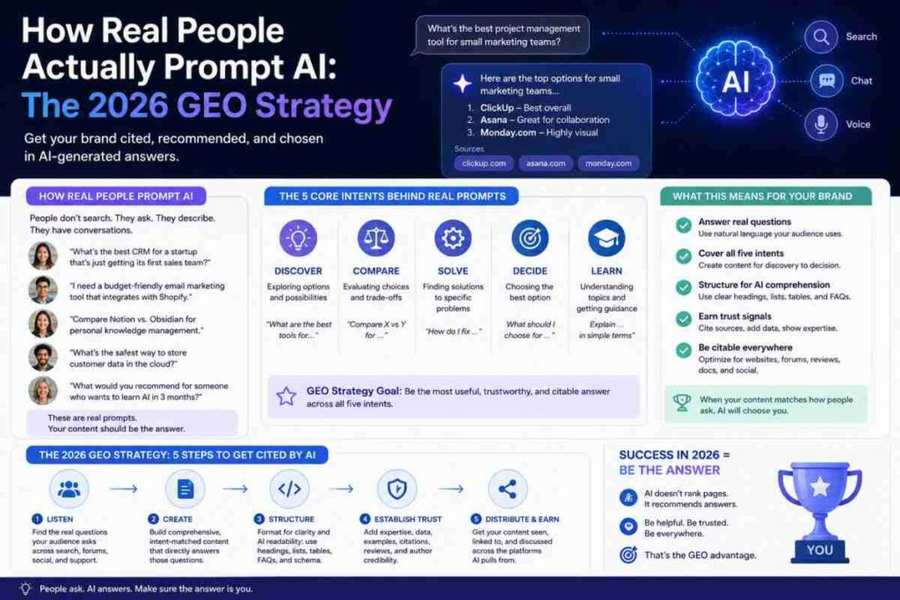
But then, you look at the raw data. The reality hits you like a bucket of ice water.
The sophisticated, multi-tiered prompting behavior we hear about on social media isn’t how the general public uses artificial intelligence. In fact, fresh consumer data shows that the vast majority of people treat AI search engines just like they treated Google back in 2010. They are typing short, messy, and direct phrases.
This massive gap between expectation and reality has triggered a complete rewrite of the digital marketing playbook. It is moving us rapidly past traditional Search Engine Optimization (SEO) and plunging us headfirst into Generative Engine Optimization (GEO). If you want your business, your brand, or your content to be cited by AI platforms, you have to understand how real people actually prompt AI. Let’s peel back the layers of real-world user behavior and map out exactly how to survive the generative search revolution.
Introduction
The digital marketing landscape is fractured. For over twenty years, the rules of visibility were simple: write a comprehensive blog post, sprinkle your target keywords throughout the text, build a few high-quality backlinks, and watch your site climb to the top of Google’s search results page.
Then came the AI explosion. Suddenly, tools like ChatGPT, Claude, Perplexity, and Google’s AI Overviews started serving up direct answers to users, bypassing the traditional list of blue links entirely.
Marketers panicked. They assumed that to win in this new era, they had to optimize for highly sophisticated, conversational inputs. They built artificial buyer personas that used flawless grammar and intricate context windows.
But new clickstream and consumer panel data from 2026 has exposed a glaring flaw in that logic. Real human beings don’t search that way.
This definitive guide will dive deep into the data behind true user behavior. We will analyze the structural differences between legacy search and the “agentic web.” Most importantly, we will show you exactly how to build a content strategy that aligns with how everyday people use AI tools.
What is Generative Engine Optimization (GEO)?
Simple Explanation
Generative Engine Optimization, or GEO, is the strategic practice of optimizing your online presence so that artificial intelligence engines cite, recommend, and mention your brand when users ask them questions.
Unlike traditional SEO, where the goal is simply to rank your website in position one or two on a static search page, GEO focuses on getting your content pulled into the AI’s “knowledge layer.” When an AI tool uses Retrieval-Augmented Generation (RAG) to pull real-time data from across the web, your site needs to be the definitive source it trusts.
Why It Matters in 2026 and Beyond
The shift toward generative answers is no longer a futuristic prediction; it is an active market reality. Recent consumer metrics reveal that over 37% of internet users now initiate their daily searches directly inside an AI interface rather than a traditional search bar.
With OpenAI’s ChatGPT surpassing hundreds of millions of active weekly users, and Apple deeply integrating native AI tools into Safari, the distribution system of the internet has fundamentally shifted. If your brand does not show up as a trusted citation inside an AI-generated response, you are effectively invisible to more than a third of your potential market.
Key Features of Real-World AI Prompts
The core reason why so many early GEO strategies fail is that they are built on “synthetic prompts”—the clean, long, and overly descriptive inputs invented by marketers. To succeed, we must look at the structural elements of actual human prompts.
The Dominance of the Short Query
Data shows that nearly two-thirds of all consumers write prompts that are 15 words or fewer. Clickstream data focusing on AI search modes reveals that the average real-world prompt length hovers between 4.2 and 8.7 words.
This means that despite the conversational capabilities of Large Language Models (LLMs), the average human still treats the prompt box like a classic search bar. They aren’t writing essays; they are typing fast fragments.
The Power of Intent Modifiers
While the queries are remarkably short, they are heavily loaded with intent. Analysis of real-world datasets shows that 24.5% of all user prompts explicitly include the word “best.”
Furthermore, roughly 28% of prompts mention hard budget or price constraints, and 16% are highly localized. Humans use AI to filter out the noise, demanding that the machine immediately surface the top, most cost-effective options available.
The “User Embedding” Context Layer
There is a fascinating nuance here: prompts actually get longer and more specific when users leverage the AI’s memory. About 32% of prompts contain deeply personal attributes, such as a user’s specific profession, health condition, size, or life stage.
Instead of typing a long prompt all at once, real people enter a short phrase, look at the AI’s response, and then refine it with a personal detail like, “I have sensitive skin, which of those options is better?” The model builds an ongoing profile of the user, altering the output based on a continuous conversation.
Benefits of Shifting to a GEO Strategy
+-----------------------------------------------------------------------+
|                             THE GEO EDGE                              |
+-----------------------------------+-----------------------------------+
|       TRADITIONAL SEO LIMITS      |         THE GEO ADVANTAGE         |
+-----------------------------------+-----------------------------------+
| * High dependency on click-rates  | * Direct inclusion in answers     |
| * Strict keyword position metrics | * Builds contextual authority     |
| * Vulnerable to layout updates    | * Omnipresent across platforms    |
+-----------------------------------+-----------------------------------+
Financial Benefits
Investing in GEO provides an incredible return on investment because it bypasses the increasingly expensive pay-per-click (PPC) bidding wars. When an LLM recommends your software, product, or service inside an answer, it acts as an authentic, organic endorsement. This highly targeted positioning yields qualified traffic with incredibly high conversion rates, completely free of ad spend.
Lifestyle and Business Benefits
For business owners and marketing directors, a solid GEO framework eliminates the constant anxiety of minor search algorithm updates. AI models look for deep topical authority, clear semantic structure, and third-party validation. By aligning your business with these foundational concepts, you build a sustainable digital asset that captures leads across multiple AI platforms simultaneously—including ChatGPT, Perplexity, and Gemini.
H3: Long-Term Value
The ultimate value of GEO lies in establishing your brand as a permanent node within an AI’s knowledge architecture. Once an LLM associates your brand name with a specific industry problem, it will continually surface your company across thousands of different long-tail queries. This creates a compounding compounding visibility loop that is incredibly difficult for your competitors to break.
Market and Intent Analysis: Keywords vs. Prompts
To understand how to optimize content effectively, we must trace how a basic keyword transitions into a real-world prompt, and how that prompt is ultimately processed by an artificial intelligence engine.
Structural Differences
Traditional search relies on matching exact syntax. Generative search, however, uses semantic vector space to understand the underlying relationship between concepts.
When a user types a messy, unstructured prompt, the AI engine does not search the web for that exact text string. Instead, it engages in “query fan-out,” breaking the user’s conversational input down into multiple simplified sub-queries to retrieve the most accurate information.
The Buyer’s Journey Shift
In the traditional model, a user moves down a funnel by clicking on different websites for awareness, consideration, and decision-making. In the AI era, that entire journey can happen within a single chat session. A user can start by asking, “Why is my laptop running hot?” and end with, “Buy the top cooling pad mentioned under $40” in less than two minutes.
The Localized AI Landscape
Local discovery has changed dramatically. While traditional local SEO depends heavily on ranking inside Google’s “Local Pack” map grid, AI engines pull information from user-generated reviews, community forums like Reddit, and local business directories. AI Overviews now appear on the vast majority of informational local queries, completely shifting how service providers and brick-and-mortar storefronts must position themselves online.
Investment Potential and Use Cases
+------------------------------------------------------------------------+
|                      GEO AUDIENCE FIT & RISK FACTOR                    |
+------------------------------------------------------------------------+
| AUDIENCE TYPE        | CORE FOCUS             | SUSTAINED VALUE        |
+----------------------+------------------------+------------------------+
| B2B SaaS Enterprise  | High-Authority Cites   | Industry Leadership    |
| Local Services       | High Intent / Location | Direct Conversions     |
| E-commerce Brands    | Price & Attribute Fits | High-Volume Sales      |
+----------------------+------------------------+------------------------+
ROI Opportunities
The highest return on investment in the GEO space belongs to early adopters in competitive niches. Because most brands are still hyper-focused on classic keyword rankings, companies that structure their sites for LLM extraction are securing exclusive real estate inside AI responses. This allows small-to-midsize businesses to outmaneuver massive corporations that are too slow to update their legacy content structures.
Risk Factors (Be Honest)
We must look at this space realistically. The primary risk of GEO is that AI platforms are fundamentally probabilistic rather than deterministic. This means that entering the exact same prompt twice can sometimes yield slightly different citations.
Furthermore, tracking your exact performance is incredibly difficult because traditional click tracking and keyword ranking tools cannot peer inside a private, individualized user conversation with an AI assistant.
Who Should Invest Immediate Resources
If you are a B2B SaaS company, a specialized local service provider, or an e-commerce store operating with clear product differentiators, you need to invest heavily in GEO immediately. If your business relies on being compared to alternatives, or if your customers regularly search for the “best” or “most cost-effective” options, your future growth is directly tied to your AI visibility score.
Comparison Section: Legacy SEO vs. Modern GEO
To truly grasp how to write content today, we need to look at exactly how traditional search approaches differ from generative engine optimization across core metrics.
Strategic Comparison Table
| Feature / Metric | Traditional SEO | Generative Engine Optimization (GEO) |
| Primary Goal | Rank in the top organic positions on a SERP | Get referenced, cited, or recommended in AI text |
| User Input Style | Short fragments (“running shoes size 10”) | Contextual questions (“best running shoes for a marathon runner with flat feet”) |
| Success Metrics | Clicks, impressions, domain authority, keyword positions | AI share of voice, citation volume, brand sentiment |
| Content Evaluation | Long-form coverage, backlink profiles, technical speed | Data density, extraction ease, quote/stat verification |
| Discovery Channel | Users click outward to your owned website | AI synthesizes your insights directly inside the chat |
Why GEO Stands Out
GEO is vastly superior for high-intent traffic because it removes the friction of browsing. When a user reads a traditional search page, they have to click open four or five tabs, read through pages of fluff, and piece the answer together themselves.
An AI search engine does that heavy lifting for them. When your brand is singled out by the AI as the ideal choice, the user’s trust level is substantially higher, leading to faster decisions and less friction.
Step-by-Step Guide to Optimizing Content for Real AI Prompts
To make sure your content is easily pulled by AI engines using Retrieval-Augmented Generation, follow this exact development workflow.
1.Map Topics to Real Prompts Instead of Keywords:Step 1.
Look at your traditional keyword lists and convert those concepts into actual natural-language questions. Use tools, forum searches, or customer service logs to find the exact conversational phrases real people use when they want to solve a problem. Focus on patterns that start with “Who,” “What,” “Where,” “Can,” or “Should.”
2.Build an LLM-Friendly Hierarchical Structure:Step 2.
Organize your page using a strict, logical progression of header tags (H1, H2, and H3). Do not mix them up or use them out of order. AI crawlers use headers to instantly map out the architecture of your text and determine which specific sub-section answers a user’s prompt.
3.Write Direct, Answer-First Prose:Step 3.
Adopt an “inverted pyramid” writing style. When you ask a question in an H2 or H3 header, provide the explicit, direct answer in the very first sentence below that header. Avoid vague introductions or marketing fluff. State the facts clearly, then use the rest of the section to provide deep context and explanation.
4.Infuse Data Density and Concrete Statistics:Step 4.
Inject real, verifiable numbers, percentages, and direct quotes into your body paragraphs. Research shows that informational pages containing dense statistics and expert quotes enjoy a 30% to 40% higher visibility and citation rate in AI search responses compared to generalized, superficial summaries.
5.Deploy Clean Schema Markup:Step 5.
Implement advanced structural data behind the scenes, including Article, FAQPage, and Organization schema markups. This technical framework gives AI crawlers a perfectly organized, machine-readable summary of your page, allowing the model to quickly ingest your content without any semantic confusion.
Expert Tips for Earning Consistent AI Citations
- Prioritize Unlinked Brand Mentions: AI models do not necessarily need a traditional hyperlink to connect your brand to an industry topic. Focus heavily on getting your company name mentioned across external press releases, industry blogs, and news sites, even if they don’t link back to you.
- Dominate Third-Party Hubs: Remember that AI platforms build their knowledge layers by reading the entire web. Your owned website only accounts for a tiny percentage of what an LLM considers. You must maintain an active, positive presence on review hubs like G2 or Trustpilot, and within community spaces like Reddit or Quora.
- Optimize for “Best” and “Price” Filters: Because more than half of real-world consumer prompts filter results by cost or quality, always include highly explicit pricing brackets, detailed product comparisons, and clear value propositions within your articles.
- Keep Your Information Fresh: Implement a visible, regularly updated “Last Modified” date at the top of your technical assets. AI models are heavily programmed to avoid serving outdated data to users, meaning fresh content holds an instant competitive advantage.
- Write Clean Summaries: Include bulleted summaries or key takeaway blocks at the end of long, complex sections. LLMs excel at pulling structured lists directly into their final chat responses.
Common GEO Mistakes to Avoid
Warning: Never optimize your content exclusively for machines while completely forgetting about the real human beings reading your pages.
One of the biggest mistakes digital marketers make is over-complicating their content. They pack sentences with heavy industry jargon and artificial prompt structures, creating an unnatural reading experience. If your text is too robotic for a human to read, its engagement metrics will tank, and AI models will eventually flag it as low-quality filler.
Another massive mistake is failing to isolate your variables. Marketers often try to optimize an entire website for hundreds of different conversational prompt variations simultaneously. This introduces an overwhelming amount of noise into your data stream, making it impossible to scale your efforts or measure whether your optimization tactics are actually working. Keep your tracking focused on clean, single-entity queries.
Future Trends in Generative Search (2026–2030)
As we look toward the end of the decade, the line between traditional search browsers and operating systems will completely blur. We are entering the era of truly agentic search, where AI software agents won’t just find information for a user—they will execute tasks on their behalf.
For example, a user will tell their phone, “Find the most reliable local roofer with availability this Tuesday and book an inspection under $150.”
The AI agent will crawl the web, parse local provider content, evaluate customer reviews, cross-reference pricing tables, and automatically finalize the appointment. Brands that have fully optimized their infrastructure for machine extraction will capture these automated conversions effortlessly, while companies lagging behind will find themselves completely locked out of the ecosystem.
Conclusion
The era of trying to game search engine algorithms with simple keyword stuffing is officially over. The data surrounding how real people actually prompt AI tools paints a remarkably clear picture: users want fast, direct, and deeply personalized answers without the friction of digging through endless pages of links. Winning in this environment requires a flawless fusion of traditional SEO foundations and modern GEO tactics.
By structuring your digital assets with absolute clarity, answering user intent instantly, and building robust authority across third-party community spaces, you ensure your brand becomes an invaluable part of the AI knowledge layer. Stop guessing what the algorithms want. Look at how real people communicate, build your content to serve those needs, and claim your spot at the center of the generative search revolution.
Frequently Asked Questions
Is GEO meant to completely replace my existing SEO strategy?
No, GEO does not replace SEO; it expands and complements it. Traditional SEO ensures your website is structurally sound, fast, and easily discoverable by web crawlers. GEO builds directly on top of that foundation, focusing specifically on making your content easily extractable and highly authoritative so that AI engines confidently cite your brand inside their conversational answers.
How can I track my business’s rankings inside AI search engines?
Tracking performance inside AI engines requires a major shift in mindset. Because traditional position tracking tools cannot view private chat histories, you must use modern AI visibility tools that measure your brand’s overall “share of voice” and tracking citations across a curated sample of core, high-intent questions.
Why do pages with a lot of statistics perform better in AI search?
AI engines prioritize accuracy, verification, and credibility. When an LLM utilizes Retrieval-Augmented Generation to construct a response, it actively searches for concrete data points to ground its claims. Pages packed with verified statistics, hard percentages, and clear expert quotes are much easier for an AI to use as definitive reference sources.
Do traditional backlinks still matter for a modern GEO strategy?
Yes, backlinks remain incredibly important, but their function has evolved. Instead of just passing algorithmic authority score, backlinks serve as critical trust signals to an LLM. When high-authority industry platforms and active community forums consistently link to your content, it proves to the AI that your brand is a trusted entity in the real world.
How do real-world prompt lengths impact my content optimization?
Because real human prompts are remarkably short and direct—often under nine words—you should not over-complicate your target keywords. Optimize your content for clean, high-volume head terms and clear consumer questions, rather than trying to match incredibly long, hyper-specific prompt strings that real people rarely type out.