
There is a distinct pulse that beats through India’s economic arteries when a long-awaited technological breakthrough finally transitions from boardroom blueprints to iron-and-steel reality. For nearly a decade, the Mumbai-Ahmedabad High-Speed Rail (MAHSR) corridor—popularly known as the Mumbai-Ahmedabad Bullet Train—felt to many like a horizon that kept receding.Skeptics pointed to land acquisition hurdles, soaring infrastructure budgets, and complex engineering challenges under marine waters and urban spans.
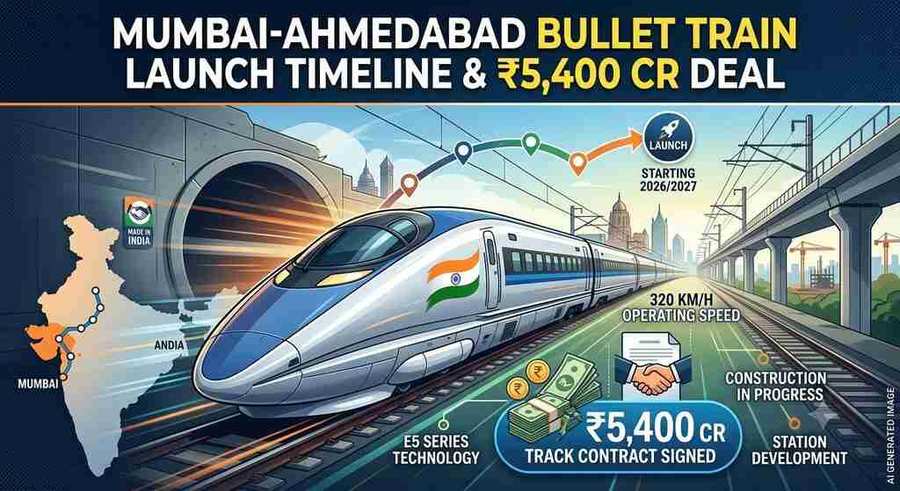
However, September 2026 marked an undeniable turning point. With National High Speed Rail Corporation Limited (NHSRCL) officially awarding a massive ₹5,400+ crore contract to PSU defense giant BEML Limited for high-speed rolling stock supply and maintenance, the timeline has solidified.The nation’s inaugural high-speed corridor now has an operational runway: trial runs beginning in mid-2027 and the first commercial section launching between Surat and Vapi by August 2027.
This comprehensive breakdown covers the new rollout schedule, domestic manufacturing breakthroughs, economic impacts, regional real estate shifts, and what passengers can expect when India enters the ultra-high-speed rail club.
               MUMBAI-AHMEDABAD HIGH-SPEED RAIL ROUTE

  [Mumbai] --- (Undersea Tunnel) --- [Thane / Virar / Boisar]
                                            |
                                            v
  [Sabarmati / Ahmedabad] <--- [Surat] <--- [Vapi]
What is the Mumbai-Ahmedabad Bullet Train Project?
A Simple Explanation
The Mumbai-Ahmedabad High-Speed Rail (MAHSR) is a 508-kilometer mega-infrastructure project engineered to connect India’s financial capital, Mumbai, with Gujarat’s primary economic engine, Ahmedabad.
Currently, traveling between these two metropolitan hubs takes anywhere from 6 to 8 hours by conventional train or 7 to 9 hours via national highways. The bullet train corridor will slash this travel time to just 1 hour and 58 minutes for express trips (stopping at major stations) and 2 hours and 07 minutes for all-stop services. Operating at commercial speeds of 250 km/h to 320 km/h, it introduces a whole new paradigm of intercity transit to the Indian subcontinent.
  TRAIN TRAVEL TIME COMPARISON

  Conventional Express Rail : [========================] 7 Hours
  Highway Travel            : [============================] 8 Hours
  Bullet Train (MAHSR)      : [======] 1 Hr 58 Min
Why It Matters in 2026 and Beyond
In 2026, India stands as one of the fastest-growing major global economies. Megacities are straining under severe highway congestion, crowded airspace, and suburban rail saturation. High-speed rail fills the vital gap between regional airlines and conventional express trains.
Moreover, this project serves as an engine for domestic technological advancement.Rather than relying entirely on fully imported trainsets, the pivotal ₹5,400 crore deal with BEML shifts high-speed rolling stock production to Indian manufacturing plants in Bengaluru under the Make in India initiative.
Key Features & Highlights
+-------------------------------------------------------------------------+
|                  PROJECT SNAPSHOT & TECHNICAL SPECIFICATIONS            |
+------------------------------------+------------------------------------+
| Parameter                          | Details                            |
+------------------------------------+------------------------------------+
| Total Length                       | 508 km (Gujarat: 348 km,           |
|                                    | Maharashtra: 156 km, UT: 4 km)    |
+------------------------------------+------------------------------------+
| Total Planned Stations             | 12 Stations                        |
+------------------------------------+------------------------------------+
| Testing Speed Target               | 280 km/h                           |
+------------------------------------+------------------------------------+
| Operational Cruise Speed           | 250 km/h - 320 km/h                |
+------------------------------------+------------------------------------+
| Key Manufacturing Partner          | BEML Limited (Bengaluru Facility)  |
+------------------------------------+------------------------------------+
| Rolling Stock Contract Value       | ₹5,400+ Crore                      |
+------------------------------------+------------------------------------+
| Initial Commercial Run Section     | Surat to Vapi (August 2027)        |
+------------------------------------+------------------------------------+
1. Indigenous High-Speed Rolling Stock (The B28 Trainset)
A standout aspect of the September 2026 milestone is the shift to indigenous manufacturing. BEML is producing high-speed trainsets (codenamed B28) at its specialized High-Speed Rail Complex in Bengaluru.Designed to achieve testing speeds of 280 km/h and regular operating speeds above 250 km/h, these trains feature advanced aerodynamic profiling, light-alloy stainless steel car bodies, and active vibration control.
2. Undersea and Underground Engineering
Out of the 508 km corridor, approximately 465 km is elevated on viaducts, 10 km on bridges, 26 km in tunnels, and 7 km traveling beneath the seabed near Thane Creek. The 21-kilometer underground tunnel between BKC (Bandra-Kurla Complex) and Shilphata includes India’s first undersea rail tunnel—a engineering feat using giant Tunnel Boring Machines (TBMs) alongside New Austrian Tunnelling Methods (NATM).
3. Modern Safety and Signaling Systems
The corridor incorporates Shinkansen-derived early-earthquake detection systems, digital automatic train control (C-ATC), and ballastless track structures (J-Slab). These systems ensure extreme stability at speeds exceeding 250 km/h, even during monsoon conditions or heavy seismic activity.
Benefits of the Mumbai-Ahmedabad High-Speed Rail
Financial Benefits
- Productivity Gains: Slashing travel times to under two hours turns a day-long business trip into a half-day excursion, saving millions of working hours annually for executives, investors, and traders.
- Logistical Cost Reduction: High-speed travel allows light cargo and time-sensitive commercial documents to move rapidly between the business districts of Mumbai, Surat, and Ahmedabad.
- Job Creation: Over 20,000 construction workers, engineers, rail operations specialists, and maintenance personnel have been directly employed during execution, with thousands of long-term operational roles opening up across the 12 depots and stations.
Business and Regional Integration
The line effectively merges the industrial hubs of Gujarat with the financial services heartland of Mumbai into a single unified economic zone:
- Surat: World capital of diamond processing and textile production.
- Vadodara: Major chemical, manufacturing, and educational center.
- Ahmedabad/Gandhinagar: Corporate hub, IT development zone, and GIFT City financial center.
- Mumbai: India’s corporate, banking, and commercial hub.
Environmental Impact
High-speed electric rail generates approximately one-fifth of the carbon emissions per passenger-kilometer compared to commercial air travel and one-fourth compared to private passenger vehicles. The shift from road and air travel to the electric bullet train is expected to eliminate thousands of tons of greenhouse gases each year.
Location & Market Analysis
                    CORRIDOR STATIONS & CONNECTIVITY

  (MH) BKC --> Thane --> Virar --> Boisar
          |
  (GJ) Vapi --> Bilimora --> Surat --> Bharuch --> Vadodara --> Anand --> Ahmedabad --> Sabarmati
The 508 km track spans 12 strategically selected stations across two states and one Union Territory:
- Mumbai (BKC) – Under-construction subterranean terminal in Mumbai’s central business district.
- Thane – Major suburban junction connecting MMR (Mumbai Metropolitan Region).
- Virar & Boisar – Expanding northern satellite towns in Maharashtra.
- Vapi – Gateway to industrial zones and Dadra & Nagar Haveli.
- Bilimora, Surat, & Bharuch – South Gujarat industrial belt.
- Vadodara & Anand – Central Gujarat manufacturing, dairy, and education belt.
- Ahmedabad & Sabarmati – Northern terminals with direct connections to metro lines and national rail tracks.
Real Estate Impact Along the Corridor
Real estate values near designated bullet train stations have seen significant movement:
- Surat & Vapi: Commercial office spaces and residential townships surrounding the bullet train terminals have seen land value appreciation as commuters eye day-travel options.
- Boisar & Virar: Suburbs previously considered distant residential outposts are evolving into transit-oriented development hubs.
- Sabarmati Hub: The multi-modal transport hub at Sabarmati is transforming northern Ahmedabad into an integrated commercial zone.
Investment Potential & Industry Impact
Public Sector and Private Sector Opportunities
The signing of the ₹5,400 crore BEML contract highlights a structural shift in how large-scale infrastructure is procured in India. Domestic public and private engineering heavyweights are stepping into roles historically dominated by foreign firms.
  BEML CONTRACT BREAKDOWN (₹5,400+ CRORE)

  [ Rolling Stock Manufacturing ] -----> 16 High-Speed Trainsets (B28)
  [ Maintenance & Depot Support ] -----> Multi-year Life-cycle Operations
  [ Supply Chain Integration   ] -----> Local Tier-1 & Tier-2 Component Suppliers
Key domestic sectors benefiting from this scale-up include:
- Specialized Metallurgy: High-tensile stainless steel, aluminum alloys, and specialized track fabrications.
- Electronics & Telecommunications: Signal processors, digital sensors, train control software, and power management units.
- Civil Infrastructure Maintenance: Long-term bridge, tunnel, and ballastless track maintenance contractors.
Risk Factors to Monitor
- Execution Delays on Urban Sections: While construction in Gujarat has moved rapidly, complex urban tunnel sections within Maharashtra face ongoing civil engineering challenges.
- Raw Material Cost Volatility: Global fluctuations in structural steel, copper, and specialized rail components can impact project costs and margins.
- Modal Adoption Rates: Long-term success depends on competitive ticket pricing relative to low-cost airline travel and express highways.
Comparison: Bullet Train vs. Alternative Travel Modes
+-----------------------------------------------------------------------------------+
|                            TRAVEL MODE COMPARISON MATRIX                          |
+---------------------+-------------------+--------------------+--------------------+
| Feature             | Bullet Train      | Flight (Air)       | Express Highway    |
+---------------------+-------------------+--------------------+--------------------+
| Travel Time         | ~2 Hours          | 1 Hr 15 Min (Flight| 7 to 9 Hours       |
|                     |                   | + 3 Hrs Airport)   |                    |
+---------------------+-------------------+--------------------+--------------------+
| City-Center Access  | Direct (BKC to    | Airport to Airport | Highway Outskirts  |
|                     | Sabarmati)        | (Outskirts)        |                    |
+---------------------+-------------------+--------------------+--------------------+
| Weather Disruptions | Very Low          | Moderate/High      | High               |
|                     | (Monsoon Proof)   | (Fog/Storms)       | (Traffic/Weather)  |
+---------------------+-------------------+--------------------+--------------------+
| Luggage Allowance   | Generous          | Restricted/Priced  | No Limit           |
+---------------------+-------------------+--------------------+--------------------+
| Carbon Footprint    | Ultra-Low         | Very High          | High               |
+---------------------+-------------------+--------------------+--------------------+
Why the Bullet Train Stands Out
While air travel seems fast on paper (a 75-minute flight time between Mumbai and Ahmedabad), city-center-to-city-center travel tells a different story. Getting to Mumbai’s Chhatrapati Shivaji Maharaj International Airport or Ahmedabad’s SVPI Airport, passing through security, waiting at gates, and commuting into town adds at least 2.5 to 3 hours to the trip.
The Bullet Train boards directly at central urban centers like BKC and Sabarmati, delivering a seamless, plug-and-play experience for business travelers.
Timeline of Progress: From Inception to Launch
<Timeline>
  <TimelineEvent title="Project Groundbreaking" time="September 2017">
    Prime Ministers of India and Japan lay the foundation stone for the 508 km corridor in Ahmedabad.
  </TimelineEvent>
  <TimelineEvent title="Undersea Tunnel Contracting" time="2023">
    Civil contracts awarded for India’s first 7-kilometer undersea rail tunnel along Thane Creek.
  </TimelineEvent>
  <TimelineEvent title="First Complete Viaduct Mileposts" time="Late 2025">
    Over 250 kilometers of elevated viaduct piers, track bed laying, and bridge spans completed across Gujarat.
  </TimelineEvent>
  <TimelineEvent title="₹5,400 Cr BEML Deal Executed" time="September 2026">
    NHSRCL signs landmark agreement with BEML for manufacturing and maintaining high-speed rolling stock in Bengaluru.
  </TimelineEvent>
  <TimelineEvent title="High-Speed Track Testing" time="Mid 2027">
    Trial runs scheduled to commence on the Surat-Vapi test section targeting speeds up to 280 km/h.
  </TimelineEvent>
  <TimelineEvent title="First Commercial Launch" time="August 2027">
    Commercial operations officially open to passengers along the 100-kilometer Surat-to-Vapi operational section.
  </TimelineEvent>
</Timeline>
5 Expert Recommendations for Investors and Businesses
- Track Transit-Oriented Real Estate Early: Look at commercial real estate within a 5 to 10 km radius of intermediate stations like Boisar, Vapi, and Bilimora. These regions are set to evolve into major commuter hubs.
- Explore Supply Chain Contracting: Local manufacturing suppliers in precision engineering, electrical componentry, and maintenance services should track vendor registrations with BEML and NHSRCL as secondary procurement phases roll out.
- Plan Dual-City Business Operations: Service firms, consultancies, and technology providers can begin structuring teams around same-day travel models between Mumbai and Gujarat hubs.
- Monitor Multi-Modal Integrations: Key regional hubs like Sabarmati, Vadodara, and BKC are building integrated bus, metro, and local rail transfers. Logistics and retail operations near these hubs stand to gain high footfall.
- Factor Energy & Tech Trends:Keep an eye on domestic rail technology development. The successful deployment of the B28 high-speed trainset will serve as the template for future planned corridors (e.g., Delhi-Varanasi, Chennai-Bengaluru).
Common Misconceptions to Avoid
- Misconception 1: “The train is entirely imported from Japan.”
Fact: While initial plans relied heavily on imported Shinkansen E5 trainsets, high costs led to a shift toward domestic manufacturing.BEML’s ₹5,400 crore deal ensures the rolling stock is made in India. - Misconception 2: “The entire 508 km line opens all at once.”
Fact: Like most major high-speed networks worldwide, the line opens in phases. The first operational phase launches between Surat and Vapi in August 2027, followed by progressive extensions north to Ahmedabad and south to Mumbai. - Misconception 3: “It only serves elite commuters.”
Fact: Multiple ticket tiers, unreserved options, and tiered pricing structures are planned to make high-speed travel accessible to everyday intercity commuters, daily business travelers, and tourists alike.
Future High-Speed Rail Corridors (2026–2030 Horizon)
The technology, local supply chains, and engineering standards built for the Mumbai-Ahmedabad route are laying the groundwork for India’s national high-speed rail network:
                  PLANNED HIGH-SPEED RAIL CORRIDORS

  [Delhi - Varanasi] -------------> ~800 km (Feasibility Completed)
  [Delhi - Ahmedabad] ------------> ~875 km (Under Planning)
  [Bengaluru - Hyderabad] --------> ~610 km (Proposed)
  [Chennai - Mysuru via BLR] -----> ~435 km (Detailed Project Report Stage)
With domestic players like BEML proving their capability to design and build high-speed trains locally, future lines are expected to see lower capital expenditures per kilometer and faster execution times.
Conclusion
The signing of the ₹5,400 crore train contract with BEML marks a decisive shift for the Mumbai-Ahmedabad High-Speed Rail project.What was once viewed primarily as an imported technology transfer has matured into a domestic industrial engine.With trial runs approaching in mid-2027 and the first passenger runs set for August 2027 between Surat and Vapi, India’s high-speed rail era is no longer a distant vision—it is actively taking shape on the tracks.
Frequently Asked Questions
What is the expected launch timeline for the Mumbai-Ahmedabad Bullet Train?
The first commercial section of the Mumbai-Ahmedabad Bullet Train, spanning roughly 100 kilometers between Surat and Vapi in Gujarat, is targeted to open to the public by August 2027. Trial runs on this section are scheduled to begin in mid-2027.
Who is manufacturing the bullet train sets for this project?
Under a contract valued at over ₹5,400 crore awarded by NHSRCL, public sector enterprise BEML Limited is manufacturing the high-speed trainsets (codenamed B28) at its specialized High-Speed Rail Complex in Bengaluru.
How fast will the Mumbai-Ahmedabad Bullet Train travel?
The train is designed for maximum testing speeds of up to 280 km/h, with regular passenger operational speeds expected to exceed 250 km/h to 320 km/h during commercial service.
How much will travel times drop between Mumbai and Ahmedabad?
Express services stopping only at major hubs will complete the 508 km journey in 1 hour and 58 minutes, while all-stop trains will cover the route in 2 hours and 07 minutes, down from the current 7 to 8 hours.
How many stations are planned along the route?
There are 12 planned stations along the corridor: Mumbai (BKC), Thane, Virar, Boisar, Vapi, Bilimora, Surat, Bharuch, Vadodara, Anand, Ahmedabad, and Sabarmati.