
For decades, the standard playbook for Indian real estate investors was disarmingly simple: purchase property in a Tier-1 metro like Mumbai, Bengaluru, Delhi-NCR, or Hyderabad, wait a few years, and watch asset values surge. However, as entry prices in primary metropolitan centers reach historic highs and rental yields hover around modest levels, the macro landscape is undergoing a structural transformation. High capital costs, lengthening daily commutes, and saturated infrastructure in tier-1 hubs have compelled savvy investors, homebuyer families, and corporate developers to shift their focus.
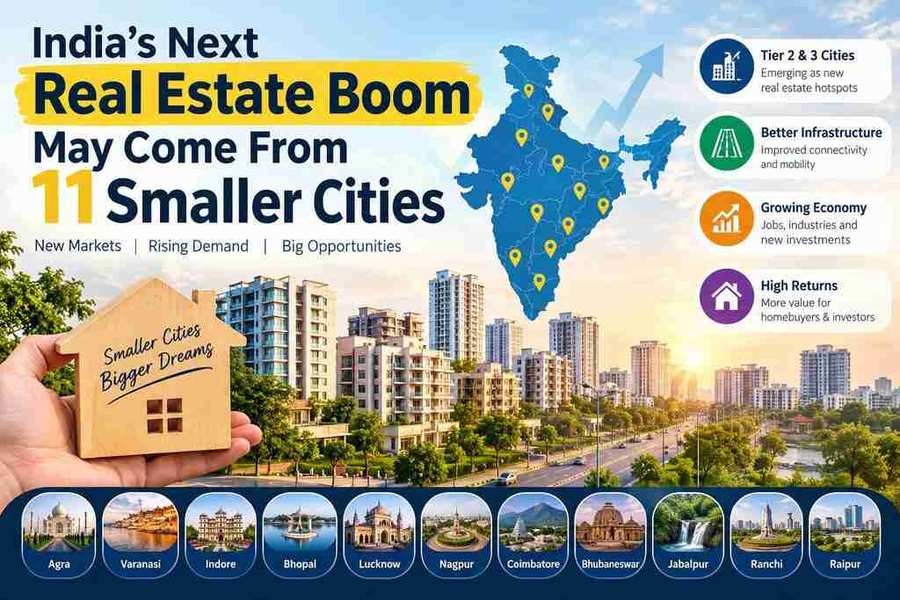
The ground reality across India’s urban landscape confirms this shift: India’s next real estate boom may come from 11 smaller cities. Driven by massive public infrastructure spending, rapid industrial decentralization, expanding expressways, and high-speed digital connectivity, secondary hubs across the country are quietly outperforming traditional powerhouses.
Recent urban development metrics show that housing prices in these key emerging markets have appreciated at nearly twice the rate of the top eight metropolitan areas over the past decade. Whether you are an individual homebuyer seeking lifestyle affordability or an institutional investor hunting for higher capital growth, understanding this migration of economic capital toward India’s emerging secondary cities is essential for navigating the decade ahead.
What is India’s Next Real Estate Boom May Come From 11 Smaller Cities?
Simple Explanation
When industry experts state that India’s next real estate boom may come from 11 smaller cities, they are referring to a structural shift in property capital deployment.According to landmark industry studies by organizations like the Confederation of Indian Industry (CII) and Knight Frank, 11 specific Tier-2 and emerging markets—namely Bhopal, Bhubaneswar, Chandigarh Tricity, Goa, Indore, Jaipur, Kochi, Lucknow, Nagpur, Visakhapatnam, and Coimbatore—are establishing themselves as primary growth drivers for residential, commercial, and logistics real estate.
Instead of urban expansion being concentrated exclusively in major metropolitan borders, wealth creation and land appreciation are spreading organically across these regional economic anchors. Lower baseline land costs combined with high-impact public investments—such as new airport terminals, ring roads, metro lines, and industrial corridors—are allowing these smaller cities to offer superior value propositions for both living and doing business.
Why It Matters in 2026+
The macroeconomic conditions of 2026 have amplified the momentum of secondary markets:
- Demographic Divergence:Cities outside the top eight metros are projected to experience urban population growth exceeding 28%, compared to less than 9% for traditional megacities.
- Infrastructure Parity: Major national initiatives—including industrial corridors, modern expressways, and regional air connectivity schemes—have drastically reduced transit times between smaller centers and primary hubs.
- Decentralized Employment:Over 50% of registered startups and a substantial portion of India’s MSME manufacturing output are now headquartered in Tier-2 and Tier-3 urban clusters.
- Yield Compression in Metros: With Tier-1 residential rental yields remaining tightly range-bound, smaller cities offer entry points where capital appreciation and rental returns can compound more effectively.
Key Features / Highlights
Feature 1: Superior Price Acceleration
Over the 2016–2026 decade, residential property across these 11 smaller markets recorded a Compound Annual Growth Rate (CAGR) of approximately 8%, compared to roughly 4% across the country’s top eight metropolitan areas.Between 2021 and 2026, property capital values in these 11 markets surged by an average of 63%, compared to a 42% rise in Tier-1 cities.
Feature 2: Robust Commercial and Logistics Footprint
Economic activity in smaller cities is no longer limited to regional administrative functions. Warehousing absorption across secondary hubs has reached parity with major metros, with cities like Lucknow, Jaipur, Nagpur, Indore, Coimbatore, and Bhubaneswar accounting for millions of square feet in industrial and logistics leasing annually.Concurrently, modern shopping centers and organized retail footprint in Tier-2 centers now constitute a significant portion of national retail stock.
Feature 3: Higher Quality of Life & Urban Affordability
Smaller markets offer modern housing options at entry price bands that remain accessible to middle-income and professional buyers. Combined with lower pollution levels, shorter commute times, and expanding healthcare and educational facilities, these cities provide an appealing urban lifestyle that megacities struggle to match.
Benefits of Investing in Smaller Cities
Financial Benefits
- Lower Barrier to Entry:Average residential entry rates across emerging hubs like Nagpur and Visakhapatnam range between ₹4,500 and ₹6,500 per sq ft, whereas cities like Indore, Lucknow, and Coimbatore offer quality developments in the ₹5,000 to ₹9,000 per sq ft range. By contrast, prime locations in Mumbai or Bengaluru command multiples of these figures.
- Higher Long-Term Capital Returns: Because these markets are earlier in their development curve, infrastructure developments—such as a new outer ring road or IT park—can trigger sharper land re-evaluations than in mature metropolitan sub-markets.
Lifestyle & Business Benefits
- Operational Cost Efficiency for Enterprises: Businesses operating in Tier-2 cities benefit from lower commercial lease costs and competitive labor expenses, driving corporate decentralization.
- Enhanced Livability for Families: Reduced congestion, access to larger home layouts, and proximity to green spaces contribute to overall well-being.
Long-Term Value Creation
India’s real estate sector is projected to reach $5.8 trillion by 2047, with Tier-2 and Tier-3 cities estimated to contribute 25% to 30% ($1.4 trillion to $1.7 trillion) of total economic output. Investing early in these 11 markets positions capital in locations expected to capture this structural value shift.
Location / Market Analysis: The 11 Growth Engines
+---------------------+-------------------------+---------------------------------+
| City / Market       | Quoted Price Band/sq ft | Key Economic / Drivers          |
+---------------------+-------------------------+---------------------------------+
| Goa                 | ₹11,500 - ₹13,500       | Holiday Homes, Tourism, MICE    |
| Chandigarh Tricity  | ₹7,500 - ₹10,500        | IT/ITeS, Services, Urban Quality|
| Jaipur              | ₹7,000 - ₹9,000         | Logistics, Tourism, MSMEs       |
| Kochi               | ₹7,000 - ₹9,000         | Maritime, IT Parks, NRI Flows   |
| Bhubaneswar         | ₹6,550 - ₹8,550         | Metals, IT Hubs, Smart Infra    |
| Lucknow             | ₹6,500 - ₹8,500         | Admin, Retail, Defense Corridor |
| Coimbatore          | ₹6,000 - ₹8,000         | Textiles, Auto Components, Tech |
| Indore              | ₹5,500 - ₹7,500         | Education, Pharma, Clean Urban  |
| Bhopal              | ₹5,000 - ₹7,000         | Administration, Logistics       |
| Visakhapatnam       | ₹4,500 - ₹6,500         | Port, Defense, Heavy Industry   |
| Nagpur              | ₹4,500 - ₹6,500         | Multi-Modal Logistics, Mining   |
+---------------------+-------------------------+---------------------------------+
(Data Source: CII-Knight Frank Industry Studies, 2026)
Connectivity & Infrastructure Growth
Public sector capital expenditure allocated toward national transport and urban connectivity infrastructure has reached historical highs. Projects such as the Samruddhi Mahamarg (benefiting Nagpur and Indore corridors), the Delhi-Mumbai Expressway (boosting Jaipur), and expanded coastal maritime routes (enhancing Kochi and Visakhapatnam) serve as major catalysts for real estate expansion.
Future Regional Potential
- North & Central Hubs (Lucknow, Jaipur, Bhopal, Indore, Chandigarh Tricity): Benefit from expanding freight corridors, manufacturing clusters, and IT satellite offices.
- Eastern & Coastal Champions (Bhubaneswar, Visakhapatnam, Kochi): Driven by port infrastructure, technology hubs, and heavy industrial investment.
- Southern Industrial Powerhouses (Coimbatore): Leverages specialized engineering, textiles, and growing technology centers.
- Specialty Destinations (Goa): Evolved from a seasonal vacation destination into a year-round luxury, remote work, and lifestyle real estate market.
Investment Potential / Use Case
ROI Opportunities
Property investment in smaller cities typically takes three primary paths:
- Residential Land Plots & Villas: High capital appreciation potential along emerging bypass corridors and ring roads.
- Commercial & Warehousing Assets: Stable long-term lease yields backed by national logistics providers and retail chains.
- Rental Apartments in IT/Education Hubs: High occupancy rates near regional universities, medical centers, and tech parks (e.g., Indore, Coimbatore, Kochi).
Risk Factors (Be Honest)
- Slower Secondary Market Liquidity: Reselling a residential asset in a Tier-2 market may take longer compared to prime Tier-1 corridors.
- Execution Risk of Regional Developers: Unorganized, smaller local builders may face project delivery delays; buyers should focus on tier-1 national developers expanding into secondary cities or top-rated local builders.
- Dependency on Employment Creation:Property appreciation relies on cities converting new infrastructure into sustained industrial and office jobs.
Who Should Invest
- End-User Buyers: Families seeking spacious, modern homes without metropolitan price tags.
- Long-Term Investors: Individuals seeking capital appreciation over 5–10 years.
- NRIs (Non-Resident Indians): Overseas buyers looking to reinvest in their native states or build diversified property portfolios in high-growth Indian hubs.
Comparison Section
Smaller Cities vs Top 8 Metros
| Feature / Metric | Top 8 Metros (Tier-1) | 11 Emerging Smaller Cities |
| 5-Year Price Growth (2021–2026) | 42% Average | 63% Average |
| 10-Year CAGR (2016–2026) | ~4% | ~8% |
| Average Entry Price (Residential) | ₹9,000 – ₹35,000+ per sq ft | ₹4,500 – ₹13,500 per sq ft |
| Commute & Traffic Density | High to Extreme | Low to Moderate |
| Warehouse & Logistics Growth | Mature / Saturated | Rapid Expansion Sector |
| Urban Population Growth Projection | ~8.7% | ~28.2% |
Why Smaller Cities Stand Out
The primary advantage of secondary cities lies in the balance of entry valuation versus growth runway. In Tier-1 centers, much of the future infrastructure value is already priced into current square-footage rates. In the 11 identified smaller markets, land valuations still have room to compound as new connectivity projects and commercial hubs mature.
Step-by-Step Guide: How to Invest in Emerging City Real Estate
Step 1: Identify Key Local Growth Corridors
Map out local infrastructure developments: identify ring roads, highway bypasses, metro rail expansions, or newly announced IT and industrial parks. Focus your property search within a 5–10 km radius of these active infrastructure projects.
Step 2: Perform RERA & Legal Due Diligence
Verify that the property and builder are fully registered under state Real Estate Regulatory Authority (RERA) databases. Ensure clear land titles, non-agricultural (NA) land conversion permissions, and local municipality approvals.
Step 3: Evaluate Developer Credentials & Track Record
Prioritize projects developed by reputed national real estate brands or well-capitalized local builders with a proven history of delivering projects on schedule.
Expert Tips (Human Touch Section)
- Follow Logistics and Retail Chains:Before buying in a new area, check where major retail centers, distribution hubs, or logistics warehouses are setting up. Commercial capital flows often precede residential booms.
- Focus on Township Projects: In Tier-2 cities, integrated gated townships offering security, power backup, clubhouses, and green spaces tend to appreciate faster and command higher rental demand than standalone buildings.
- Inspect Physical Connectivity Personally: Never buy land in a secondary city based solely on marketing brochures. Visit the location to assess road connectivity, water supply access, and proximity to municipal limits.
- Prioritize Education and Medical Hub Proximity: Emerging cities often develop around major university campuses or specialty hospital centers, which provide consistent rental demand.
- Maintain a 5 to 7 Year Investment Horizon: To capture maximum value from public infrastructure completion, hold secondary market assets through full development cycles.
Common Mistakes to Avoid
- Buying Unregistered Agricultural Land: Purchasing cheap rural land without proper Non-Agricultural (NA) zoning or municipal approval can lead to legal and approval delays.
- Overestimating Short-Term Rental Yields: Buying property in a location without established corporate or educational anchors can result in extended vacancy periods.
- Ignoring Local Employment Micro-Trends:Infrastructure alone does not guarantee real estate growth. Confirm that the target city is actively attracting new corporate investments, factories, or service-sector employers.
- Neglecting Property Management Plans: If investing in a city away from your primary residence, set up reliable local property management support to handle tenant turnover and property maintenance.
Future Trends (2026–2030)
- Rise of GCC Satellite Campuses:Global Capability Centers (GCCs) and IT services firms are expanding satellite offices in Tier-2 markets like Coimbatore, Kochi, Indore, and Chandigarh to access regional talent pools.
- Expansion of Organized Retail Malls:Modern, multi-brand shopping centers will continue expanding across Tier-2 cities, bringing international brands closer to regional consumers.
- Green & Smart Urban Features: New residential projects in smaller cities are increasingly adopting solar integration, rainwater harvesting, and smart home automation to appeal to younger homebuyer demographics.
Conclusion
The data is clear: India’s next real estate boom may come from 11 smaller cities.As primary metropolitan markets adjust to high valuations, cities like Bhopal, Bhubaneswar, Chandigarh Tricity, Goa, Indore, Jaipur, Kochi, Lucknow, Nagpur, Visakhapatnam, and Coimbatore offer a compelling combination of capital growth, affordable entry prices, and expanding urban infrastructure.
For homebuyers and investors looking to optimize long-term returns, shifting focus toward these emerging urban centers offers a strategic advantage in India’s evolving property landscape. Evaluate local growth corridors, prioritize verified RERA-approved developments, and align your investments with the ongoing decentralization of Indian real estate.
Frequently Asked Questions
Which 11 smaller cities are driving India’s next real estate boom?
The 11 emerging cities identified by real estate industry research are Bhopal, Bhubaneswar, Chandigarh Tricity, Goa, Indore, Jaipur, Kochi, Lucknow, Nagpur, Visakhapatnam, and Coimbatore. These markets have outperformed top Tier-1 cities in price growth due to strong infrastructure investment, rising consumption, and commercial decentralization.
Why are smaller cities outperforming Tier-1 metros in property price growth?
Smaller cities offer lower baseline land costs, expanding job markets, and high-impact infrastructure projects like ring roads and expressways.Residential prices in these 11 markets grew by an average of 63% between 2021 and 2026, compared to 42% across top eight metropolitan areas.
Is it safe to invest in Tier-2 city real estate for long-term ROI?
Yes, provided you invest in RERA-approved projects developed by reputed builders near active commercial or infrastructure corridors. Tier-2 cities benefit from expanding manufacturing, IT, and logistics sectors, creating sustained housing demand and attractive long-term capital appreciation.
What is the average property price range in these emerging smaller cities?
Property prices vary depending on the city and locality.Entry rates in markets like Nagpur and Visakhapatnam range from ₹4,500 to ₹6,500 per sq ft, while cities like Indore, Lucknow, and Coimbatore quote between ₹5,500 and ₹9,000 per sq ft.Premium markets like Goa range between ₹11,500 and ₹13,500 per sq ft.
Should I invest in residential plots or apartments in smaller cities?
Both asset classes offer clear advantages. Residential plots in expanding suburban corridors often deliver higher percentage capital appreciation over a 5 to 7 year horizon, whereas gated apartment townships yield better rental income and require less active management.