
Imagine standing at a choked city intersection in suburban India during peak evening hours. Horns blare, exhaust fumes hang heavy in the air, and the traffic light cycles three times before your vehicle inches forward ten feet. Now, imagine walking just five minutes to an elevated, air-conditioned station, stepping onto a sleek stainless-steel train, and zipping across the metropolis in twenty minutes flat.
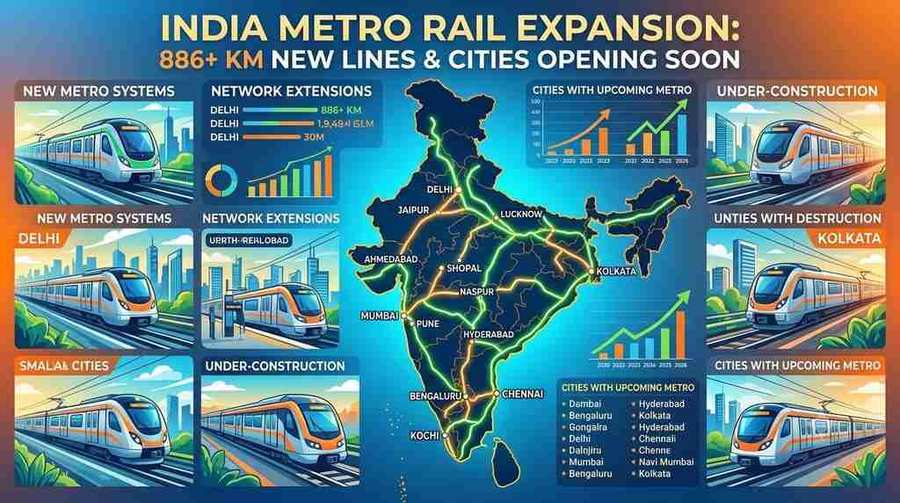
That contrast isn’t just a urban planner’s pipe dream; it is the daily reality taking shape across dozens of Indian cities. India is currently in the middle of the world’s most ambitious urban transit transformation. With nearly 886 kilometers to over 1,000 kilometers of new metro rail lines under active construction, urban transit in India is expanding at a scale never seen before in South Asia.
From Tier-1 megacities like Delhi, Mumbai, and Bengaluru to rapidly expanding Tier-2 hubs like Surat, Bhubaneswar, and Patna, track layers and tunnel boring machines are operating around the clock. Millions of commuters are eagerly tracking these updates, wondering: When will a metro line reach my neighborhood?
In this comprehensive analysis, we unpack India’s massive metro expansion footprint, dissect the cities scheduled to open new lines next, explore the real estate and financial ripple effects, and reveal what urban mobility in India will look like through 2030.
What Is the India Metro Rail Expansion?
Simple Explanation
The India metro rail expansion refers to the nation’s coordinated, multi-billion-dollar infrastructure effort to build mass rapid transit systems (MRTS) across urban hubs. It encompasses heavy metro rail networks, regional rapid transit corridors (such as Namo Bharat RRTS), and light-rail solutions designed specifically for smaller cities, including Metrolite and Metro Neo.
Rather than relying purely on road widening—which inevitably succumbs to induced demand—India is shifting its transit foundation onto tracks. The goal is simple: provide clean, punctual, high-capacity public transport that operates completely separated from surface road traffic.
Why It Matters
Urbanization in India is accelerating at a historic pace. By the end of this decade, over 40% of the country’s population will reside in urban centers. Without mass transit, cities risk total gridlock, soaring carbon emissions, and massive productivity losses.
Modern metro systems are not merely transportation networks; they act as the economic circulatory system of modern cities. They democratize mobility, allowing office workers, students, daily wage earners, and business owners to navigate vast urban landscapes efficiently and affordably.
Key Features & Highlights of India’s Metro Expansion
The scale of this infrastructure initiative is defined by key technological and engineering advances:
1. Driverless Train Operations (DTO)
Modern network expansions—such as sections of Delhi Metro Phase IV, Mumbai Metro, and Bengaluru Namma Metro Phase 2—are adopting Grade of Automation 4 (GoA4). This allows trains to operate completely autonomously from central control rooms, increasing operational frequency, minimizing human error, and reducing energy consumption through optimized acceleration and braking.
2. Multi-Modal Transit Integration
Gone are the days when a metro station stood as an isolated island. Modern corridor planning prioritizes seamless interchange nodes. New stations are being physically linked via skywalks, travelators, and unified ticketing systems to existing Indian Railways junctions, bus rapid transit (BRT) terminals, and airports.
3. Tier-2 Adaptation (Metrolite & Metro Neo)
Recognizing that full-scale heavy metro systems carry high capital expenditure (often exceeding ₹200–300 Crore per kilometer), the Union Ministry of Housing and Urban Affairs (MoHUA) has standardized lightweight alternatives:
- Metrolite: Lower-cost light rail systems operating on dedicated rights-of-way, perfect for cities with lower peak-hour peak-direction traffic (PHPDT).
- Metro Neo: Electric bus-trolley systems running on elevated or dedicated concrete guideways, offering metro-like speed and reliability at a fraction of the build cost.
Benefits of the Expanding Metro Network
                  ┌─────────────────────────────────────────┐
                  │       India Metro Expansion Benefits    │
                  └────────────────────┬────────────────────┘
                                       │
         ┌─────────────────────────────┼─────────────────────────────┐
         ▼                             ▼                             ▼
┌─────────────────┐           ┌─────────────────┐           ┌─────────────────┐
│Financial Growth │           │ Quality of Life │           │ Long-Term Value │
├─────────────────┤           ├─────────────────┤           ├─────────────────┤
│• Travel Savings │           │• Time Reclaimed │           │• Carbon Reduction│
│• Property Value │           │• Weather Proof  │           │• Transit Hubs   │
│• Commercial Hubs│           │• Safe Commuting │           │• TOD Development│
└─────────────────┘           └─────────────────┘           └─────────────────┘
Financial Benefits
- Direct Cost Savings for Commuters: Switching from personal vehicles or cab aggregators to metro rail cuts monthly commuting costs by up to 60–70%.
- Real Estate Appreciation: Properties located within a 500-meter to 1.5-kilometer radius of upcoming metro stations consistently experience property value increases of 15% to 45% between project clearance and commercial operations.
Lifestyle & Business Benefits
- Punctuality & Reclaimed Hours: A commuter traveling from suburban Mumbai or Outer Delhi to downtown financial districts can save 1.5 to 2 hours every day. That translates to hundreds of hours of reclaimed personal time annually.
- Expanded Labor Pool: Businesses operating near transit corridors can tap into talent pools from across an entire metropolitan area, rather than relying solely on nearby residents.
Long-Term Value
- Environmental Decarbonization: Electric metro trains significantly reduce urban air pollution and reduce national reliance on imported fossil fuels.
- Transit-Oriented Development (TOD): Cities are revising zoning laws along metro lines, allowing higher floor space index (FSI) to create vibrant, mixed-use commercial and residential hubs directly around transit nodes.
Regional Breakdown: Which Cities Are Opening New Lines Soon?
With roughly 1,000 km under construction nationwide, several major metros and new entrant cities are on the verge of cutting ribbons on key corridors. Here is a detailed look at the major regions:
┌───────────────────────────────────────────────────────────────────────────┐
│                      Major Metro Corridors Opening                        │
├───────────────────┬─────────────────────────────┬─────────────────────────┤
│ City / Region     │ Key Expansion Corridors     │ Primary Impact Zone     │
├───────────────────┼─────────────────────────────┼─────────────────────────┤
│ Delhi-NCR         │ Phase 4 (Golden, Magenta)   │ S. Delhi, Airport, Noida│
│ Mumbai Metro      │ Lines 2B, 4, 6, 9           │ Western & Eastern Suburbs│
│ Bengaluru         │ Pink, Blue (Airport Line)   │ Outer Ring Road, Hebbal │
│ Chennai           │ Phase 2 (3 Corridors)       │ IT Corridor, Suburbs    │
│ Tier-2 Entrants   │ Surat, Patna, Bhubaneswar   │ New Regional Networks   │
└───────────────────┴─────────────────────────────┴─────────────────────────┘
1. Delhi-NCR (Phase IV & RRTS Expansion)
The Delhi Metro Rail Corporation (DMRC) continues to push the boundaries of urban transit with its massive Phase IV project.
- Priority Extensions:Priority stretches on the Golden Line (Aerocity to Tughlaqabad) and extensions to the Magenta and Pink Lines are reaching advanced stages of civil execution and systems integration.
- Regional Integration:The Namo Bharat Regional Rapid Transit System (RRTS) is actively linking Delhi to satellite hubs like Ghaziabad and Meerut, proving that regional high-speed transit can seamlessly blend with local urban lines.
2. Mumbai Metropolitan Region (MMR)
Mumbai is carrying out a monumental shift from a reliance on north-south suburban railways to a multi-directional grid of elevated and underground metro lines.
- Key Lines Moving Toward Opening:Major focus rests on Metro Line 2B (D.N. Nagar to Mandale), Line 4 (Wadala to Kasaradavavali), Line 6 (Swami Samarth Nagar to Vikhroli), and Line 9.
- Impact: Once operational, these lines will relieve pressure on the overloaded Mumbai suburban train network and significantly ease arterial road congestion along the Western Express Highway (WEH) and Eastern Express Highway (EEH).
3. Bengaluru (Namma Metro Phase 2, 2A & 2B)
Bengaluru’s tech corridors have long suffered from severe surface road congestion. Namma Metro’s ongoing expansion directly targets these key pain points:
- Outer Ring Road (ORR) & Airport Line: Phase 2A (Silk Board to KR Puram) and Phase 2B (KR Puram to Kempegowda International Airport) represent the city’s most anticipated infrastructure developments.
- Pink Line: The underground and elevated stretch from Kalena Agrahara to Nagawara is set to establish a crucial north-south corridor through dense residential and business districts.
4. Chennai Metro Phase 2
Chennai is building one of the largest simultaneous metro expansions in South India.
- Scope:Phase 2 spans 118.9 km across three distinct corridors (Corridor 3, 4, and 5), crisscrossing the city from Madhavaram down to the OMR IT corridor and Sholinganallur.
- Phased Openings: Initial elevated stretches, particularly along the Poonamallee to Porur section, are targeted for phased commercial clearance ahead of the deeper underground network.
5. Tier-2 Cities Making Their Metro Debut
The expansion is no longer limited to Tier-1 capitals:
- Surat Metro: Gujarat’s commercial textile and diamond hub is nearing completion on its Dream City to Althan stretch, marking a milestone for regional transit in western India.
- Patna Metro: Priority corridors in Bihar’s capital are progressing through active construction to deliver mass transit to one of India’s most densely populated urban centers.
- Bhubaneswar Metro: Odisha’s capital has embarked on Phase 1 construction connecting Capital Hospital to Trishulia, laying the groundwork for future regional transit growth.
Real Estate & Economic Use Case: Who Should Invest?
The announcement and execution of an 886+ km national metro pipeline creates clear opportunities for property buyers and institutional investors alike.
                 ┌────────────────────────────────────────────────┐
                 │           Metro Transit ROI Lifecycles         │
                 └───────────────────────┬────────────────────────┘
                                         │
       ┌─────────────────────────────────┼─────────────────────────────────┐
       ▼                                 ▼                                 ▼
┌──────────────┐                  ┌──────────────┐                  ┌──────────────┐
│ DPR Approval │                  │ Construction │                  │ Operations   │
│  (0 - 15%)   │ ───────────────► │  (15 - 35%)  │ ───────────────► │  (35 - 50%+) │
└──────────────┘                  └──────────────┘                  └──────────────┘
ROI Opportunities
- Pre-Construction Entry: Investing in residential or commercial land right when a Detailed Project Report (DPR) is approved generally yields maximum long-term capital appreciation.
- Rental Yield Expansion: Residential units located within walking distance of operational metro stations command rental premiums of 10% to 20% compared to similar properties located further away from mass transit.
Honest Risk Factors to Consider
While transit-adjacent real estate is attractive, prospective investors should keep practical risks in mind:
- Construction Delays: Large-scale infrastructure projects can face timeline adjustments due to complex land acquisition, utility shifting, or specialized underground tunneling requirements.
- Temporary Disruption: Living or running a ground-level business directly along an active metro construction corridor involves enduring noise, dust, and temporary traffic diversions for multiple years.
Who Should Invest?
- First-Time Homebuyers: Looking for inflation-hedged residential properties that ensure an easy commute to major employment hubs.
- Commercial Property Investors: Targeting retail storefronts or micro-office spaces situated right at metro station exit gates to capitalize on high foot traffic.
- Long-Term Land Banks: Institutional investors buying land along proposed Metrolite or Metro Neo routes in emerging Tier-2 corridors.
Comparison: Heavy Metro vs. Metrolite vs. Metro Neo vs. Bus Rapid Transit (BRT)
Choosing the right transit mode depends on a city’s capacity requirements, budget, and existing density:
| Feature / Metric | Heavy Metro | Metrolite | Metro Neo | Bus Rapid Transit (BRT) |
| Average Cost / km | ₹200 – ₹350+ Crore | ₹100 – ₹120 Crore | ₹50 – ₹70 Crore | ₹10 – ₹20 Crore |
| Passenger Capacity (PHPDT) | 40,000 – 80,000+ | 15,000 – 30,000 | 8,000 – 15,000 | 4,000 – 10,000 |
| Track Infrastructure | Heavy Rail / Steel Wheels | Light Rail Track | Rubber Tyres on Guideway | Dedicated Asphalt Lane |
| Ideal City Type | Tier-1 Megacities (Delhi, Mumbai) | Tier-2 Capitals (Gorakhpur, Nashik) | Medium Cities / Feeders | Secondary Arterial Roads |
| Operational Speed | 35 – 45 km/h (Avg) | 30 – 35 km/h (Avg) | 25 – 30 km/h (Avg) | 18 – 25 km/h (Avg) |
Step-by-Step Guide: How Cities Plan, Build, and Open a Metro Line
Building an urban metro line is a complex engineering and administrative undertaking. Here is how a corridor progresses from an initial blueprint to its grand opening:
<Sequence>
  <Step title="Feasibility & Detailed Project Report (DPR)">
    State transit agencies conduct comprehensive traffic mobility surveys to assess Peak Hour Peak Direction Traffic (PHPDT). Based on this data, planners draft a Detailed Project Report outlining exact alignment, station locations, civil engineering requirements, estimated costs, and expected financial internal rate of return (FIRR).
  </Step>
  <Step title="Government Approvals & Financial Sanctions">
    The DPR moves through the State Cabinet and is subsequently submitted to the Union Ministry of Housing and Urban Affairs (MoHUA) and the Union Cabinet for clearance. Funding models are established—typically involving a 50:50 equity split between Central and State governments, supplemented by soft loans from international agencies (e.g., JICA, ADB, AIIB, EIB).
  </Step>
  <Step title="Land Acquisition & Utility Shifting">
    Civil engineering teams identify land requirements for station pillars, underground shafts, and maintenance depots. High-voltage power lines, underground water mains, gas pipelines, and telecom cables are carefully relocated without interrupting core municipal services.
  </Step>
  <Step title="Civil Construction (Viaducts & Tunnels)">
    For elevated stretches, launching girders place pre-cast concrete pier caps and U-girders along road medians. For underground sections, massive Tunnel Boring Machines (TBMs) work beneath the city surface to excavate tunnels and install reinforced concrete liner segments.
  </Step>
  <Step title="Track Laying, Electrification & Signaling">
    Once civil structures are complete, specialized track-laying teams install ballastless track beds. Overhead Equipment (OHE) or Third Rail power systems are erected alongside advanced Communication-Based Train Control (CBTC) signaling systems.
  </Step>
  <Step title="Trial Runs & CMRS Inspection">
    Empty train sets undergo months of rigorous speed testing, emergency brake checks, and automated signaling integration trials. Finally, the Commissioner of Metro Railway Safety (CMRS) conducts exhaustive physical inspections to issue final commercial safety clearance.
  </Step>
</Sequence>
Expert Tips for Navigating City Commutes and Property Purchases
- Verify the CMRS Mandate, Not Just Press Releases: If you are buying property based on an upcoming metro line, track official safety inspection schedules. A line only opens for commercial public use after receiving formal clearance from the Commissioner of Metro Railway Safety (CMRS).
- Prioritize Interchange Stations: Properties located near multi-line interchange stations retain higher resale value and stronger rental demand because they connect commuters to multiple city quadrants without requiring a street-level transfer.
- Look at Last-Mile Connectivity: A shiny new metro line is only as good as your access to it. Check whether nearby stations feature dedicated feeder bus bays, shared e-rickshaw stands, or secure park-and-ride facilities.
- Leverage National Common Mobility Cards (NCMC): Avoid daily ticket queues by adopting NCMC-compliant transit cards or digital UPI ticketing apps, which work seamlessly across metro systems, municipal bus lines, and suburban rail networks nationwide.
- Inspect Noise Insulation for Direct-Line Properties: If you are purchasing a home situated within 50 meters of an elevated metro viaduct, ensure the building features sound-dampening double-glazed windows and check whether the transit authority has installed acoustic rubber bearings and noise barriers along the tracks.
Common Real-World Mistakes to Avoid
- Assuming Proposed Lines Are Set in Stone: Buying real estate based purely on initial feasibility studies or master plan announcements can be risky. Metro alignments often shift during detailed engineering surveys due to underground utility conflicts or land acquisition challenges. Wait until civil construction tenders are officially awarded.
- Ignoring Station Entry/Exit Locations: Station structures can span hundreds of meters. A property might look close to a transit line on paper, but if the nearest designated exit gate is located across a multi-lane highway without a pedestrian crossing, daily access can prove difficult.
- Overlooking Depots and Land Requirements: Underground and elevated lines both require large, dedicated maintenance depots. Purchasing property adjacent to a site designated for a major maintenance yard can mean dealing with persistent high-intensity lighting and low-frequency rail movement noise during overnight maintenance hours.
Future Trends: What Urban Mobility Looks Like (2026–2030)
As India’s urban rail network targets a total operational footprint of 1,500+ kilometers over the coming years, key transformations will reshape how people move:
                                  ┌──────────────────────────────────┐
                                  │   Urban Mobility Horizons 2030   │
                                  └─────────────────┬────────────────┘
                                                    │
             ┌──────────────────────────────────────┼──────────────────────────────────────┐
             ▼                                      ▼                                      ▼
┌──────────────────────────┐           ┌──────────────────────────┐           ┌──────────────────────────┐
│   Solar & Green Power    │           │ Unified Digital Mobility │           │ National Rapid Transit   │
├──────────────────────────┤           ├──────────────────────────┤           ├──────────────────────────┤
│• Rooftop Solar Depots    │           │• Single QR / Open Banking│           │• High-Speed Regional     │
│• Regenerative Braking    │           │• Integrated Micro-Mobility│          │  RRTS Network Expansion  │
│• Net-Zero Station Design │           │• Real-Time Fleet Tracking│           │• Airport Express Links   │
└──────────────────────────┘           └──────────────────────────┘           └──────────────────────────┘
- 100% Green Energy Stations: Metro networks across India are aggressively deploying rooftop solar panels across elevated stations and maintenance depots. Advanced regenerative braking systems installed on modern rolling stock feed electrical energy back into the grid during decelerations, offsetting up to 30% of total traction power demands.
- Seamless AI-Driven Ticketing: Multi-modal travel is moving toward unified digital ecosystems. Commuters will be able to book a single digital pass covering their first-mile electric feeder scooter, main-line metro ride, and last-mile auto-rickshaw using open mobility protocols and unified QR-code standards.
- Expansion of RRTS Inter-City Webs: Following the rollout of early Namo Bharat corridors, regional rapid transit networks will continue expanding across major urban clusters. This allows workforce mobility across distances of 100+ kilometers in under 45 minutes, transforming satellite towns into thriving residential extensions of primary economic hubs.
Conclusion
The construction of over 886 kilometers of new metro rail lines across India is more than just a massive civil engineering project—it is a fundamental restructuring of urban life. By lifting millions of daily commuters out of gridlocked surface traffic and onto fast, clean, reliable electric rail, India is laying the foundation for sustainable economic growth across its metropolitan regions.
Whether you are a daily commuter looking forward to shorter travel times, a homebuyer planning your next move, or an investor tracking growth corridors, keeping an eye on upcoming line openings offers a clear window into where Indian cities are heading next. The tracks are laid, the trains are running, and the future of urban mobility in India is arriving right on schedule.
Frequently Asked Questions
Which Indian city currently has the largest operational metro network?
Delhi-NCR operates the largest metro rail network in India, spanning over 350 kilometers with hundreds of operational stations. It connects the capital city seamlessly with neighboring satellite hubs, including Noida, Ghaziabad, Gurugram, Faridabad, and Bahadurgarh.
How do Metrolite and Metro Neo differ from a traditional metro?
Metrolite and Metro Neo are lower-cost mass transit systems designed for Tier-2 cities with lower passenger volumes.Metrolite uses smaller light-rail trains running on elevated or dedicated ground tracks, while Metro Neo uses electric rubber-tyred trolley buses operating on dedicated concrete elevated guideways.
How does a new metro line impact nearby real estate prices?
The construction of a new metro line typically increases surrounding property values by 15% to 45% over the project lifecycle. Property values generally experience an initial rise upon formal project approval, followed by steady gains during construction and operational launch.
What is the National Common Mobility Card (NCMC) in India?
The National Common Mobility Card (NCMC) is an interoperable transport card backed by the Government of India. It enables commuters to use a single card or digital wallet to pay for metro rides, suburban trains, municipal buses, toll booths, and parking facilities across participating networks nationwide.
How are underground metro tunnels constructed in busy Indian cities?
Underground tunnels are excavated using advanced Tunnel Boring Machines (TBMs) operating deep beneath street level. These massive machines cut through soil and rock, remove excavated earth, and install pre-cast concrete structural tunnel rings simultaneously, minimizing surface traffic disruptions above.