Navigating through industrial corridors during peak hours often feels like a test of patience. Heavy freight containers, pothole-ridden lanes, dust, and sudden monsoon waterlogging have long plagued commuters and logistics operators around Greater Noida’s key manufacturing hubs. However, relief is officially on the horizon. The Greater Noida Industrial Development Authority (GNIDA) has approved a major infrastructure project aimed at transforming the primary transit arterial of Ecotech-3.
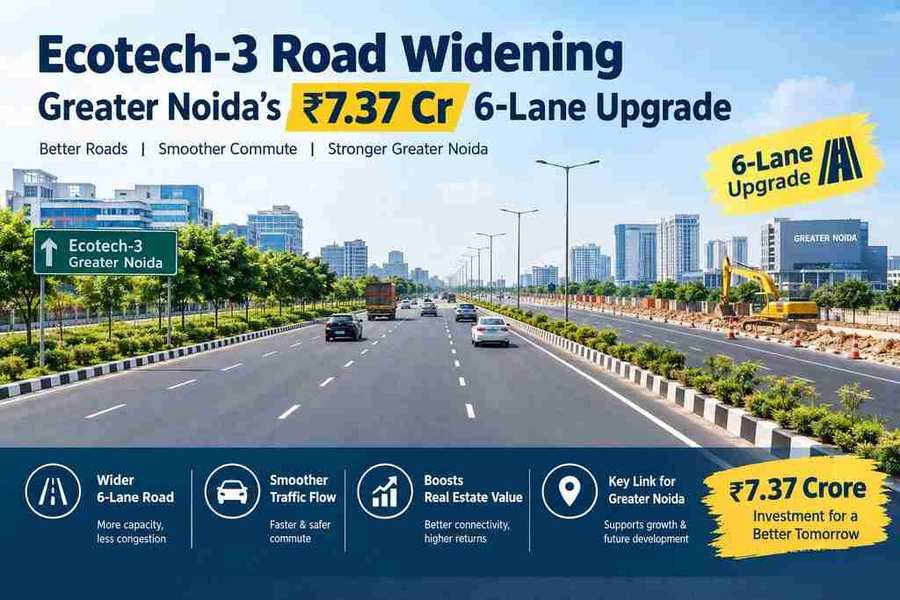
This investment involves expanding a vital 2-kilometer stretch from four lanes to six lanes, stretching directly from the Noida-Surajpur-Dadri road up to the New Holland Roundabout. Backed by a dedicated budget of ₹7.37 crore, this project is not merely a paving job—it addresses core logistical bottlenecks, storm drainage, and air quality issues. In this deep dive, we will explore what this infrastructure project entails, how it impacts regional connectivity, its influence on real estate and commerce, and why it represents a major milestone for Greater Noida’s urban growth.
What is the Ecotech-3 Road Expansion Project?
Simple Explanation
The Ecotech-3 road expansion is a targeted infrastructure upgrade designed to widen approximately 2 kilometers of industrial roadway from a standard 4-lane layout to a high-capacity 6-lane corridor. The project covers the key industrial stretch linking the Noida-Surajpur-Dadri main road with the busy New Holland Roundabout (Golchakkar).
In addition to physical asphalt widening, the project includes:
- Drainage Completion:Finishing long-pending stormwater drains along the corridor to prevent seasonal flooding.
- Eco-Friendly Paving: Installing grass paver blocks and perforated tiles along the shoulders to promote rainwater harvesting directly into the subterranean water table.
- Dust Control Measures: Hard-paving earthen shoulders to prevent heavy vehicle tires from churning up airborne particulate matter.
Why It Matters in 2026+
As Greater Noida consolidates its position as NCR’s premier industrial and electronics manufacturing hub, transport logistics require continuous upgrades. By expanding road capacity, GNIDA ensures that heavy industrial traffic moving between Greater Noida West, Surajpur, and Dadri can flow smoothly without stalling commercial transit or damaging passenger vehicles on deteriorated surfaces.
Key Features and Project Highlights
Feature 1: Capacity Expansion (4-Lane to 6-Lane)
Widening the 2 km stretch provides extra lane clearance specifically tailored for heavy commercial vehicles, trailers, and logistics trucks that frequent Ecotech-3.
Feature 2: Integrated Drainage & Water Harvesting
Unfinished drainage systems along this corridor previously caused heavy water accumulation during monsoons.Completing these drains, combined with perforated eco-tiles along the road margins, enables rapid surface runoff clearance and promotes groundwater recharge.
Feature 3: Anti-Dust & Environmental Engineering
Dust pollution from unpaved roadsides is a major source of poor air quality in industrial sectors. By lining the entire 2-kilometer stretch with grass paver blocks, the project locks down loose topsoil and cuts down PM10 and PM2.5 emissions caused by vehicular movement.
Benefits of the Ecotech-3 Expansion
Financial Benefits
For factory owners, logistics operators, and local businesses, reduced transit delays directly translate into lower fuel consumption and minimal vehicle wear-and-tear. Faster turnaround times for delivery trucks improve operational efficiency across the industrial belt.
Lifestyle & Business Benefits
Daily commuters traveling between Greater Noida West (Noida Extension), Dadri, and Surajpur will experience significantly shorter commute times during rush hours.The elimination of standing water and potholes creates safer driving conditions for two-wheelers and passenger cars alike.
Long-Term Value
Well-maintained, flood-resistant industrial infrastructure increases property values for surrounding commercial plots, warehouse facilities, and nearby residential sectors.
Location and Market Analysis
Connectivity
Ecotech-3 serves as a vital bridge connecting the dense residential clusters of Greater Noida West with the heavy industrial corridors of Surajpur and Dadri. Smooth throughput along the New Holland Roundabout keeps freight moving efficiently toward regional highways.
Infrastructure Growth
GNIDA’s multi-pronged approach—combining road widening, environmental containment, and flood mitigation into a single project—sets a strong framework for upcoming industrial sector retrofits across National Capital Region (NCR).
Future Potential
With logistics hubs expanding near Dadri and the nearby Noida International Airport at Jewar pushing industrial demand across Gautam Buddha Nagar, Ecotech-3 is poised to attract higher-tier manufacturing investments once traffic bottlenecks are cleared.
Investment Potential and Use Case
ROI Opportunities
Investors holding warehousing space, commercial land, or industrial plots in Ecotech-3 and nearby zones stand to see enhanced capital appreciation and higher rental yields as supply chain reliability improves.
Risk Factors (Be Honest)
- Construction-Phase Traffic Delays: During active roadworks and drainage excavation, temporary lane closures may cause short-term slowdowns.
- Timeline Execution: Infrastructure projects rely heavily on strict contractor adherence to deadline milestones, especially regarding drainage works prior to monsoon seasons.
Who Should Invest
- Logistics & Warehousing Firms: Seeking fast access between Surajpur, Dadri, and national highways.
- Industrial Entrepreneurs: Looking for locations with modernized municipal services and environmental compliance.
- Commercial Real Estate Buyers: Aiming to capture rental growth driven by nearby residential and industrial expansion.
Comparison Section
Ecotech-3 Upgrade vs. Standard Road Resurfacing
| Feature | Standard Resurfacing | Ecotech-3 6-Lane Expansion Project |
| Scope | Basic asphalt overlay | Full 4-to-6 lane road widening |
| Drainage Work | None / Patchwork | Completion of master stormwater drains |
| Environmental Engineering | None | Perforated tiles & grass paver blocks for dust/water |
| Budget Allocation | Minimal repair cost | Dedicated ₹7.37 Crore outlay |
| Traffic Relief Level | Short-term smoothing | Long-term heavy vehicle capacity boost |
Why It Stands Out
Unlike basic patch-and-repair jobs, GNIDA’s holistic ₹7.37 crore allocation addresses the root causes of road degradation—water pooling, heavy vehicle overload, and soil erosion—providing a sustainable, long-term solution.
Step-by-Step Guide for Commuters & Business Owners
Step 1: Identify Alternate Peak-Hour Routes
During active construction along the 2 km stretch between the Noida-Surajpur-Dadri road and New Holland Roundabout, plan journey buffers or use secondary arterial connectors.
Step 2: Audit Facility Access for Freight
Logistics teams operating in Ecotech-3 should coordinate heavy truck loading times during off-peak hours to avoid construction zones.
Step 3: Leverage Improved Drainage Integration
Factory owners along the expansion stretch should align their internal drainage outlets with the newly completed GNIDA stormwater drains to prevent localized pooling during heavy rains.
Expert Tips (Human Touch Section)
- Track Authority Bulletins: Keep an eye on official GNIDA notifications for lane diversion schedules during peak asphalt laying.
- Optimize Delivery Windows: Shift heavy freight movements to late-evening or early-morning windows while work is ongoing.
- Verify Drainage Alignments:Property owners adjacent to the road should inspect perimeter walls to ensure paver block installation doesn’t obstruct private access gates.
- Factor in Long-Term Plot Value: If planning property acquisitions in Ecotech-3, target parcels near upgraded 6-lane arteries for superior freight access.
- Report Potholes Early: Utilize civic reporting portals for any temporary road surface hazards during construction.
Common Mistakes to Avoid
- Ignoring Temporary Traffic Diversions: Driving heavy vehicles through active road-laying zones causes surface deformation before asphalt fully sets.
- Blocking Drainage Outlets:Dumping industrial debris near open drain trenches disrupts the installation of completed stormwater networks.
- Assuming Immediate Completion: Infrastructure upgrades require structured phases; allow time for base compaction, drainage completion, and paver block laying before expecting peak traffic flow.
Future Trends (2026–2030)
- Green Industrial Corridors: Incorporating grass paver blocks and perforated tiles will likely become the standard design framework for all future industrial sector roadworks across NCR.
- Integrated Logistics Nodes: Improved road link capacity will accelerate the convergence of manufacturing facilities and cold-chain logistics in the Dadri-Surajpur belt.
- Smart Drainage & Flood Mitigation: Eco-tile rainwater harvesting integration will help manage urban runoff while recharging local groundwater reserves.
Conclusion
The widening of the 2-kilometer Ecotech-3 stretch from four to six lanes is a vital development for Greater Noida’s industrial network. With ₹7.37 crore dedicated to expanding lanes, completing stormwater drains, and mitigating dust through grass paver blocks, GNIDA is addressing traffic congestion, seasonal flooding, and environmental concerns all at once.For businesses, commuters, and real estate stakeholders across Greater Noida West, Dadri, and Surajpur, this project delivers smoother transit, cleaner roads, and long-term economic value.
For investors seeking a balance of consistent rental income and strong future capital appreciation, the Cyber Arch IT Park Studio Apartment Greater Noida offers an undeniable opportunity. Its location is a magnet for the corporate and student population, locking in long-term demand. Now is the opportune moment to conduct final due diligence and secure your stake in the future of Greater Noida West. Invest in a Cyber Arch IT Park Studio Apartment Greater Noida today and position your portfolio for exponential growth.
❓ SEO FAQ SECTION
Frequently Asked Questions
Q1: What is the main objective of the Ecotech-3 road expansion project in Greater Noida?
The project aims to widen a key 2-kilometer road stretch in Ecotech-3 from 4 to 6 lanes.Backed by a ₹7.37 crore budget, GNIDA is undertaking this work to reduce traffic congestion, finish incomplete drainage systems, and control industrial dust pollution.
Q2: Which exact route is being upgraded in Ecotech-3?
The widening project covers the approximately 2-kilometer road connecting the main Noida-Surajpur-Dadri road to the New Holland Roundabout in the Ecotech-3 industrial sector.
Q3: How will the ₹7.37 crore budget be utilized by GNIDA?
The budget covers road widening to 6 lanes, repairing existing potholes, finishing incomplete stormwater drains, and installing perforated grass paver tiles along roadsides to manage rainwater and dust.
Q4: How does this road expansion help prevent monsoon waterlogging?
In addition to widening the road, GNIDA is completing missing drainage links and laying porous grass paver blocks.These features allow rainwater to drain quickly and sink into the ground, reducing surface flooding.
Q5: Who will benefit most from this infrastructure upgrade?
Commuters traveling between Greater Noida West, Surajpur, and Dadri, as well as industrial unit operators and logistics companies in Ecotech-3, will benefit from faster commutes and reduced traffic delays.