
Living without electricity in the blistering heat or freezing winter is a reality no family should face. Yet, for over 150,000 residents residing across thousands of households in the floodplain (Doob Area) colonies of the Yamuna and Hindon rivers in Western Uttar Pradesh—including Noida, Greater Noida, and Ghaziabad—this has been an ongoing struggle.
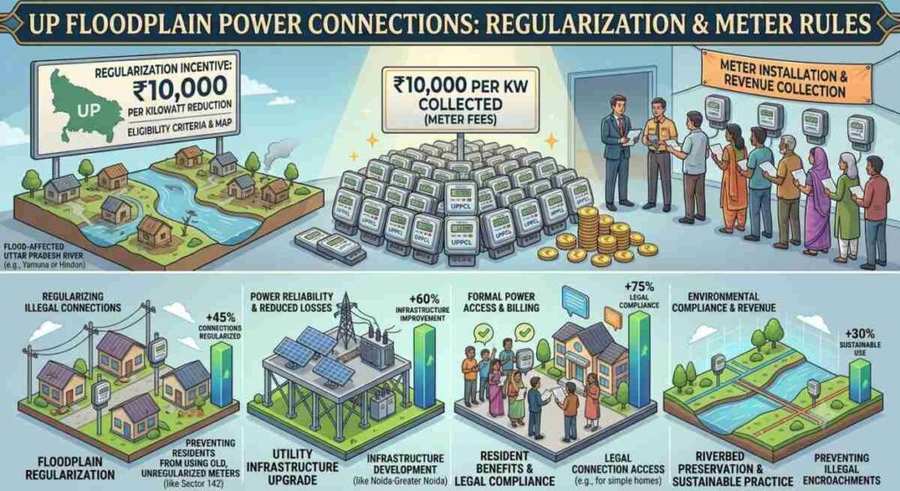
For years, these unauthorized residential pockets have existed in an administrative gray zone. Environmental mandates from the National Green Tribunal (NGT) banned permanent infrastructure on active river floodplains, while local power distribution discoms like Pashchimanchal Vidyut Vitran Nigam Limited (PVVNL) struggled to curb rampant illegal power tapping.
However, a major policy shift is underway. The Uttar Pradesh Government, led by Chief Minister Yogi Adityanath, is formulating a balanced regulatory mechanism.By introducing temporary, prepaid electricity meters and legal power lines for Doob Area colonies, the state aims to eliminate dangerous power syndicates, plug multi-crore losses from power theft, and fulfill a basic humanitarian requirement for thousands of working-class families.
What is the UP Government Floodplain Power Connection Scheme?
Simple Explanation
The UP Government Floodplain Power Connection Initiative is a policy framework designed to provide legal, prepaid, temporary electrical infrastructure to residences located in designated river floodplains (Doob Kshetra).
Instead of treating these residents as invisible or forcing them to rely on dangerous hook lines (katiya connections) run by local power syndicates, Uttar Pradesh Power Corporation Limited (UPPCL) is deploying temporary power lines using heavy-duty armoured cables. These connections come equipped with prepaid meters, ensuring that every unit of electricity consumed is accounted for and paid in advance.
[Illegal Tapping / Unsafe Hooking]
                 │
                 ▼
[State Interventions: Disconnection Drives & Mass FIRs]
                 │
                 ▼
[Policy Framework: Legal Temporary Infrastructure]
                 │
                 ▼
[Prepaid Meters & Armoured Aerial Bunched Cables]
Why It Matters
This framework addresses a complex nexus of urban development, environmental safety, and energy economics:
- Eradicating Illegal Electricity Syndicates:Local power mafias have historically tapped into 11kV primary lines, running unregulated networks and overcharging residents ₹10–₹12 per unit while racking up massive distribution losses for discoms.
- Protecting Public Safety: Unregulated, exposed electrical wires hanging across narrow lanes pose severe electrocution risks, especially during heavy rains and monsoon river overflows.
- Humanitarian Access to Basic Needs: Denying electricity deprives children of study light, disables household water pumps, and severely impacts daily life. Legal connections provide immediate relief without granting formal land ownership rights.
Key Features and Highlights
1. Prepaid Metering Infrastructure
To prevent non-payment and avoid long-term administrative disputes, all temporary connections in the Doob Area require smart prepaid meters. Residents recharge their accounts digitally prior to consumption.
2. High-Safety Armoured Cables
The state distribution utilities are deploying overhead Aerial Bunched Cables (ABC) and heavy-duty armoured lines. These cables are insulated against physical tampering, drastically reducing opportunities for unauthorized hooking (katiya).
3. Non-Land Titling Clause (Legal Disclaimer)
A critical feature of this policy is its strict distinction between utility access and property ownership. Receiving a temporary power connection does not grant the resident legal land title, immunity from urban development authority action, or defense against future court-ordered demolitions.
Benefits of Regulating Doob Area Power Supply
| Benefit Category | Key Advantages | Impact on Stakeholders |
| Financial | Curbs multi-crore Aggregate Technical & Commercial (AT&C) power losses. | Discoms (PVVNL / UPPCL) recover legitimate revenue. |
| Consumer Protection | Eliminates middlemen who charge exorbitant rates per unit. | Low-income residents pay standard, regulated state tariffs. |
| Safety & Infrastructure | Replaces dangerous, sagging hook lines with insulated armoured wiring. | Reduces fire hazards, transformer blowouts, and electrocution risks. |
| Administrative Control | Maps previously unmonitored households into state energy databases. | Enhances grid tracking and urban planning oversight. |
Location and Market Analysis: Gautam Buddh Nagar & Ghaziabad
The primary focus of this regularized temporary connection drive lies along the active and buffer floodplains of the Yamuna and Hindon rivers in Western UP.
                 UP Floodplain Power Regularization
                                 │
         ┌───────────────────────┴───────────────────────┐
         ▼                                               ▼
[Hindon River Basin]                            [Yamuna River Basin]
 • Chhajarsi                                     • Chotpur
 • Bahlolpur                                     • Sadullapur
 • Kulsera                                       • Sorkha
 • Haldauni                                      • Parthala
Connectivity & Urban Growth
These floodplain areas adjoin major economic centers including Sector 62, Sector 63, and the Noida-Greater Noida Expressway. Due to their proximity to industrial hubs and commercial zones, thousands of migrant workers, small business operators, and low-income families settled here over the past two decades.
Infrastructure & Ecological Balance
While commercial and residential infrastructure expanded rapidly, the lack of planned municipal drainage and legal power networks resulted in severe seasonal vulnerability.The Central Government’s updated floodplain zoning definitions—delineating “active floodplains” (5-year flood return) from broader “regulatory zones” (25-year flood return)—are providing state authorities with clearer boundaries to manage utility distribution safely.
Legal and Administrative Context: The Policy Dilemma
Providing power connections in floodplain zones requires balancing statutory environmental directives with civic requirements.
┌────────────────────────────────────────────────────────────────────────┐
│                        THE LEGAL & POLICY BALANCING ACT                │
├───────────────────────────────────┬────────────────────────────────────┤
│   Environmental & Judicial Orders │   Humanitarian & Economic Demands  │
├───────────────────────────────────┼────────────────────────────────────┤
│ • NGT bans permanent construction │ • Over 150,000 citizens live in    │
│   and permanent power utilities in│   floodplain colonies.             │
│   active floodplains [1.1.2, 1.1.5].  │ • Illegal power theft causes heavy │
│ • Irrigation Dept guidelines bar  │   AT&C financial losses [1.1.10].   │
│   government facility creation in │ • Widespread social demand for     │
│   encroached zones [1.1.4].       │   basic living standards [1.1.1].    │
└───────────────────────────────────┴────────────────────────────────────┘
The UP Government’s temporary prepaid connection strategy directly solves this conflict:
- Compliance with NGT Mandates: No permanent sub-stations or permanent fixtures are erected in core eco-sensitive zones.
- Conditional Supply:Consumers sign an explicit undertaking to vacate if ordered by courts or river management authorities, allowing the discom to disconnect supply immediately during enforcement actions.
Comparison: Illegal Hooking vs. Legal Temporary Connections
| Parameter | Illegal Tapping (Katiya) | Official Temporary Connection |
| Cost to Resident | Exorbitant flat fees to local cartels (₹300/meter line + high per-unit rates). | Standard regulated tariff via state prepaid meters. |
| Electrical Safety | High risk; bare wires, overloaded transformers, frequent shorts. | Low risk; insulated armoured cables, proper fuse protection. |
| Service Reliability | Frequent low voltage, outages, sudden discom disconnection drives. | Stable power supply backed by discom infrastructure. |
| Legal Status | Offense under Electricity Act (Risk of FIRs and heavy penalties). | Authorized temporary utility consumer status. |
How Residents Can Apply for Temporary Connections
Step 1: Verification and Eligibility Check
Check whether your residential cluster is included in the discom’s survey list for temporary connections (covering recognized floodplain pockets in Gautam Buddh Nagar/Ghaziabad).
Step 2: Documentation Submission
Applicants must submit standard identification documents along with the mandatory state legal undertaking:
- Aadhaar Card or official ID proof
- Address proof of current residency
- Signed Undertaking:Declaring that the power connection is temporary, grants no land ownership/regularization rights, and can be terminated upon legal or administrative orders.
Step 3: Payment for Electrical Infrastructure & Meter Installation
Pay the designated nominal connection fee and infrastructure costs (for armoured lead wire and prepaid meter assembly) through official PVVNL online portals or authorized discom camps. Avoid paying cash to unauthorized third parties or local middlemen.
Practical Tips for Residents in Doob Area Colonies
- Never Pay Middlemen: Process all applications directly through official UPPCL/PVVNL portals or authorized state distribution camps.
- Maintain Your Prepaid Balance: Monitor smart meter balances through the discom mobile app to prevent automatic disconnection during peak hours.
- Ensure Grounding and Safety: Ask certified electricians to install an Earth Leakage Circuit Breaker (ELCB) inside your home to protect family members during monsoon humidity.
- Keep Undertaking Copies: Store copies of your application receipt and signed undertaking securely for administrative reference.
Common Pitfalls to Avoid
- Confusing Utility Access with Property Regularization: Obtaining an electricity meter does not legalise unauthorized land construction or protect against future master plan enforcement.
- Reverting to Illegal Secondary Hooking: Sub-letting power lines to neighboring structures violates discom terms and results in immediate connection cancellation and legal penalties.
- Ignoring Flood Safety Warnings: During high discharge events in the Yamuna or Hindon rivers, follow district administration evacuation orders promptly.
Future Trends: Energy Management in Suburban River Basins (2026–2030)
                 FUTURE SUBURBAN ENERGY TRENDS (2026-2030)
                                     │
      ┌──────────────────────────────┼──────────────────────────────┐
      ▼                              ▼                              ▼
[Smart Solar Microgrids]  [Prepaid Digital Grids]     [Dynamic Flood Alerts]
 Off-grid solar solutions   100% digital metering      Automatic grid shutoffs
 for sensitive river banks  and theft tracking         during high-water alerts
- Transition to Solar Microgrids: To minimize physical wiring along riverbanks, state agencies are evaluating localized solar-plus-storage microgrids for temporary floodplain settlements.
- 100% Digital Prepaid Integration: Physical meter readings will be completely phased out in favor of remote-monitored smart meters capable of real-time load management.
- Climate-Resilient Grid Infrastructure: Power infrastructure near river basins will increasingly feature elevated distribution panels and automatic isolation switches triggered during flood alerts.
Conclusion
The UP Government’s initiative to provide legal, temporary power lines with prepaid meters to floodplain colonies strikes a practical balance between regulatory compliance, financial discipline, and essential public welfare.By curbing power theft and eliminating unauthorized energy cartels, this framework delivers safe, reliable electricity to thousands of families while upholding environmental and administrative standards.
The Koru Ville represents a brilliantly executed fusion of secure land ownership and raw natural immersion. It sidesteps the severe risks associated with purchasing isolated rural land while capturing the immense lifestyle and financial upside of the Jim Corbett and Tumariya Dam eco-tourism boom.
If you are looking for a hyper-liquid asset to flip within three months, this is not the product for you. However, if your goal is to anchor your capital in a legally clean, physically secure, and high-yielding generational land asset that serves as a wellness sanctuary for your family and a consistent revenue engine via luxury tourism, The Koru Ville is an exceptional, rock-solid addition to your portfolio.
Frequently Asked Questions
Does getting a temporary electricity connection regularize my house in the Doob area?
No. Official temporary connections are granted strictly for basic utility access. They do not grant land ownership titles, regularize unauthorized structures, or prevent future enforcement actions by local development authorities or courts.
What type of meters are installed in floodplain colonies?
Discoms install prepaid smart meters equipped with insulated overhead armoured cables. Residents recharge their accounts in advance to use power, ensuring accurate billing and preventing electricity theft.
Why were illegal power lines being disconnected in Noida and Ghaziabad?
Unregulated power connections tap directly into high-voltage lines without metering, causing massive revenue losses to state power utilities and creating severe fire and electrocution hazards.
How do temporary power connections help state discoms like PVVNL?
Temporary prepaid connections bring unmonitored electricity users into the formal grid.This recovers lost revenue, reduces Aggregate Technical & Commercial (AT&C) losses, and stabilizes the local power distribution network.
Can the electricity department cut the power supply during floods or legal actions?
Yes. Consumers sign an undertaking permitting the power utility to disconnect supply immediately during river flood emergencies, environmental enforcement drives, or court-mandated land actions.