
The ground beneath the digital marketing world just fractured. If you’ve opened your Google Search Console recently and noticed a sickening downward trend in organic click-through rates despite steady or rising keyword rankings, you are not imagining things—and you are certainly not alone.
A groundbreaking study published in mid-2026 by SparkToro, utilizing comprehensive clickstream data from Similarweb, has revealed a devastating new reality: 68.01% of all Google searches now end without a single click to an external website.
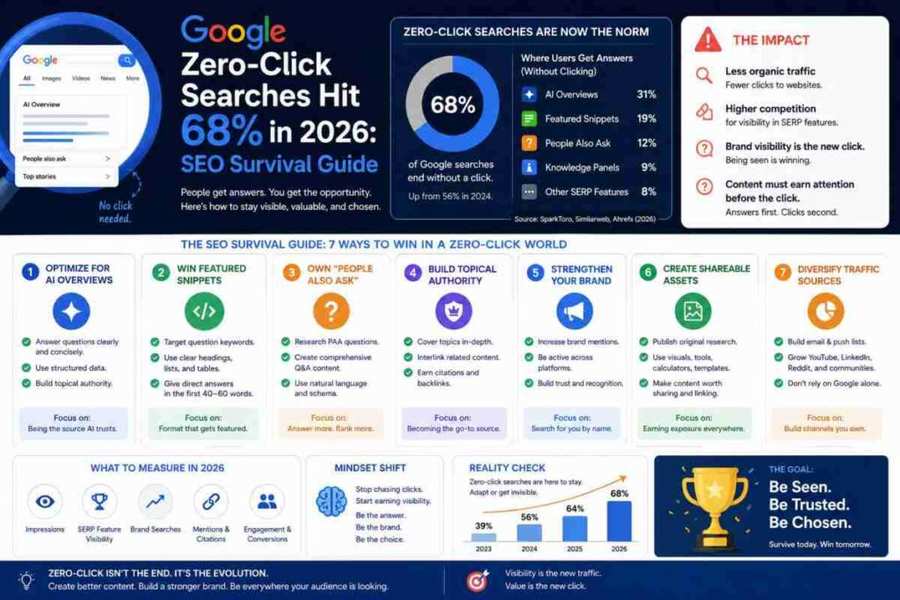
For over two decades, the unwritten contract of the open web was simple: you create high-quality content, Google indexes it, and in return, they send interested users to your website. In early 2026, that contract was officially torn up. Google has rapidly transitioned from a search engine into an advanced, automated “answer engine,” trapping users inside a monetization-heavy walled garden.
For business owners, corporate investors, and content creators, this structural shift requires an immediate and radical overhaul of your digital strategy. This comprehensive analysis breaks down what the 68% zero-click statistic means for your brand’s future survival and provides an exact blueprint for turning this threat into your greatest competitive advantage.
What is Google Zero-Click Search?
Simple Explanation
A zero-click search occurs when a user types or speaks a query into Google and receives a complete, fully contextualized answer directly on the Search Engine Results Page (SERP). Because their information need is instantly satisfied, the user closes the tab or moves on to a new query without clicking on any organic links, paid ads, or third-party web destinations.
Instead of routing traffic outward to independent publishers, e-commerce stores, or informational blogs, Google uses its platform real estate to extract and synthesize your content, presenting it as its own answer. Your website pays the price in creation costs, while Google retains the user’s attention.
Why It Matters in 2026+
While zero-click behavior has been slowly rising for years via simple definitions and local flight times, 2026 marks the tipping point where it has become the statistical majority. The zero-click rate climbed from roughly 50% in 2019 to 58.5% in 2024, before violently leaping to 68.01% in early 2026.
This sudden, aggressive escalation is driven by the mature integration of generative artificial intelligence layer systems—specifically Google’s ubiquitous AI Overviews (formerly SGE) and the widespread rollout of its comprehensive “AI Mode.”
Google is no longer just a index map pointing to places; it has become the destination. Ignoring this structural shift means watching your organic pipeline completely evaporate over the next few quarters.
Key Features Driving the Zero-Click Era
The modern SERP is an interactive matrix designed to resolve user intent instantly. Three distinct features are primarily responsible for siphoning away nearly 70% of traditional web traffic.
Feature 1: AI Overviews (Generative Summaries)
AI Overviews are the single largest driver of organic traffic suppression in 2026. Dominating over 20% to 30% of all informational queries, these large language model summaries compile data from multiple top-ranking pages into a clean, conversational answer box right at the top of the screen. According to data from independent SEO audits, when an AI Overview is present, organic click-through rates for the top-ranked traditional text results plunge by an astonishing 58% to 61%.
Feature 2: Rich Featured Snippets & Knowledge Panels
Before generative AI took over, Google trained users to expect instantaneous gratification using Featured Snippets (the paragraph, list, or table answers yanked from a site) and Knowledge Panels. In 2026, these elements have become hyper-optimized. If a user searches for a direct question like “What is the capital gains tax rate for real estate in 2026?”, a meticulously styled snippet resolves the query instantly on both desktop and mobile layouts.
Feature 3: Deeply Integrated Local & Product Graph Elements
For local and commercial queries, Google has built highly intuitive native ecosystems. The Local Three-Pack displays interactive maps, customer reviews, operational hours, and tap-to-call options seamlessly. Similarly, product carousels allow users to compare retail prices and read verified specifications without ever leaving the Google platform.
H2: Benefits of Shifting to a Zero-Click SEO Strategy
While these numbers sound grim, this evolution is not a death sentence for digital marketing. Instead, it is an aggressive filtering mechanism. Moving away from traditional traffic-chasing metrics and adopting a modern “Generative Engine Optimization” (GEO) framework unlocks hidden, highly lucrative value.
Financial Benefits: Maximizing High-Value Clicks
While general informational traffic is drying up, the clicks that do survive are of immensely higher quality. Studies indicate that post-AI Overview click-throughs result in a 23% higher conversion rate, a 41% lower bounce rate, and substantially higher average order values. Because casual searchers get their quick answers from the AI interface, the users who actually bother to click through to your site are deeply qualified, high-intent buyers who are ready to make a transactional decision.
Lifestyle & Business Benefits: Building Market Authority
When Google’s advanced models repeatedly cite your brand name as the trusted source inside its AI Overviews and featured text fragments, it acts as the ultimate corporate endorsement. Your business earns massive, cross-platform brand authority. Users will start recognizing your business name as the definitive voice in your vertical, leading to an explosion of high-value direct navigation and organic branded searches.
Long-Term Value: Immune to Algorithmic Shocks
Brands that restructure their content to align perfectly with Google’s underlying semantic entity graph establish a permanent presence within the AI training models. This modern approach protects your brand’s digital real estate from standard core algorithm shake-ups, establishing sustainable market visibility that your competitors cannot easily replicate.
Market & Sector Impact Analysis
The impact of the 68% zero-click benchmark is felt unevenly across different industries. Understanding where your specific business model sits on this spectrum determines your level of immediate financial risk.
+------------------------------------+------------------------------------+
| Sector Category                    | Zero-Click Impact Severity         |
+------------------------------------+------------------------------------+
| Informational & Educational        | Critical (Up to 84% Zero-Click)    |
| (Definitions, Recipes, Basic Q&A)  |                                    |
+------------------------------------+------------------------------------+
| Professional B2B Tech & Healthcare | High (Severe Organic Clicks Drop)  |
| (Industry Guides, Whitepapers)     |                                    |
+------------------------------------+------------------------------------+
| Local & Service-Based Businesses   | Moderate (Shifted to Local Packs)  |
| (Plumbers, Lawyers, Clinics)       |                                    |
+------------------------------------+------------------------------------+
| Commercial E-Commerce & Retail     | Low/Stable (Requires Store Clicks) |
| (Physical Products, High-Intent)   |                                    |
+------------------------------------+------------------------------------+
H3: Informational & B2B Tech Verticals
Sectors heavily reliant on top-of-funnel educational articles (such as healthcare, software-as-a-service, and financial advice) are experiencing the most intense organic turbulence. Mobile informational queries are seeing up to an 84% zero-click rate. If your primary customer acquisition model relies on writing 800-word articles defining common industry jargon, your visibility is likely facing severe disruption.
E-Commerce & Retail Verticals
Thankfully, transactional queries are holding up remarkably well. Google recognizes that when a user wants to buy a physical product, they still need to navigate to an online retail store to complete the checkout process. Only about 10% of strictly commercial intent keywords trigger a prominent AI Overview summary. The system is designed to feed high-intent buyer traffic directly into ad auctions and rich schema-marked retail landing pages.
Future Potential: The Rise of Walled Garden Commerce
Google’s long-term play involves eliminating transactional clicks by rolling out a native universal checkout experience. In this looming landscape, users will prompt Gemini or Google Search to purchase an item, and the entire transaction will be executed securely right within the SERP interface. Adapting to this means transitioning your digital asset into an optimized product feed rather than just a standalone website.
Investment Potential / Use Case
For venture capital investors, institutional buyers, and corporate brands evaluating digital real estate in 2026, the zero-click metrics radically alter how web properties must be valued.
ROI Opportunities in the New Landscape
Investing in traditional, ad-supported portfolio sites built purely on basic info traffic is a fast-failing play. The true return on investment now lies in backing brands that capture “Zero-Click Real Estate”. Brands that successfully secure consistent citations inside Google’s generative AI layer earn a compounding advantage: Seer Interactive data highlights that companies cited in AI Overviews enjoy a 35% boost in non-branded organic clicks and a 91% surge in paid campaign performance.
Risk Factors (Be Honest)
The risk profile of relying exclusively on search engine traffic is higher than it has ever been. Alphabet’s financial metrics show a 17% growth in Google search revenue, driven by restructuring pages to steer high-intent commercial clicks directly into paid placements. If your digital business does not have a robust diversified marketing framework—such as an active email newsletter list, direct community engagement, or strong social media channels—your traffic line is highly vulnerable to monetization updates.
Who Should Pivot Immediately
If you run an e-commerce storefront with net profit margins sitting around 12% to 15% and you are watching your non-branded traffic decline without clear explanation, you must pivot your strategy today. You cannot afford to write generic volume content. Your path forward requires embedding deep semantic entity architecture across every landing page.
Comparison Section
Traditional SEO vs. 2026 Generative Engine Optimization (GEO)
To survive in this new ecosystem, you must understand how classical search optimization stacks up against modern Generative Engine Optimization.
| Strategic Element | Traditional SEO Approach (Old Model) | Generative Engine Optimization (2026 GEO) |
| Primary Metric | Organic Clicks, Impressions, Traffic | Brand Share of Voice, Mentions, AI Citations |
| Content Goal | High word count, repetitive long-tail keywords | Extreme factual density, clear expert consensus |
| Technical Focus | URL pathing, basic meta tags, sitemaps | Semantic graph IDs, advanced JSON-LD Schema |
| Keyword Target | High-volume informational phrases | Long-tail conversational questions, commercial intent |
Why GEO Stands Out
Traditional SEO treats Google like a passive filing cabinet. GEO treats Google like an active, analytical student who needs to read, synthesize, and trust your content implicitly. By shifting your focus toward optimizing for AI extraction, you gain visibility within Google’s AI summary boxes, Perplexity answers, and ChatGPT search modules all at once.
Step-by-Step Guide to Optimizing for Zero-Click Search
To reclaim your visibility on modern search result pages, implement this precise, multi-layered optimization blueprint immediately.
1.Identify and Audit Strategic Zero-Click Nests:Step 1: 1-2 Days.
Open your Google Search Console profile and look for pages with strong impressions, stable rankings in positions 1 through 5, but a click-through rate collapsing below 2%. These pages are your zero-click nests—locations where Google is actively using your data to resolve queries on-platform. Target these high-exposure URLs for immediate semantic optimization.
2.Integrate High-Density Citation Blocks:Step 2: Ongoing Content Prep.
Structure every key section of your content using an explicit “citation block.” Start each heading with a concise, direct 40 to 60-word summary that answers the core query completely. AI models prioritize clean, extracted blocks. Research shows that content achieving high semantic completeness scores is over 4 times more likely to be featured as a source link in AI summaries.
3.Inject Verifiable Factual Density:Step 3: Editing Phase.
Strip all fluff, generic filler phrases, and repetitive sentences from your text. Insert a verifiable data point, original statistic, or official industry reference every 150 to 200 words. Content containing unique, structured proprietary data receives a 30% to 40% higher visibility lift inside generative AI search answer grids.
4.Deploy Advanced Multi-Layer Schema Markup:Step 4: Technical Setup.
Implement precise, customized JSON-LD schema across your entire architecture. Do not settle for basic configurations; explicitly deploy advanced FAQPage, HowTo, Product, Review, and Author graphs. Tie these elements directly to a verified corporate Knowledge Graph ID to make your data instantly legible to AI crawlers.
Expert Tips (The Human Touch Section)
Here is insider advice directly from the digital trenches on how to navigate marketing when traditional link clicks are harder to come by:
- Abandon Organic Traffic as Your Core KPI: If your digital marketing success is measured solely by raw website hits, you are misreading the room. Shift your core key performance indicators to track total brand impressions, absolute branded search volume, and overall conversions.
- Optimize Intentionally for Zero-Clicks: Embrace the concept of “In-SERP Branding.” Design your content snippets so elegantly that when a user reads your advice inside a Google summary box, your brand name is inextricably linked with the correct answer.
- Target Conversational Long-Tail Strings: Use specialized search intelligence tools to extract natural-language queries. Structure your core pages around complex multi-turn question structures, which match how real humans interact with advanced AI assistants.
- Build Bulletproof Author E-E-A-T: Ensure every piece of content is explicitly tied to a verifiable human specialist. Pages displaying comprehensive author profiles, clear professional credentials, and external social proof are over 3 times more likely to be pulled into AI summaries.
- Publish Fragmented Formats: Diversify your content into short-form videos, highly detailed infographics, and interactive elements. Google frequently prioritizes its native YouTube assets inside multimedia AI summary segments.
Common Mistakes to Avoid
Avoid these critical, traffic-killing errors that many legacy brands continue to make out of habit:
⚠️ The Volume Trap: Publishing hundreds of low-quality, AI-generated blog posts that merely rehash existing search results. Google’s algorithmic systems are systematically filtering out unoriginal content, rendering large-scale automated writing useless.
⚠️ Neglecting Branded Footprints: Over-optimizing for generic informational phrases while completely ignoring your brand’s digital reputation. If a user cannot find clean, accurate data when searching for your exact company name, your entire marketing funnel breaks.
⚠️ Leaving Data Formats Flat: Sticking to massive, unstructured paragraphs of text. AI data collectors struggle to parse unstructured walls of prose. If you do not break up data into structured tables, clear lists, and marked-up headers, you lose visibility.
Future Trends (2026–2030)
As we look toward the end of the decade, the evolution of search behavior will follow a clear, predictable trajectory:
- The 75% Zero-Click Horizon: As Google continues to iterate on its AI systems and voice-activated search integrations, the global zero-click average is projected to crawl toward 72% to 75% by 2028, turning traditional search into a highly competitive premium channel.
- Agentic Search Dominance: Traditional user keyword entry will slowly give way to autonomous AI agents performing multi-step research on behalf of users. Optimizing for visibility will shift from appealing to human eye scanning to making your site seamlessly parseable for automated software agents.
- Hyper-Monetization of AI Real Estate: Expect Google to scale back free organic real estate inside its generative boxes, gradually introducing interactive ad models right into the middle of conversational AI answers.
Conclusion
The revelation that 68% of Google searches end without a click should not spark panic—it should spark immediate strategic clarity. The era of driving easy, cheap organic traffic through generic content creation is over. Google has modified the digital landscape to prioritize its own platform engagement and corporate bottom line.
To thrive in this new environment, your business must transition from a basic web publisher into an authoritative semantic entity. Build genuine brand authority, optimize your content for clean AI data extraction, and ensure your site is built to capture high-intent buyers rather than casual information seekers.
Stop waiting for your traditional organic traffic numbers to return. Audit your low-click pages today, inject deep semantic structure into your digital strategy, and claim your unfair share of the remaining 32%.
Frequently Asked Questions
Why are Google zero-click searches rising so fast in 2026?
The rapid ascent to a 68% zero-click rate is primarily catalyzed by Google’s widespread deployment of AI Overviews and conversational AI models. These tools synthesize answers directly on the search page, instantly fulfilling user intent and removing any practical need for searchers to click through to external websites.
Does a 68% zero-click rate mean traditional SEO is dead?
No, SEO is undergoing a structural mutation into Generative Engine Optimization (GEO). While overall informational traffic is declining, the surviving organic clicks display a 23% higher conversion rate. Success now requires optimizing for AI summary citations and building strong entity authority rather than chasing raw traffic volumes.
How can my business check if it is losing traffic to AI Overviews?
Review your Google Search Console performance data. Look for specific informational landing pages that maintain high impressions and strong top-3 rankings, but show a steep drop in click-through rates. These patterns reveal where Google’s in-SERP features are answering queries on-platform using your data.
Which industries are hit hardest by zero-click search behavior?
Highly informational, educational, and reference-based sectors (like healthcare, basic financial definitions, and software guides) face the most severe traffic disruption. Conversely, transactional e-commerce categories remain highly stable, as buyers must still click through to independent online stores to purchase physical items.
What is the single most effective way to get cited in Google’s AI summaries?
You must maximize the factual density of your content. Structure your articles with clear, standalone 40 to 60-word answers directly beneath your main headers, and back up your assertions with unique statistics every 150 words. Adding pristine schema markup makes your content highly legible to AI scrapers.