
The landscape of Northern India is undergoing a monumental shift. If the 20th century was defined by the railways, the 21st century in Uttar Pradesh is being written in asphalt and high-speed corridors. The Ganga Expressway, a massive 594-km greenfield project, has officially transitioned from a blueprint of hope to a reality of progress.
Introduction
Imagine starting your day with the morning breeze of Meerut and reaching the holy Sangam in Prayagraj by lunch. For decades, this journey was a grueling 12-hour endurance test through congested city centers and crumbling state highways. Today, that narrative has changed.
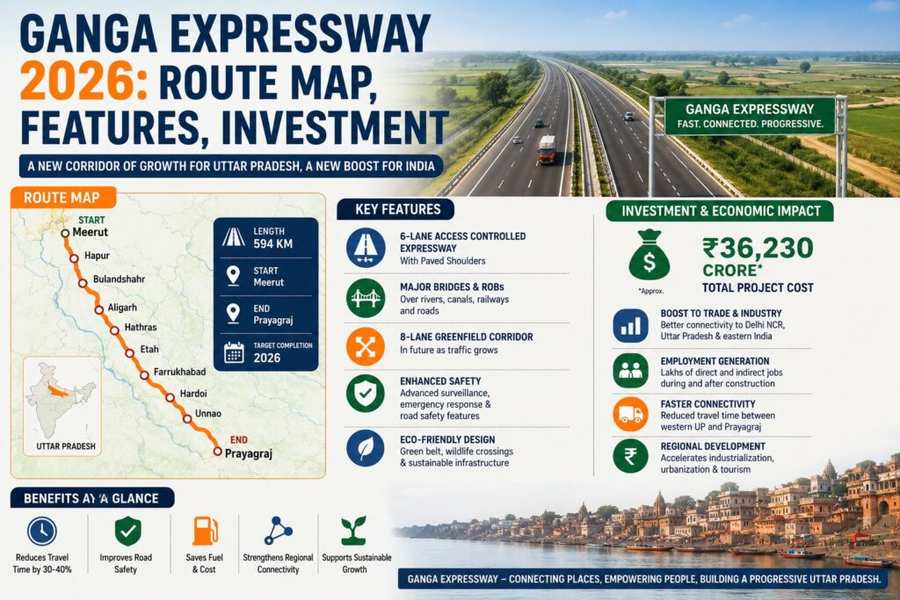
The Ganga Expressway is not just a road; it is a 594-km long economic artery designed to pump life into the heart of Uttar Pradesh. Recently inaugurated in April 2026, this project serves as a bridge between the industrial west and the spiritual east. Whether you are an investor looking for the next big real estate hub, a logistics provider aiming for faster turnarounds, or a traveler seeking the soul of India, the Ganga Expressway is the catalyst you’ve been waiting for.
In this comprehensive guide, we dive deep into why this expressway is being called the “lifeline of UP,” its investment potential, and what the future holds as it expands toward Haridwar and beyond.
What is the Ganga Expressway?
Simple Explanation
At its core, the Ganga Expressway is a 6-lane wide (expandable to 8 lanes), access-controlled highway that runs almost parallel to the holy river Ganges. It connects Bijauli village in Meerut to Judapur Dandu village in Prayagraj. By bypassing traditional bottlenecks, it allows vehicles to maintain a steady speed, slashing travel times by nearly 50%.
Why It Matters in 2026+
As of May 2026, the expressway is officially operational, marking a milestone in India’s “Viksit Bharat” (Developed India) vision. It isn’t just about speed; it’s about connectivity. With Phase 1 complete and Phase 2 (extending to Haridwar in the west and Ballia in the east) already in the works, this corridor is becoming the central nervous system of North India’s logistics.
Key Features & Highlights
1. Massive Scale and Reach
Spanning 594 kilometers, it is one of India’s longest expressways. It touches 12 key districts: Meerut, Hapur, Bulandshahr, Amroha, Sambhal, Budaun, Shahjahanpur, Hardoi, Unnao, Rae Bareli, Pratapgarh, and Prayagraj.
2. Engineering Marvels: The Air Strip
A unique feature of this project is the 3.5-km long emergency air strip in Shahjahanpur. This allows Indian Air Force fighter jets to land and take off during emergencies, highlighting the project’s strategic importance to national security.
3. Green and Smart Infrastructure
The project followed a “Greenfield” approach, meaning it was built on entirely new land to ensure a straighter, faster route. It includes over 140 bridges, 7 overbridges, and 28 flyovers, ensuring that local traffic and wildlife are not disrupted by high-speed transit.
Benefits of the Ganga Expressway
Financial Benefits
For the logistics industry, time is money. A truck traveling from Meerut to Prayagraj previously consumed massive amounts of fuel due to idling in traffic. Now, with a streamlined route, fuel costs are expected to drop by 20–30%, significantly lowering the cost of doing business in the region.
Lifestyle & Business Benefits
- Industrial Clusters: The UP government has earmarked thousands of hectares along the route for food processing units, textile hubs, and MSME parks.
- Tourism Boost: Pilgrims can now travel between the religious hubs of Haridwar, Meerut, and Prayagraj with unprecedented ease, boosting the local hospitality economy.
Long-Term Value
Real estate prices in districts like Budaun, Hardoi, and Unnao—previously considered “sleeping” markets—have seen a 3x jump since construction began. The long-term value lies in the “Expressway Economy,” where towns along the exit ramps evolve into satellite cities.
Market Analysis & Future Potential
Connectivity
The Ganga Expressway doesn’t exist in a vacuum. It connects with the Delhi-Meerut Expressway at one end and provides easy access to the Purvanchal Expressway and Bundelkhand Expressway via feeder roads. This creates a seamless grid across the most populous state in India.
Infrastructure Growth
With the inauguration in April 2026, the focus has shifted to Phase 2. Plans are already underway to extend the route to Haridwar (Uttarakhand) and Ballia (Bihar border). This will create a trans-national corridor linking the Himalayas to the plains of Bihar.
Future Potential
By 2030, the regions surrounding the Ganga Expressway are projected to contribute significantly to UP’s goal of becoming a $1 trillion economy. The proximity to the river also opens doors for “Jal Marg” (Waterway) integration, creating a multi-modal transport hub.
Investment Potential: Is It Too Late?
ROI Opportunities
If you missed the initial land boom in 2021, don’t worry. The “secondary boom” is happening now. With the road open, commercial investments in warehousing, cold storage, and petrol pumps are at an all-time high. Investors are focusing on the “interchange points” where the expressway meets local state highways.
Risk Factors (Be Honest)
- Toll Costs: For commercial vehicles, the toll can be significant (over ₹5,000 for heavy trucks). This may lead some local transporters to stick to older routes initially.
- Land Acquisition for Expansion: While Phase 1 is done, Phase 2 may face local hurdles, potentially delaying secondary connection points.
Who Should Invest?
- Logistics Companies: Seeking a central hub in North India.
- Agri-businesses: Benefiting from faster access to Delhi/NCR markets.
- Long-term Real Estate Investors: Looking for high-yield residential plots in emerging districts like Amroha or Hardoi.
Step-by-Step Guide: How to Use the Expressway Effectively
- Step 1: Check Your Entry Point. The main entry is at Bijauli (Meerut) or the Prayagraj bypass. Ensure your FASTag is recharged, as this is a fully digital tolling corridor.
- Step 2: Plan Your Fuel Stops. While there are world-class “Way Side Amenities” (WSAs) every 50km, the expressway is long. Know where the major food courts and fuel stations are located.
- Step 3: Monitor Your Speed. The expressway is designed for a top speed of 120 km/h for light vehicles. Advanced AI cameras monitor speed and lane discipline strictly.
Expert Tips: Insider Advice for Travelers & Investors
- The “Golden Exit” Strategy: For investors, the land within 5-10km of an interchange is the most valuable. Don’t just buy “near the road”—buy near the exits.
- Night Driving: The expressway is well-lit at interchanges but can be very dark in rural stretches. Ensure your vehicle’s lighting system is top-notch.
- Local Flavors: Stop at the WSAs in Pratapgarh for the famous Amla products or Sambhal for unique handicrafts—the expressway is designed to showcase local ODOP (One District One Product) items.
Common Mistakes to Avoid
- Ignoring the 15-Day Rule: Immediately after the April 2026 inauguration, the road was toll-free for 15 days. Many drivers expected this to last forever. Check current rates to avoid surprises at the exit.
- Speeding in Fog: During winter months (December–February), the Ganga plains experience thick fog. Even an expressway cannot protect you from poor visibility—always slow down.
- Buying Disputed Land: Many local brokers offer “expressway-facing” land that lacks proper commercial conversion (CLU) permits. Always verify titles through UPEIDA or local authorities.
Future Trends (2026–2030)
We predict that by 2028, the Ganga Expressway will be the first in India to feature dedicated EV charging lanes that can charge vehicles while they are in motion (induction charging). Additionally, the extension to Haridwar will likely make it the busiest pilgrimage route in the world during the 2027-2028 Mahakumbh period.
Conclusion
The Ganga Expressway is more than a feat of civil engineering; it is a promise of a faster, more prosperous India. It bridges the gap between the farmer in Hardoi and the trader in Delhi. It brings the student in Prayagraj closer to the opportunities in Meerut.
As the wheels of progress turn faster on this 594-km stretch, one thing is certain: the map of Uttar Pradesh has been redrawn forever. Whether you’re driving for faith, for family, or for business, the road ahead has never looked smoother.
CTA: Ready to explore the new heart of UP? Plan your trip today or consult with a local investment advisor to secure your spot in the “Expressway Revolution.”
Frequently Asked Questions (FAQs)
1. What is the total length and route of the Ganga Expressway?
The Ganga Expressway is approximately 594 km long. It starts at Bijauli village in Meerut and ends at Judapur Dandu in Prayagraj. It passes through 12 major districts, including Hapur, Bulandshahr, Amroha, Budaun, and Unnao, providing a high-speed link across Uttar Pradesh.
2. How much time will I save using the Ganga Expressway?
Travelers can save significant time. The journey from Meerut to Prayagraj, which previously took 11–12 hours, can now be completed in just 6–7 hours. This makes it an ideal route for long-distance commuters and commercial logistics providers looking for efficiency.
3. Is the Ganga Expressway open for the public now?
Yes, the Ganga Expressway was officially inaugurated by the Prime Minister in late April 2026. Following a 15-day toll-free introductory period to allow commuters to familiarize themselves with the route, it is now a fully operational toll-paying highway.
4. What are the toll charges for a car from Meerut to Prayagraj?
Far far away, behind the word mountains, far from the countries Vokalia and Consonantia, there live the blind texts. Separated they live in Bookmarksgrove right at the coast of the Semantics, a large language ocean.
5. Will the Ganga Expressway be extended to other cities?
Far far away, behind the word mountains, far from the countries Vokalia and Consonantia, there live the blind texts. Separated they live in Bookmarksgrove right at the coast of the Semantics, a large language ocean.