
Imagine the bustling streets of Bangalore or the packed local trains of Mumbai. For decades, we believed that the “hustle” required a physical presence in a cubicle. But then, the world stopped. We learned that productivity didn’t die; it moved to our dining tables. Recently, Prime Minister Narendra Modi reignited this conversation, urging a shift toward Work From Home (WFH) and flexible work modules.
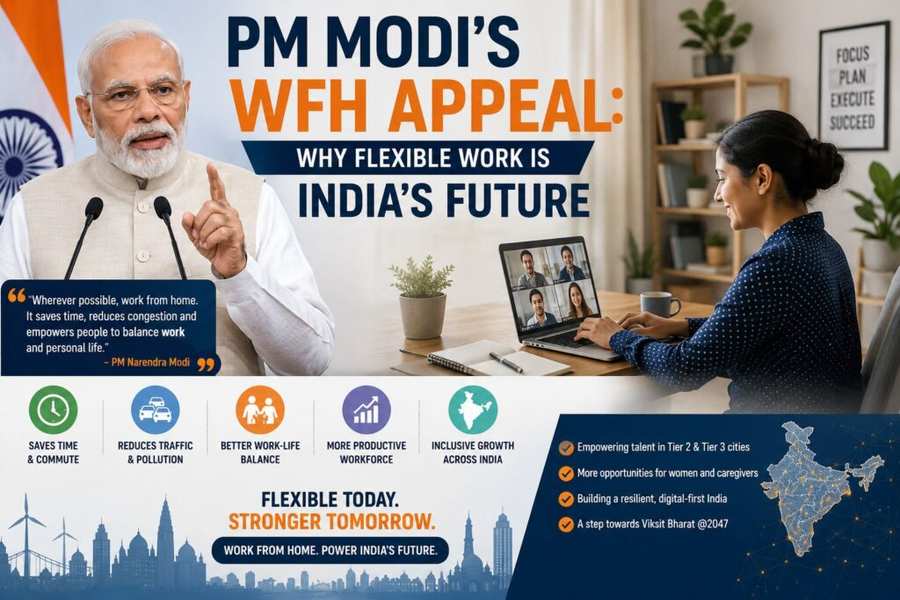
This isn’t just about avoiding traffic. It’s a strategic economic pivot. The PM’s appeal is a visionary call to democratize the workforce, empower women, and reduce the literal and metaphorical carbon footprint of our growing economy. In this deep dive, we explore why India is being asked to embrace the “COVID-era” flexibility once more, not as a crisis response, but as a permanent pillar of the “Amrit Kaal” vision.
What is the PM Modi Work From Home Appeal?
Simple Explanation
At its core, the PM Modi Work From Home appeal is a recommendation to industries and labor departments to institutionalize flexible work. During the pandemic, WFH was a survival tactic. Today, the Prime Minister views it as a tool for inclusive growth. By allowing people to work from their hometowns or homes, the government aims to bridge the gap between urban centers and rural talent.
Why It Matters in 2026+
As we move further into 2026, the global economy is increasingly digital. India’s goal of becoming a $5 trillion economy requires every hand on deck. Traditional 9-to-5 office culture often excludes talented individuals—particularly women with caregiving responsibilities or youth in Tier-2 and Tier-3 cities who cannot afford the high cost of living in metros. The appeal signifies a policy shift toward “Work from Anywhere” as a national strength.
Key Features of the Flexible Work Vision
1. Integration of the “GIG” Economy
The government is looking to formalize the gig and platform economy. By encouraging WFH, the PM is signaling that the legal framework for labor needs to protect those who don’t sit in a traditional office, ensuring social security for remote workers.
2. Focus on Female Labor Force Participation (FLFP)
One of the highest priorities of this appeal is increasing the number of women in the workforce. Flexible hours allow women to balance professional ambitions with social realities, potentially adding billions to the GDP.
3. Reduced Urban Pressure
Our metros are bursting at the seams. A “Work from Home” culture distributes the population. When a software engineer works from a village in Himachal instead of a flat in Gurgaon, they spend their salary locally, boosting the rural economy.
Benefits of the PM Modi Work From Home Appeal
Financial Benefits
For companies, the overhead costs of maintaining massive glass-and-steel offices are staggering. Electricity, real estate, and maintenance costs drop significantly with a remote workforce. For employees, the savings on commuting, professional wardrobes, and expensive city food add up to a “hidden raise.”
Lifestyle & Business Benefits
Mental health has moved from a “fringe” topic to a boardroom priority. Reducing a two-hour commute significantly lowers stress levels. From a business perspective, WFH allows companies to hire the best talent from across the country, not just the best talent within a 20-mile radius of the office.
Long-Term Value
The long-term value lies in Sustainability. Less commuting means fewer vehicles on the road and lower CO2 emissions. This aligns with India’s “Net Zero” targets. Furthermore, it prevents “Brain Drain” from rural areas to cities, allowing for a more balanced national development.
Market & Infrastructure Analysis
Connectivity: The Backbone
The success of the PM’s appeal rests entirely on the Digital India mission. With the widespread rollout of 5G and the expansion of BharatNet (bringing fiber-to-the-home in villages), the technical barriers to WFH are vanishing.
Infrastructure Growth
We are seeing a rise in “Co-working hubs” in smaller cities like Jaipur, Indore, and Kochi. The infrastructure is no longer just about highways; it’s about high-speed data highways that allow a seamless Zoom call from a remote farm-stay.
Future Potential
By 2030, it is predicted that nearly 50% of the Indian IT workforce could be operating under a hybrid or remote model. This will lead to a real estate boom in Tier-2 cities as people look for larger, more affordable homes to accommodate home offices.
Investment Potential & Use Cases
ROI Opportunities
Investors should look at PropTech and EdTech. As more people work from home, the demand for home-office furniture, high-end laptops, and cybersecurity software will skyrocket. Additionally, real estate in satellite towns is a goldmine.
Risk Factors (Be Honest)
- Social Isolation: Long-term WFH can lead to a lack of team cohesion.
- Security Risks: Data breaches are more likely on home networks.
- The “Always-On” Culture: Without physical office boundaries, many employees find themselves working longer hours, leading to burnout.
Who Should Invest?
Entrepreneurs building tools for remote collaboration and real estate developers focusing on “lifestyle” housing outside of traditional tech hubs are the best-positioned stakeholders.
Comparison: WFH vs. Traditional Office
| Feature | Work From Home (New Vision) | Traditional Office (Old School) |
| Talent Pool | National / Global | Local |
| Cost to Company | Low (Digital Infrastructure) | High (Real Estate/Utilities) |
| Employee Wellbeing | High (Flexibility) | Variable (Commute Stress) |
| Inclusion | High (Inclusive of PwD/Women) | Limited |
Why the PM’s Vision Stands Out
Unlike corporate-driven WFH, the PM’s appeal is rooted in national development. It’s not just about profit margins; it’s about making sure the resident of a small village in Odisha has the same opportunity as someone in South Delhi.
Step-by-Step Guide for Companies Transitioning
Step 1: Audit Job Roles
Identify which roles are “Remote-Friendly,” “Hybrid,” or “On-Site Mandatory.” Not everyone can work from home (e.g., manufacturing), but most service sectors can.
Step 2: Invest in Cloud Infrastructure
Move all workflows to the cloud. Ensure that your team has access to collaborative tools that track output rather than “hours spent at a desk.”
Step 3: Cultural Shift
Train managers to lead by Outcomes, not Observation. Trust is the currency of the WFH era. If the work is done well and on time, it shouldn’t matter if it was done at 2:00 PM or 2:00 AM.
Expert Tips (The Insider Perspective)
- The 80/20 Hybrid Rule: For most, 100% remote is lonely. Aim for 80% remote and 20% in-person meetups to keep the “human” element alive.
- Ergonomics Matter: Don’t work from your bed. If the PM is encouraging this shift, treat your home office with professional respect. Invest in a good chair.
- Digital Decorum: Set “Do Not Disturb” hours. Respecting boundaries is the only way to make WFH sustainable.
- Over-Communicate: In an office, you catch vibes. In WFH, you only catch what is typed or said. Be explicit with instructions.
- Local Networking: If you are working from a small town, join a local co-working space once a week to avoid “cabin fever.”
Common Mistakes to Avoid
- Micromanagement: Installing “tracking software” to see if an employee’s mouse is moving is a surefire way to kill morale and lose top talent.
- Ignoring Cybersecurity: Using “Password123” on a home router while accessing company servers is a recipe for disaster.
- Neglecting the “Water Cooler”: Companies often forget the informal chats that spark innovation. Use “Virtual Coffee” sessions to bridge this gap.
Future Trends (2026–2030)
As we look toward 2030, the “Metaverse Office” will likely become a reality, making remote work feel more immersive. We will also see the rise of “Digital Nomad Visas” within India, where states compete to attract remote workers by offering better lifestyle amenities and internet speeds. The distinction between “office” and “home” will blur into a singular “Workspace” that exists wherever you are.
Conclusion
The PM Modi Work From Home appeal is more than just a nod to convenience; it is a blueprint for a modern, decentralized India. By breaking the shackles of the mandatory office commute, we open doors for millions who were previously excluded from the economic narrative. It is a win-win: lower costs for businesses, better quality of life for employees, and a balanced growth trajectory for the nation.
Are you ready to embrace the flexible future? Whether you are a business owner or an employee, the time to build your remote-ready toolkit is now.
Frequently Asked Questions
1. Why is PM Modi encouraging Work From Home?
The Prime Minister views WFH as a way to increase the female labor force participation rate and reduce the burden on urban infrastructure. By allowing flexibility, the government aims to empower workers in smaller towns, ensuring that economic growth is not restricted to just a few major metro cities.
2. Is the WFH appeal mandatory for private companies?
No, the appeal is a recommendation and a strategic vision. While the government is creating a supportive legal and digital framework (like the New Labour Codes), it is ultimately up to individual organizations to decide which work model best suits their operational needs and productivity goals.
3. How does WFH help the Indian economy?
Far far away, behind the word mountains, far from the countries Vokalia and Consonantia, there live the blind texts. Separated they live in Bookmarksgrove right at the coast of the Semantics, a large language ocean.
4. What are the challenges of following the PM’s WFH vision?
The primary challenges include maintaining data security on domestic networks, managing employee mental health due to isolation, and the potential for blurred work-life boundaries. Companies must invest in robust cybersecurity and “outcome-based” management styles to overcome these hurdles effectively.
5. Will WFH affect productivity in the long run?
Far far away, behind the word mountains, far from the countries Vokalia and Consonantia, there live the blind texts. Separated they live in Bookmarksgrove right at the coast of the Semantics, a large language ocean.