

Buying a home is often the biggest emotional and financial rollercoaster of a person’s life. You’ve spent months comparing floor plans, haggling over the base price, and finally signing that thick stack of paperwork. But just as you’re ready to pop the champagne, a line item appears on your final demand letter: IFMS.
For many buyers, IFMS feels like just another “hidden cost” designed to squeeze a little more out of their savings. Is it a tax? Is it a service fee? Or is it just the developer’s way of padding the bill?
In reality, IFMS in real estate is the invisible backbone of any high-quality residential or commercial project. It stands for Interest-Free Maintenance Security. While it might feel like a burden at the closing table, it is actually your primary insurance policy against the decay of your property. In this deep dive, we’re going to peel back the jargon and look at why IFMS is the difference between a thriving community and a crumbling building five years down the line.
What is IFMS in Real Estate?
Simple Explanation
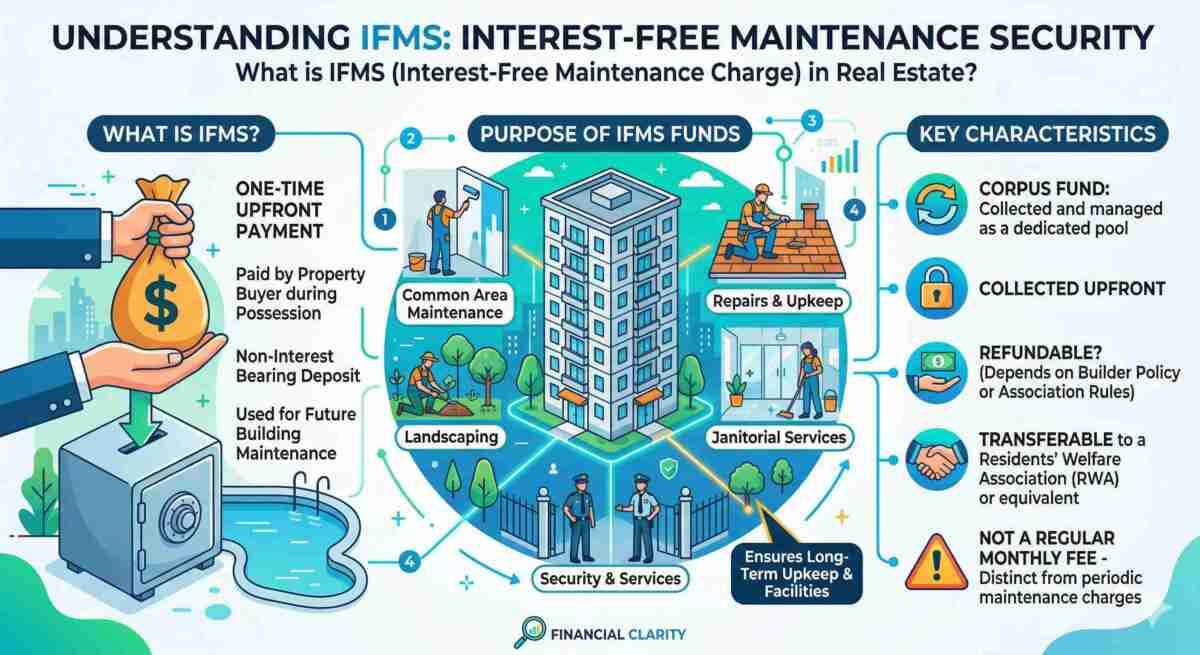
At its core, IFMS (Interest-Free Maintenance Security) is a corpus fund collected by the developer from the buyer at the time of possession. Unlike your monthly maintenance bills, which cover day-to-day costs like cleaning and security guards, the IFMS is a “security deposit” meant for major, non-recurring expenses.
Think of it as a community emergency fund. If the building’s elevators fail, the central water pump dies, or the exterior needs a massive repainting job, the money doesn’t come out of the monthly budget; it comes from the IFMS. The “Interest-Free” part means the developer (or later, the Resident Welfare Association) doesn’t pay you interest on this money, but they also cannot “spend” it on their own profits.
Why It Matters in 2026+
As we move into 2026, the real estate landscape has shifted toward “Smart Cities” and high-tech gated communities. Modern buildings are no longer just brick and mortar; they are complex ecosystems of IoT sensors, automated waste management, and high-speed elevators.
Maintaining these systems is expensive. Without a robust IFMS fund, a society can quickly fall into disrepair when the developer hands over the keys to the residents. In today’s market, savvy investors look at the IFMS structure as a sign of a developer’s long-term vision. A well-funded IFMS ensures that the luxury property you bought today doesn’t look like a “distress sale” ten years from now.
Key Features / Highlights of IFMS
Feature 1: The One-Time Nature
Generally, IFMS is a one-time payment made during the possession process. It is usually calculated based on the Super Area of your unit (e.g., $X$ amount per square foot). This makes it different from the Annual Maintenance Charges (AMC), which are recurring.
Feature 2: Transferability
One of the most critical features of IFMS is that it stays with the property, not the person. If you sell your apartment in three years, you don’t get your IFMS back from the developer. Instead, the buyer usually pays you the equivalent amount, or it is simply factored into the sale price, and the credit is transferred to the new owner’s name in the society records.
Feature 3: The Trust Factor
The IFMS is meant to be held in a separate escrow account. Legally, in many jurisdictions under RERA-like frameworks, the developer is a mere custodian of this money. Once the Resident Welfare Association (RWA) is formed, the developer is obligated to transfer the entire corpus fund to the RWA.
Benefits of IFMS in Real Estate
Financial Benefits
While it feels like an outflow, IFMS protects your Capital Appreciation. A building with peeling paint, broken tiles in the lobby, and a malfunctioning gym will see its market value plummet. By ensuring there is always money available for capital repairs, IFMS keeps the “curb appeal” of your investment high, ensuring you can command a premium price if you ever decide to sell.
Lifestyle Benefits
Living in a society where the elevators are always working, the pool is pristine, and the backup generators kick in within seconds is a luxury we often take for granted. These high-cost mechanical and electrical systems require periodic overhauls. IFMS ensures that these repairs happen seamlessly without the RWA having to knock on every resident’s door asking for an “emergency contribution.”
Long-Term Value
For business owners in commercial real estate, IFMS is even more vital. A commercial building’s reputation depends on its upkeep. If the central AC fails in a commercial hub, businesses lose money. The IFMS acts as a buffer that guarantees business continuity, which in turn attracts high-quality tenants and steady rental income.
Market Analysis: The Impact of Maintenance
Infrastructure Growth
In rapidly developing hubs, new infrastructure often brings dust, vibrations, and heavy wear and tear on building exteriors. Properties located near new metro lines or highways may require more frequent facade cleaning and structural checks. A healthy IFMS fund allows a society to adapt to these environmental changes without financial strain.
Future Potential
We are seeing a trend where “Green Buildings” are becoming the standard. Retrofitting older buildings with solar panels or better water recycling systems is a huge capital expense. In the future, societies with large IFMS reserves will be able to upgrade their infrastructure to meet new environmental laws, making them more “future-proof” than societies living month-to-month.
Investment Potential / Use Case
ROI Opportunities
From an investment standpoint, IFMS is a “hidden” ROI protector. High-end tenants—especially expats or corporate HNIs—are very picky about maintenance. They are willing to pay 20-30% higher rent for a building that looks brand new. Therefore, paying your IFMS upfront is effectively investing in your future rental yield.
Risk Factors (Be Honest)
There is a risk: Mismanagement.
If a developer uses the IFMS funds for their next project instead of keeping them in a dedicated account, the residents suffer. When the time comes to hand over the fund to the RWA, the developer might claim the money was spent on “initial upkeep.” This is why it is vital to check the track record of the developer and ensure the IFMS terms are clearly stated in the Allotment Letter.
Who Should Invest?
- End-Users: If you plan to live in the house for 10+ years, IFMS is your best friend.
- Long-Term Investors: If you want steady rental income without the headache of building decay.
- Commercial Buyers: Essential for maintaining the “Grade A” status of office spaces.
Comparison: IFMS vs. Sinking Fund vs. AMC
| Feature | IFMS | Sinking Fund | AMC (Monthly Maintenance) |
| Payment Frequency | One-Time | Monthly/Quarterly | Monthly |
| Purpose | Major Capital Repairs | Long-term structural replacement | Day-to-day operations |
| Refundable? | No (Transferred to RWA) | No | No |
| Calculation | Per Sq. Ft. basis | Percentage of maintenance | Per Sq. Ft. or Flat rate |
While AMC pays the security guard’s salary, the IFMS pays for the replacement of the CCTV system he monitors. They are two sides of the same coin.
Step-by-Step Guide: Handling IFMS During Possession
Step 1: Verify the Amount
Check your original Builder-Buyer Agreement (BBA). Ensure the IFMS rate per square foot matches what you were promised at the time of booking. It shouldn’t be a “surprise” figure at the end.
Step 2: Demand an Escrow Statement
Ask the developer if the IFMS is being kept in a separate account. While not all developers provide this, asking shows you are an informed buyer and puts pressure on them to maintain transparency.
Step 3: The Handover Process
Once the RWA is formed, ensure that the transfer of the IFMS corpus is part of the official handover checklist. The RWA should not take over maintenance responsibility until the developer provides proof of the fund transfer.
Expert Tips (The Human Touch)
As someone who has navigated the murky waters of real estate for years, here is my “insider” advice:
- Don’t Fight the Fee: I’ve seen buyers try to litigate their way out of IFMS. It’s a bad move. If you don’t pay, and others don’t pay, your building will look like a ruin in five years.
- Audit the RWA: Once the money moves from the developer to the RWA, keep an eye on the minutes of the meetings. Ensure the interest earned on the IFMS corpus is being reinvested into the fund.
- Check for “Double Dipping”: Some developers try to charge for “Initial Maintenance” and IFMS. Make sure the initial maintenance covers the first year of operations, while the IFMS remains untouched for future emergencies.
- Factor it into your Budget: When calculating the “On-Road” price of a flat, always add $X$ amount for IFMS, club membership, and electricity connection.
- Look for Transparency: Top-tier developers now provide digital portals where you can see the status of the corpus fund. Prioritize these builders.
Common Mistakes to Avoid
- Assuming it’s Refundable: Many buyers think they get this money back when they move out. You don’t. It stays with the “unit.”
- Ignoring the BBA Clauses: Always read the fine print. Does the developer have the right to use the interest from the IFMS for their own expenses? (They shouldn’t).
- Not Transferring Credits During Resale: If you sell your flat, make sure the “No Dues Certificate” from the society mentions that the IFMS credit has been transferred to the new owner.
Future Trends (2026–2030)
In the coming years, I predict we will see Smart IFMS Management. Using blockchain technology, developers and RWAs will be able to show real-time tracking of corpus funds to every homeowner. This will eliminate the “trust gap” that currently exists.
Furthermore, as buildings become more sustainable, we might see “Green IFMS” bonuses, where a portion of the fund is legally mandated to be spent on energy-efficient upgrades, reducing the overall monthly maintenance burden on residents.
Conclusion
IFMS in real estate isn’t just another line item on a spreadsheet—it is the lifeblood of your property’s future. It represents a collective commitment by every homeowner to keep their community safe, functional, and beautiful.
While paying a large lump sum at possession can be painful, remember that you are essentially paying for peace of mind. You are ensuring that when you press the elevator button five years from now, it actually arrives. You are ensuring that the park where your children play remains manicured.
Pro-Tip: Before you sign that possession letter, ask one simple question: “Where is the IFMS being held, and what is the plan for its transfer to the RWA?” A confident answer from your developer is the best “Welcome Home” gift you could ask for.
It is important for homebuyers to understand the concept of IFMS and its implications before investing in a property. By being aware of this charge, buyers can make informed decisions and ensure that they are financially prepared for the additional expense.
In conclusion, IFMS (Interest-Free Maintenance Charge) is a one-time payment made by homeowners for the maintenance and upkeep of common areas in a residential complex or society. It promotes shared responsibility, professional maintenance, long-term sustainability, enhanced property value, and transparent financial management. By understanding IFMS, homebuyers can ensure a comfortable living experience and protect their investment in the long run.
FAQs
FAQ 1: What is IFMS in real estate?
IFMS is a one-time maintenance security deposit paid by property buyers to cover future maintenance costs. It ensures funds are available for long-term upkeep of the building or society.
FAQ 2: Is IFMS refundable?
Yes, IFMS is generally refundable when ownership is transferred, but the terms depend on the builder agreement. Always verify conditions before signing.
FAQ 3: How is IFMS calculated?
IFMS is usually calculated on a per square foot basis and varies depending on the project, amenities, and developer policies.
FAQ 4: Is IFMS mandatory?
In most modern residential projects, IFMS is mandatory. It is included as part of the total cost during property purchase.
FAQ 5: What is the difference between IFMS and maintenance charges?
IFMS is a one-time deposit, while maintenance charges are recurring monthly payments used for daily upkeep and services.
FAQ 6: Can buyers negotiate IFMS?
Yes, in some cases, buyers can negotiate IFMS charges, especially if they seem higher than market standards or lack transparency.
FAQ 7: Why do builders collect IFMS?
Builders collect IFMS to ensure there is a reserve fund available for future maintenance, repairs, and infrastructure upkeep of the property.