
The modern workplace is a place of perpetual connection. Thanks to smartphones, laptops, and the omnipresent nature of email and messaging apps, the once-clear line separating professional obligations from personal life has been utterly blurred. The working day no longer ends at 5 PM; instead, it often stretches into the evening, through dinner, and even into the sanctity of a family holiday. This culture of ‘always-on’ availability is fueling a global epidemic of employee burnout, stress, and declining mental health. This critical social and economic challenge has led to the drafting and introduction of a landmark legislative proposal: the Right to Disconnect Bill.
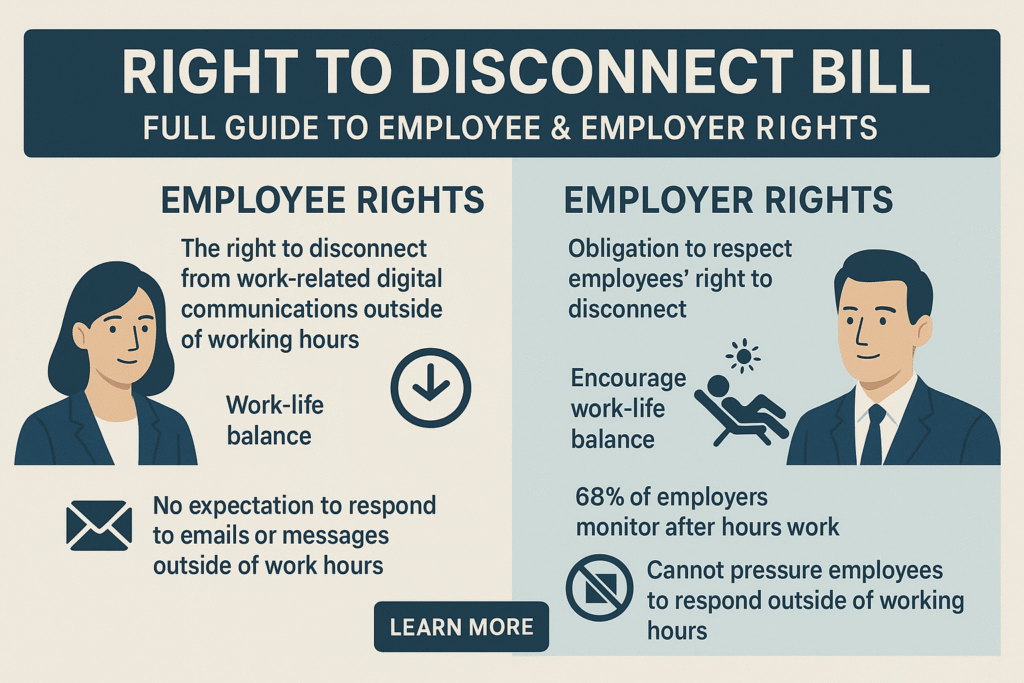
This transformative legislative measure is designed to re-establish fundamental boundaries in the digital age. At its core, the Right to Disconnect Bill seeks to grant employees the statutory right to legally ignore or refuse to respond to work-related communications, such as calls, emails, and messages, outside of their designated working hours. It is more than just a new policy; it is a profound philosophical shift, recognizing that an employee’s time outside of work is their own and should be protected from encroachment by the employer. Understanding the provisions, implications, and future potential of the Right to Disconnect Bill is essential for every employee and employer navigating the complexities of the 21st-century labor market. This comprehensive guide will explore the history, key features, and deep societal impact of this necessary piece of labor legislation, providing a definitive resource on the Right to Disconnect Bill and its role in shaping a healthier, more productive future for all.
Understanding the Right to Disconnect Bill: Core Principles and Intent
The essence of the Right to Disconnect Bill lies in the belief that digital tools, while offering flexibility, must not become instruments of perpetual servitude. This landmark bill is founded on the principle that every employee is entitled to psychological detachment from work after their official shift ends. In simpler terms, the Right to Disconnect Bill aims to make the traditional eight-hour workday viable again in the digital realm. The intent is not merely to create a rule but to change the underlying work culture that pressures employees into constant availability, a phenomenon often referred to as “telepressure.” By legally securing the right to disconnect, the bill provides a crucial shield against this constant pressure, reinforcing that an employee’s personal time, rest, and leisure are fundamental components of a dignified life. This foundational understanding is the critical first step in evaluating the overall implications of the Right to Disconnect Bill for both workers and management. The legislative effort emphasizes that protecting this right is directly linked to safeguarding employee well-being.
The Modern Crisis Driving the Need for the Right to Disconnect Bill
Why is a legislative solution like the Right to Disconnect Bill necessary now? The answer lies in the dramatic evolution of work post-digital revolution and, more recently, post-global remote work acceleration. The advent of remote work made homes the new office, and the tools designed to connect us seamlessly—like Slack, WhatsApp, and Microsoft Teams—have effectively tethered employees to their desks 24/7. This constant connectivity, though convenient for emergency situations, has normalized unpaid overtime and chronic stress. Studies cited by proponents of the Right to Disconnect Bill point to alarming statistics: a significant percentage of the workforce reports checking emails and taking calls outside of work hours, leading to sleep deprivation, emotional exhaustion, and burnout. The psychological toll of being ‘always on’ is immense. Consequently, the Right to Disconnect Bill is framed as a crucial public health measure, addressing the systemic issue of overwork that digital communication has enabled. The goal is to move from a culture of constant monitoring to one that prioritizes measurable output and essential rest.
Key Provisions of the Right to Disconnect Bill for Employees
The proposed Right to Disconnect Bill contains several specific provisions designed to empower employees and enforce clear boundaries. One of the primary features is the legal right for employees to simply refuse to respond to any work-related electronic communications—including emails, calls, SMS, and video conference requests—beyond their officially contracted working hours and on designated holidays. Crucially, the Right to Disconnect Bill includes strong anti-retaliation clauses. This means an employer cannot subject an employee to disciplinary action, such as demotion, dismissal, or negative performance review, for exercising their right to disconnect. Furthermore, the bill often mandates that if an employee and employer mutually agree on the need for after-hours work, that work must be compensated with overtime pay at the standard wage rate. This is a direct attempt by the Right to Disconnect Bill to curb the prevalent problem of unpaid overtime, making the cost of after-hours communication transparent to the employer.
Comparison with International Examples of the Right to Disconnect Law
The movement for the right to disconnect is a global one, and the proposed Right to Disconnect Bill draws inspiration from pioneering legislation around the world.
- France (2017): France was one of the first countries to implement a droit à la déconnexion. While the law itself doesn’t impose fines, it mandates that companies with over 50 employees must negotiate a charter with unions or employee representatives defining the employees’ rights to disconnect and establishing procedures for regulating digital communications outside of working hours.
- Spain (2018): Spanish legislation secures employees’ right to digital disconnection, particularly in relation to the use of digital tools, and specifies that the right must be balanced with the need to protect the continuity of the business.
- Portugal (2021): Portugal’s law, particularly relevant for remote work, explicitly prohibits employers from contacting employees outside of work hours, except in specific emergency situations, and carries fines for non-compliance.
- Australia (Recent): Australia has also moved to secure this right, emphasizing the ability for workers to decline unreasonable contact from employers.
By studying these global models, the Right to Disconnect Bill aims to create a framework that is robust, enforceable, and tailored to the unique economic context of the local labor force. The global trend validates the necessity of the Right to Disconnect Bill as a modern labor standard.
The Role of the Employees’ Welfare Authority in the Right to Disconnect Bill
A critical component proposed in various forms of the Right to Disconnect Bill is the establishment of a dedicated Employees’ Welfare Authority. This body would be tasked with overseeing the implementation and enforcement of the bill’s provisions. Its responsibilities would include:
- Conducting Baseline Studies: Collecting data on how digital communication tools are currently being used outside of work hours to establish clear metrics.
- Mandating Negotiation: Directing companies above a certain employee threshold (e.g., 10 or 20 employees) to formally negotiate and draft a “Right to Disconnect Policy” with employee representatives or unions. This ensures the policy is customized to the specific sector and work model while upholding the spirit of the Right to Disconnect Bill.
- Grievance Redressal: Providing a mechanism for employees to file complaints if their right to disconnect is violated or if they face retaliation.
- Promoting Awareness: Offering counselling services and promoting digital detox centers to help both employees and the public develop healthier relationships with technology.
This Authority is intended to be the mechanism that moves the Right to Disconnect Bill from a theoretical concept to an enforceable reality, ensuring genuine compliance and protecting vulnerable workers.
Implications of the Right to Disconnect Bill on Work-Life Balance and Well-being
The most profound impact of the Right to Disconnect Bill is its effect on the work-life balance and mental health of the workforce. For years, “work-life balance” has been a soft-skill aspiration; the Right to Disconnect Bill proposes to make it a legal right. By eliminating the expectation of constant availability, the bill allows employees to achieve genuine “psychological detachment” from work during their off-hours. This detachment is crucial for reducing stress hormones, improving sleep quality, and preventing chronic anxiety associated with the fear of missing an urgent work message. The implementation of the Right to Disconnect Bill fosters an environment where personal pursuits, family time, and rest are not secondary to professional obligations but are acknowledged as essential for long-term productivity and human dignity. This societal shift is arguably the most valuable outcome of the Right to Disconnect Bill.
How the Right to Disconnect Bill Affects Employee Mental Health
The constant checking of emails, sometimes referred to as ‘telepressure,’ maintains a low-level, chronic state of alert in employees. This perpetual state of readiness is a direct contributor to stress, anxiety, and eventual burnout. The clear boundaries established by the Right to Disconnect Bill address this issue head-on. By legally permitting employees to turn off their work phones and ignore emails without fear of professional penalty, the Right to Disconnect Bill effectively gives employees back control over their personal time. This restoration of autonomy is vital for mental health, helping to prevent the emotional exhaustion that comes from feeling perpetually beholden to one’s employer, thus proving the bill’s immense value in the modern, hyper-connected economy.
Right to Disconnect Bill Pros and Cons for Employers
The introduction of the Right to Disconnect Bill is often met with mixed reactions from the corporate sector. Employers naturally fear a loss of flexibility and responsiveness.
Pros for Employers:
- Increased Productivity: Well-rested employees are significantly more focused, creative, and productive during work hours. The Right to Disconnect Bill promotes quality work over simply long hours.
- Reduced Employee Turnover: Companies respecting boundaries have higher job satisfaction and lower rates of burnout, leading to better talent retention.
- Legal Clarity: The Right to Disconnect Bill forces companies to create clear, consistent policies, which reduces the risk of future legal disputes over unpaid overtime or unfair labor practices.
Cons for Employers:
- Operational Challenges: Businesses operating across multiple time zones or those with genuine emergency services (e.g., IT, healthcare) face complex implementation of the Right to Disconnect Bill.
- Need for Policy Overhaul: Companies must invest time and resources into formalizing internal communication protocols and drafting an official ‘Right to Disconnect Policy’.
Ultimately, the long-term benefit of a healthy, motivated workforce often outweighs the initial implementation hurdles associated with the Right to Disconnect Bill.
Provisions of the Right to Disconnect Bill for Remote Workers and the Gig Economy
The challenges presented by the Right to Disconnect Bill are especially pronounced in the context of remote work and the gig economy. For remote workers, the physical boundary between work and home is non-existent, making the legal boundary provided by the Right to Disconnect Bill even more essential. The bill’s emphasis on defining clear working hours is vital for those who structure their own day. For the burgeoning gig economy, where work often operates on demand and outside standard hours, the Right to Disconnect Bill must adapt. Proponents argue that the bill’s overtime provisions become especially relevant here, ensuring that flexible or contract workers are properly compensated if their availability is required outside of mutually agreed-upon terms, reinforcing the dignity and value of all forms of labor under the Right to Disconnect Bill.
Penalties and Enforcement for Non-Compliance with the Right to Disconnect Bill
To ensure the Right to Disconnect Bill has teeth, it includes explicit penalties for employers who violate its terms. A common provision proposes a sanction—often calculated as a percentage (e.g., 1%) of the total remuneration of the non-compliant entity’s employees. This financial penalty serves as a powerful deterrent, forcing employers to take the creation and enforcement of their internal Right to Disconnect policies seriously. Moreover, the proposed Employees’ Welfare Authority plays a key enforcement role by investigating complaints and overseeing the imposition of these fines. The ability of the Right to Disconnect Bill to achieve its objectives rests heavily on the robust and consistent application of these penalty and enforcement mechanisms. The purpose of these measures is to fundamentally change the culture of expectation within organizations.
Growth and Future Potential of the Right to Disconnect Bill
The journey of the Right to Disconnect Bill from a proposal to a fully enacted law is often a complex, multi-year process involving numerous debates and revisions. However, its momentum is undeniable. Given the global trend towards prioritizing employee well-being and the increasing visibility of burnout statistics, the future potential of the Right to Disconnect Bill is significant. It is poised to become a core pillar of modern labor law, much like the introduction of the eight-hour workday was a century ago. Future iterations of the Right to Disconnect Bill may need to address nuances like AI-driven work assignments, global team collaboration, and further refine exceptions for “critical” or “emergency” roles. Ultimately, the successful passing of the Right to Disconnect Bill will not just create a law, but cement a new societal expectation: that digital labor must be sustainable, and personal time is non-negotiable.
Expert Insights on the Right to Disconnect Bill: A New Labor Standard
Labor law experts, industrial psychologists, and business strategists overwhelmingly view the Right to Disconnect Bill as an inevitable and necessary evolution in workplace legislation. Industrial psychologists confirm that “time affluence”—the feeling of having enough time for oneself—is a more accurate predictor of happiness and lower stress than financial wealth for many workers. The Right to Disconnect Bill directly supports this by safeguarding non-work time. Furthermore, legal analysts suggest the Right to Disconnect Bill is a proactive measure that will help businesses avoid larger, more costly class-action lawsuits related to mental health claims or misclassified overtime in the future. The consensus among these experts is that the Right to Disconnect Bill is not a constraint on business but a standardization of a healthier and more humane labor practice that is already being adopted by forward-thinking, high-performing organizations globally.
Why You Should Champion the Right to Disconnect Bill
Whether you are an employee seeking to reclaim your evenings or an employer aiming for a highly productive and loyal workforce, you should champion the Right to Disconnect Bill. For the employee, it provides legal protection against the erosion of personal life, ensuring that they can engage in rest, hobbies, or family obligations without the fear of a looming work message. For the employer, championing the Right to Disconnect Bill is a powerful statement of corporate social responsibility and a proven method for future-proofing your workforce against the high costs of burnout and high turnover. The Right to Disconnect Bill is a foundation for a balanced, sustainable, and ultimately more equitable digital work environment.
Conclusion – Final Thoughts on the Transformative Right to Disconnect Bill
The Right to Disconnect Bill represents a critical inflection point in the history of work. It is a legislative response to the digital age’s most insidious challenge: the relentless creep of the office into every hour of an employee’s life. By conferring a clear, statutory right to disengage from work-related communications outside of defined working hours, the Right to Disconnect Bill is poised to restore the essential boundary between professional commitment and personal freedom. Its provisions, including the mandate for overtime pay for agreed-upon after-hours work and the establishment of an Employees’ Welfare Authority, demonstrate a comprehensive and serious approach to a complex problem. The Right to Disconnect Bill is a necessary foundation for a sustainable working culture, one that values the mental health and well-being of its people as much as their output. This bill, drawing from the best international practices, offers a clear path toward alleviating “telepressure” and building a more balanced, productive, and happier workforce for the future.
This comprehensive analysis has thoroughly explored the crucial necessity and transformative potential of the Right to Disconnect Bill. We have established that the bill is a timely and vital piece of legislation, designed to counter the widespread crisis of burnout and overwork fueled by constant digital connectivity. From its core principle of securing psychological detachment to its specific provisions for remote workers and its system of penalties for non-compliance, the Right to Disconnect Bill offers a robust framework for redefining the modern employer-employee relationship. By introducing anti-retaliation clauses and mandating clear, negotiated work-hour policies, the Right to Disconnect Bill elevates work-life balance from a human resources talking point to a legal right. The future of work must be one where productivity is driven by focus and rest, not by perpetual availability. Embrace this change. We urge every stakeholder—employee, manager, and policymaker—to support the swift adoption and effective implementation of the Right to Disconnect Bill to ensure a healthier and more sustainable working future for all.
FAQs
Q1. Why is the Right to Disconnect Bill becoming popular now?
A1. The popularity of the Right to Disconnect Bill is driven by the rise of remote and hybrid work, which has severely blurred the line between work and personal life. The widespread experience of “telepressure” and high rates of employee burnout necessitate a legal framework. The Right to Disconnect Bill is a modern solution to a digital-age problem.
Q2. How does the Right to Disconnect Bill compare to competitors or existing labor laws?
A2. Existing labor laws primarily focus on maximum working hours, but the Right to Disconnect Bill specifically addresses electronic communication outside those hours, a gap traditional laws do not cover. Unlike general labor codes, the Right to Disconnect Bill provides a unique legal shield against the expectation of being ‘always on,’ focusing on the right to psychological detachment.
Q3. What are the legal provisions of the Right to Disconnect Bill regarding after-hours communication?
A3. The key provision of the Right to Disconnect Bill is the legal right of an employee to refuse or not respond to work-related communication (emails, calls, messages) after their officially agreed-upon working hours. Crucially, the Right to Disconnect Bill also mandates that any agreed-upon after-hours work must be compensated as overtime.
Q4. Does the Right to Disconnect Bill apply to all employees, including senior management?
A4. Yes, the Right to Disconnect Bill is intended to apply broadly to every employee. While management roles may have contractually defined, higher levels of required availability, the principle of the Right to Disconnect Bill requires that these terms be clearly negotiated, agreed upon, and compensated appropriately, rather than being an unspoken expectation.
Q5. What is the ‘Employees’ Welfare Authority’ proposed in the Right to Disconnect Bill?
A5. The Employees’ Welfare Authority is a body proposed by the Right to Disconnect Bill to enforce the law, conduct studies on digital communication usage, and oversee the negotiation of company-specific policies. This Authority ensures that the Right to Disconnect Bill is effectively implemented and provides a structured mechanism for grievance redressal.
Q6. What happens if an employer violates the Right to Disconnect Bill?
A6. The Right to Disconnect Bill includes specific financial penalties for non-compliance, often a fine based on a percentage of the total employee remuneration. Furthermore, the bill contains strong anti-retaliation provisions, making it illegal for an employer to punish an employee for exercising their right conferred by the Right to Disconnect Bill.
Q7. How will the Right to Disconnect Bill benefit a company’s overall productivity?
A7. By encouraging a genuine break from work, the Right to Disconnect Bill reduces employee burnout and stress, leading to a healthier, more rested, and more focused workforce. This psychological detachment has been proven to increase concentration and overall productivity during actual working hours, making the Right to Disconnect Bill a net positive for business efficiency.
