
Imagine needing to transfer a significant sum of money—perhaps for a business deal, a substantial investment, or a real estate purchase—and needing the transaction to be processed instantly, securely, and with absolute finality. In the fast-paced world of modern finance, delays can translate directly into missed opportunities or elevated risk. This pressing need for immediate, guaranteed settlement of large-value transactions is precisely what the Real-Time Gross Settlement (RTGS) system was designed to address.
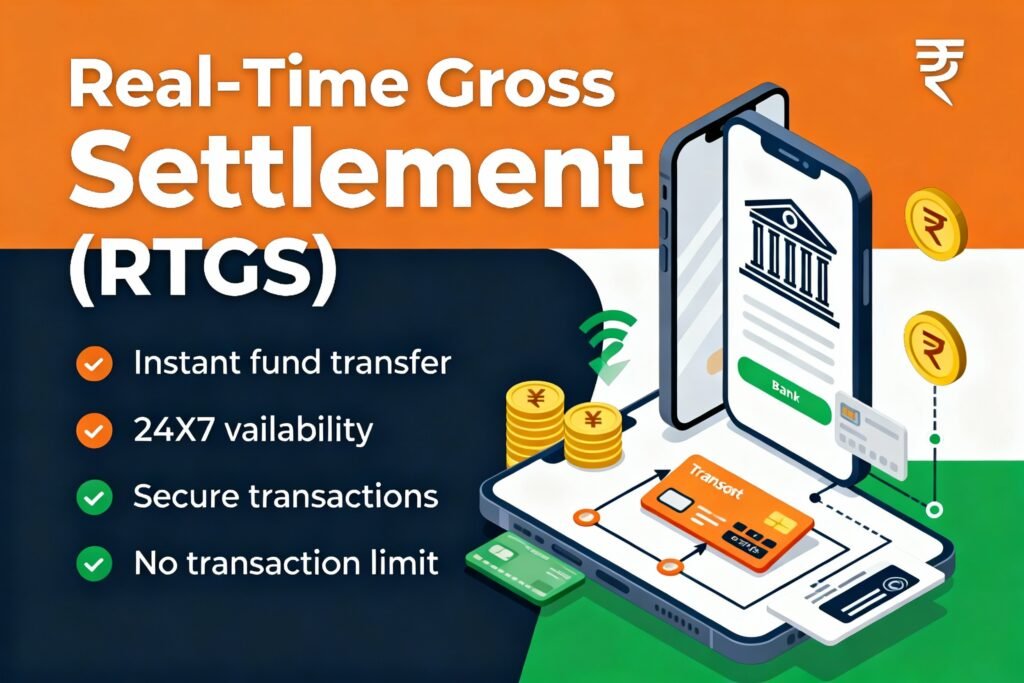
RTGS is an acronym for Real-Time Gross Settlement. This innovative electronic payment system is the bedrock for high-value fund transfers in many major economies, including India, where it is regulated and overseen by the central bank. It represents a monumental leap forward from traditional batch-processing methods, which often introduced delays and uncertainty into the transfer process. By offering an immediate, continuous, and secure transfer mechanism, the Real-Time Gross Settlement (RTGS) system ensures that money moves swiftly from the remitter’s account to the beneficiary’s account, minimizing credit and liquidity risks for all parties involved.
The core principle of RTGS is its “real-time” and “gross” settlement. “Real-time” means the transaction is processed as soon as the instruction is received, with no waiting period. “Gross” means the settlement of funds transfer instructions occurs individually, one-to-one, without being bundled with any other transactions. This dual nature ensures maximum speed and transaction finality. Over the next few sections, we’ll dive deep into the mechanics, unparalleled advantages, and strategic importance of the Real-Time Gross Settlement (RTGS) system, offering a comprehensive and authoritative perspective on this critical financial infrastructure.
Understanding Real-Time Gross Settlement (RTGS)
The full form of RTGS—Real-Time Gross Settlement—perfectly encapsulates its operational philosophy. It’s an electronic payment system that facilitates interbank funds transfer on a continuous, transaction-by-transaction basis. To truly appreciate the value of RTGS, we must dissect its two fundamental components: Real-Time and Gross Settlement.
Real-Time refers to the processing of payment instructions at the very moment they are received. There is no lag, no waiting for a scheduled cut-off time, and no queuing. The speed of Real-Time Gross Settlement (RTGS) ensures that fund transfers are as immediate as technology allows, making it ideal for time-sensitive, high-stakes financial operations.
Gross Settlement is the other critical half. It signifies that the funds transfer instructions are settled individually, one at a time, on a one-to-one basis. Unlike “net settlement” systems, where multiple transactions are bundled together and offset at a set time, Real-Time Gross Settlement (RTGS) guarantees that each payment is settled in full. This “gross” mechanism is crucial because it eliminates settlement risk; if one party defaults, it doesn’t endanger a whole batch of other unrelated transfers, thereby fortifying the stability of the financial system. The security and speed offered by RTGS are why it is the preferred channel for large corporate and institutional transfers.
Why Real-Time Gross Settlement (RTGS) Is Important in Today’s Market
The relevance of the Real-Time Gross Settlement (RTGS) system has only grown in the digital era. In a world increasingly dominated by instant transactions and global commerce, the ability to move large sums of money securely and without delay is paramount. RTGS serves several vital roles that underpin the health and efficiency of the modern economy:
- Minimizing Settlement Risk: By settling transactions individually and instantly, RTGS significantly reduces the time between a payment instruction being sent and the funds being settled. This immediate finality drastically lowers the risk that one of the parties could fail to meet its obligation (counterparty risk).
- Enhancing Liquidity Management: Banks and corporations can manage their cash flow and liquidity much more effectively when they know precisely when large payments are being credited or debited. This real-time visibility provided by the Real-Time Gross Settlement (RTGS) system enables better financial planning and operational efficiency.
- Supporting High-Value Commerce: For transactions involving large amounts—such as property purchases, stock market settlements, major supplier payments, or interbank lending—RTGS is indispensable. It provides the necessary finality and speed that commercial transactions of this magnitude demand.
- Boosting Financial System Stability: Central banks, which typically operate the Real-Time Gross Settlement (RTGS) system, view it as a critical tool for maintaining the stability of the financial infrastructure. Its design ensures that systemic risk—the risk of a failure in one part of the system causing a chain reaction—is contained.
Without a robust system like Real-Time Gross Settlement (RTGS), the high-value segment of the financial market would be slower, riskier, and significantly less efficient.
Key Features and Advantages of Real-Time Gross Settlement (RTGS)
The design of the Real-Time Gross Settlement (RTGS) system incorporates features that deliver substantial advantages over other electronic fund transfer methods:
- 24x7x365 Availability: A significant evolution of the Real-Time Gross Settlement (RTGS) system in many countries is its availability every hour of every day, including weekends and public holidays. This continuous operation supports globalized business practices and provides ultimate convenience for urgent payments, regardless of the time zone or calendar.
- Irrevocable and Final Settlement: Once an RTGS transaction is successfully completed, the payment is final and cannot be reversed. This characteristic is the cornerstone of its security and reliability, assuring both the sender and the receiver of the transaction’s permanence.
- Mandatory Minimum Transaction Limit: RTGS is specifically designed for large-value transactions, typically requiring a minimum transfer amount (e.g., ₹2,00,000 in India). This dedicated focus ensures the system is optimized for high-volume traffic, maintaining its speed and efficiency, and distinguishes it from smaller-value systems like NEFT. Critically, there is no upper limit on the amount that can be transferred via RTGS, making it scalable for the largest corporate needs.
- High Security and Regulation: As central bank-operated (or regulated) payment rails, Real-Time Gross Settlement (RTGS) systems adhere to the highest standards of security and regulatory oversight. This robust framework protects against fraud and systemic vulnerabilities, making it one of the most secure ways to transfer money.
The combined effect of these features is a superior fund transfer experience that prioritizes speed, security, and certainty for the user of the Real-Time Gross Settlement (RTGS) system.
The Operational Mechanics: How Real-Time Gross Settlement (RTGS) Works
Understanding the step-by-step process of a Real-Time Gross Settlement (RTGS) transaction illuminates its efficiency and security. The operation of RTGS involves the remitting customer, the remitting bank, the central bank (the operator of the RTGS system), the beneficiary bank, and the final beneficiary.
- Initiation: The customer (remitter) initiates the RTGS transfer through their bank’s digital channels (net banking) or by filling out a physical form at the branch. The key information required includes the beneficiary’s name, account number, amount, and the Indian Financial System Code (IFSC) of the beneficiary’s bank branch. The IFSC is a unique 11-character code that identifies every bank branch participating in the RTGS network.
- Validation and Forwarding: The remitting bank validates the customer’s account for sufficient funds and authenticates the transaction details. Once verified, the bank sends the payment message securely to the central bank’s RTGS system.
- Central Bank Processing: The central bank’s system receives the message. It debits the account of the remitting bank and credits the account of the beneficiary bank, all in real time and on a gross basis. This simultaneous settlement in the central bank’s books is what makes the transfer final and irrevocable.
- Credit to Beneficiary: The central bank instantly sends a payment message to the beneficiary bank. Upon receiving this message, the beneficiary bank has a regulatory maximum time frame (often just a few minutes) to credit the funds to the beneficiary’s account.
- Confirmation: Both the remitting and beneficiary customers are notified of the successful Real-Time Gross Settlement (RTGS) transaction, typically via SMS or email, completing the seamless, end-to-end transfer.
This multi-stage yet instantaneous process is the backbone of the RTGS system’s reliability and superior performance.
Real-Time Gross Settlement (RTGS) vs. NEFT: A Critical Comparison
While both the Real-Time Gross Settlement (RTGS) system and the National Electronic Funds Transfer (NEFT) system are popular electronic fund transfer mechanisms, their operational characteristics and intended uses differ significantly. A key difference lies in their settlement methodology, which fundamentally impacts transaction speed and size.
| Feature | Real-Time Gross Settlement (RTGS) | National Electronic Funds Transfer (NEFT) |
| Full Form | Real-Time Gross Settlement | National Electronic Funds Transfer |
| Settlement Basis | Gross (Individual transaction settlement) | Net (Settled in batches at specific intervals) |
| Speed | Real-Time (Funds transferred instantly) | Deferred (Based on half-hourly or hourly batches) |
| Minimum Limit | High (e.g., ₹2 Lakh) | No minimum limit (can be as low as ₹1) |
| Ideal For | High-value, urgent transfers | Low-to-medium value, routine transfers |
| Irrevocability | Immediate (Final upon settlement) | Final upon batch settlement |
Choosing the appropriate system—RTGS or NEFT—depends entirely on the amount and the urgency of the transfer. For large, time-critical payments, the certainty and speed of Real-Time Gross Settlement (RTGS) are unmatched. For smaller, less urgent transfers, NEFT may be preferred due to its lower or non-existent transaction limits.
Future Growth and Development Potential for Real-Time Gross Settlement (RTGS)
The evolution of the Real-Time Gross Settlement (RTGS) system is not static; it continues to adapt to the demands of a hyper-digital economy. Central banks are continuously exploring ways to enhance the system’s utility and integration.
One major area of development is its cross-border potential. Linking domestic RTGS systems across different countries could dramatically reduce the cost and time involved in international high-value payments, potentially rivaling or integrating with existing systems like SWIFT. This move toward interoperable Real-Time Gross Settlement (RTGS) would create an instant, secure global payment highway, boosting international trade efficiency.
Furthermore, integrating new technologies like Distributed Ledger Technology (DLT) or blockchain, while maintaining the finality and security of the current RTGS framework, is a path being actively researched. These innovations could further reduce processing costs, enhance transparency, and introduce even more sophisticated risk management tools to the Real-Time Gross Settlement (RTGS) environment. The goal remains to maintain the RTGS system as the most robust, fastest, and most secure channel for transferring large sums of money.
The Buyer’s and Investor’s Perspective on Real-Time Gross Settlement (RTGS)
For individuals and corporations engaged in high-value transactions, the Real-Time Gross Settlement (RTGS) system offers a decisive advantage: certainty.
- Real Estate Transactions: A major pain point in property deals is the transfer of large down payments or final closing amounts. Using RTGS provides instant confirmation to the seller, eliminating the need to wait for checks to clear or for NEFT batches to settle. This speeds up the closing process and builds trust, as the transfer is final and irrevocable.
- Corporate Investors: Stock market transactions, mergers and acquisitions, or large-scale debt financing require prompt fund movements. Investors rely on the speed of Real-Time Gross Settlement (RTGS) to capitalize on fleeting market opportunities or to meet strict contractual payment deadlines. A delay could cost millions, making RTGS an operational necessity.
- E-Tender/Auction Deposits: Businesses participating in large government tenders or auctions must often submit substantial earnest money deposits (EMDs) with tight deadlines. The immediate settlement of Real-Time Gross Settlement (RTGS) ensures the funds arrive before the deadline, preventing disqualification.
In essence, for the buyer or investor, RTGS is not just a payment option; it’s a strategic tool for mitigating financial risk and ensuring transactional integrity in high-value commercial engagements.
Expert Insights and Market Analysis on Real-Time Gross Settlement (RTGS)
Financial regulators and market analysts consistently hail the Real-Time Gross Settlement (RTGS) system as a core component of a modern, resilient financial system. The shift to a 24×7 RTGS operation was a game-changer, described by experts as a critical step in making the financial infrastructure ‘future-ready’ and aligning with global real-time payment trends.
Analysts point out that the high-value focus of RTGS acts as a buffer for the retail payment systems. By siphoning off the largest and most systemic transactions, Real-Time Gross Settlement (RTGS) prevents the congestion that could otherwise affect everyday consumer transactions (like those handled by IMPS or NEFT). The operational stability of RTGS is, therefore, a key indicator of the underlying health of the financial clearing system.
Market reports also confirm that the use of RTGS continues to grow in volume and value, particularly for business-to-business (B2B) payments. The clear advantage of its gross settlement principle—that an RTGS transaction cannot be canceled or failed due to another participant’s issue—provides a level of confidence essential for systemic trust. The system is the high-security vault of electronic fund transfers, built for certainty and speed above all else.
Why You Should Choose Real-Time Gross Settlement (RTGS) for High-Value Needs
When the transaction size exceeds the lower limit and immediacy is non-negotiable, choosing Real-Time Gross Settlement (RTGS) is the strategic choice. It’s an investment in peace of mind and transactional efficiency.
- Unrivaled Speed and Finality: No other traditional electronic transfer system offers the instant, final settlement of RTGS. If you need the money to be in the beneficiary’s account now, Real-Time Gross Settlement (RTGS) is the way to go.
- Maximum Security: Backed by the highest regulatory standards and run on a robust central bank platform, a transaction via RTGS is one of the most secure ways to move money. This is vital when the stakes are high.
- Simplicity and Consistency: Despite its complex technical backbone, the customer experience of initiating a Real-Time Gross Settlement (RTGS) transfer is straightforward, whether online or at a branch. The consistent 24×7 availability further simplifies planning.
For any individual or business managing significant sums, the advantages of security, speed, and finality offered by the Real-Time Gross Settlement (RTGS) system make it the definitive choice for critical financial transfers.
Conclusion — The Final Word on Real-Time Gross Settlement (RTGS) (185 words)
The Real-Time Gross Settlement (RTGS) system stands as an indispensable pillar of the modern financial infrastructure. Its full form, Real-Time Gross Settlement, perfectly describes its two most powerful features: the immediate execution of a transaction and the individual, final settlement of that transfer. This dual commitment to speed and security makes RTGS the unequivocal choice for high-value financial movements, ensuring that millions are transferred reliably and without delay, 24 hours a day, 365 days a year.
By isolating each transaction and settling it instantly, the Real-Time Gross Settlement (RTGS) system effectively eliminates settlement risk, providing banks, corporations, and individuals with the confidence and operational efficiency required to conduct large-scale commerce. As the financial world becomes more interconnected and demands greater immediacy, the robust, proven, and continuously evolving RTGS system will remain the gold standard for secure, high-stakes fund transfers. Embrace the power of RTGS to secure your most important financial commitments.
Are you Looking to Invest in Commercial Property? Do RTGS !
If you’re planning to invest in commercial real estate, this is the perfect time—especially with RTGS now officially approved as a secure payment option for property transactions.
This approval has made the entire buying process smoother, faster, and more transparent for investors. With RTGS, you can transfer high-value payments instantly, ensuring same-day settlement directly into the developer’s or seller’s account. No delays, no hassles.
Why This Matters for Investors:
✓ High-value payments allowed – Perfect for commercial property purchases.
✓ Instant & real-time settlement – No waiting for funds to clear.
✓ More secure & traceable – Ideal for professional investors and businesses.
✓ Accepted officially for buying property – Makes transactions completely compliant.
So, if you’re looking to book office space, retail shops, food courts, or commercial plots, you can now confidently proceed with RTGS as a safe, government-approved payment method.
Invest smart. Invest secure. Invest with ease — thanks to RTGS approval for property purchases.
Why Contact Best Real Estate Advisor by Vivek Singh?

Author
Vivek Singh is a real estate expert with 22+ years of experience, Specialized in investment, residential & commercial properties, and market trends. He is the Experienced author of byviveksingh.in, a platform sharing practical insights on real estate/Investment/Lifestyle & Stocks . With Education background in Bachelor of Commerce, Master’s in Marketing & Finance, and PG Diploma in Advertising/Public Relations, Vivek Singh blends industry expertise with strategic vision.
Vivek Singh
Serve as Director Sales at
Sumiram Sai Realtors (SSR)
FAQs
Q1. What makes Real-Time Gross Settlement (RTGS) the most secure method for large fund transfers?
A1. The Real-Time Gross Settlement (RTGS) system is inherently secure because of its design. It operates under the direct oversight of the central bank, and its ‘Gross Settlement’ principle ensures that each RTGS transaction is settled individually and is final and irrevocable upon completion. This eliminates settlement risk and provides maximum certainty.
Q2. How is Real-Time Gross Settlement (RTGS) different from NEFT in terms of transaction speed?
A2. Real-Time Gross Settlement (RTGS) is significantly faster because it settles funds in real-time, meaning the transfer is processed instantly as soon as the instruction is received. In contrast, NEFT operates on a Deferred Net Settlement basis, where transactions are collected and settled in batches at specific time intervals.
Q3. Is there an upper limit on the amount of money I can transfer using Real-Time Gross Settlement (RTGS)?
A3. While the Real-Time Gross Settlement (RTGS) system has a mandatory minimum transfer limit (e.g., ₹2,00,000) because it is intended for large-value transactions, there is no maximum or upper ceiling set by the central bank for an RTGS transfer, making it ideal for the largest corporate or institutional payments.
Q4. What is the full form and significance of the IFSC code in an RTGS transaction?
A4. The IFSC stands for Indian Financial System Code. In a Real-Time Gross Settlement (RTGS) transaction, the 11-character IFSC is crucial because it uniquely identifies the beneficiary’s bank branch that participates in the RTGS network, ensuring the funds are routed correctly and instantly to the intended destination.
Q5. Can I use Real-Time Gross Settlement (RTGS) for personal transfers, or is it only for businesses?
A5. Yes, while primarily used by businesses for high-value B2B transactions, any individual can use the Real-Time Gross Settlement (RTGS) system, provided the amount they wish to transfer meets the system’s minimum transfer limit. It’s often used by individuals for real estate, vehicle, or other large personal purchases.
Q6. Does Real-Time Gross Settlement (RTGS) operate 24 hours a day, including on holidays?
A6. Yes, the Real-Time Gross Settlement (RTGS) system in many countries, like India, has been made available 24 hours a day, 7 days a week, 365 days a year. This continuous operation ensures that critical high-value transfers can be executed anytime, regardless of banking hours or public holidays.
