
The dynamic real estate landscape of the National Capital Region (NCR) is perpetually shaped by policy shifts, none more fundamental than the rules governing how much a developer can build on a given plot of land. At the heart of this regulation is the Floor Area Ratio (FAR), also known as Floor Space Index (FSI). Simply put, FAR is the ratio of a building’s total floor area to the size of the plot it stands on. When the Noida Authority announces an increase in this ratio, it’s more than just a bureaucratic tweak; it’s a seismic event that recalibrates the supply-demand equilibrium, profoundly altering the trajectory of property price in the region.
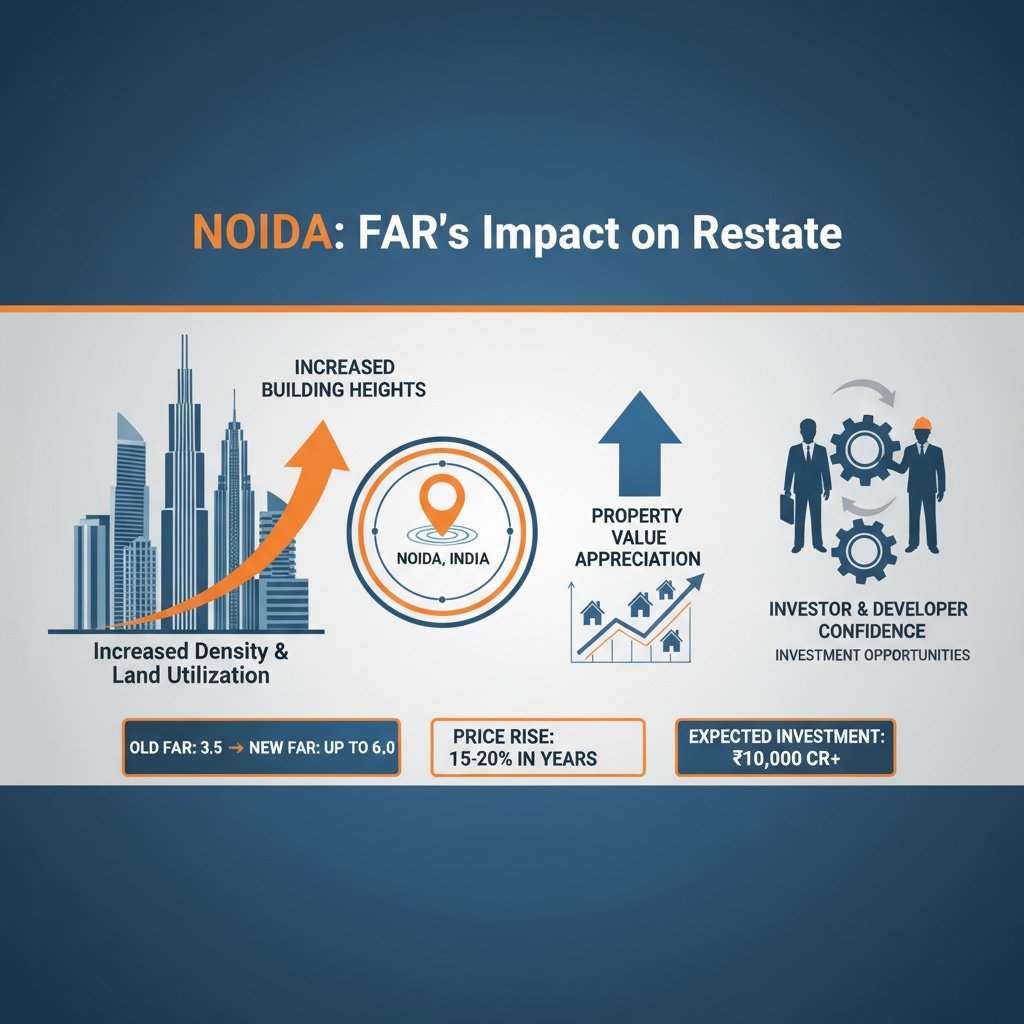
The latest move to increase the permissible FAR across various sectors in Noida signals a clear intent from the administration: to facilitate vertical growth, densify the urban core, and, crucially, unlock a massive new inventory of housing and commercial space. This analysis delves deep into the economic, infrastructural, and social ripple effects of this significant policy change. We’ll explore the short-term market corrections, the long-term investment implications, and the critical balance between increased construction and the necessary civic infrastructure upgrades required to sustain a vertically evolving Noida. For homebuyers, investors, and developers alike, understanding the full consequences of the Noida Authority FAR increase is the key to navigating this new, dense, and potentially more valuable real estate market.
Decoding FAR: The Economic Engine of Property Development
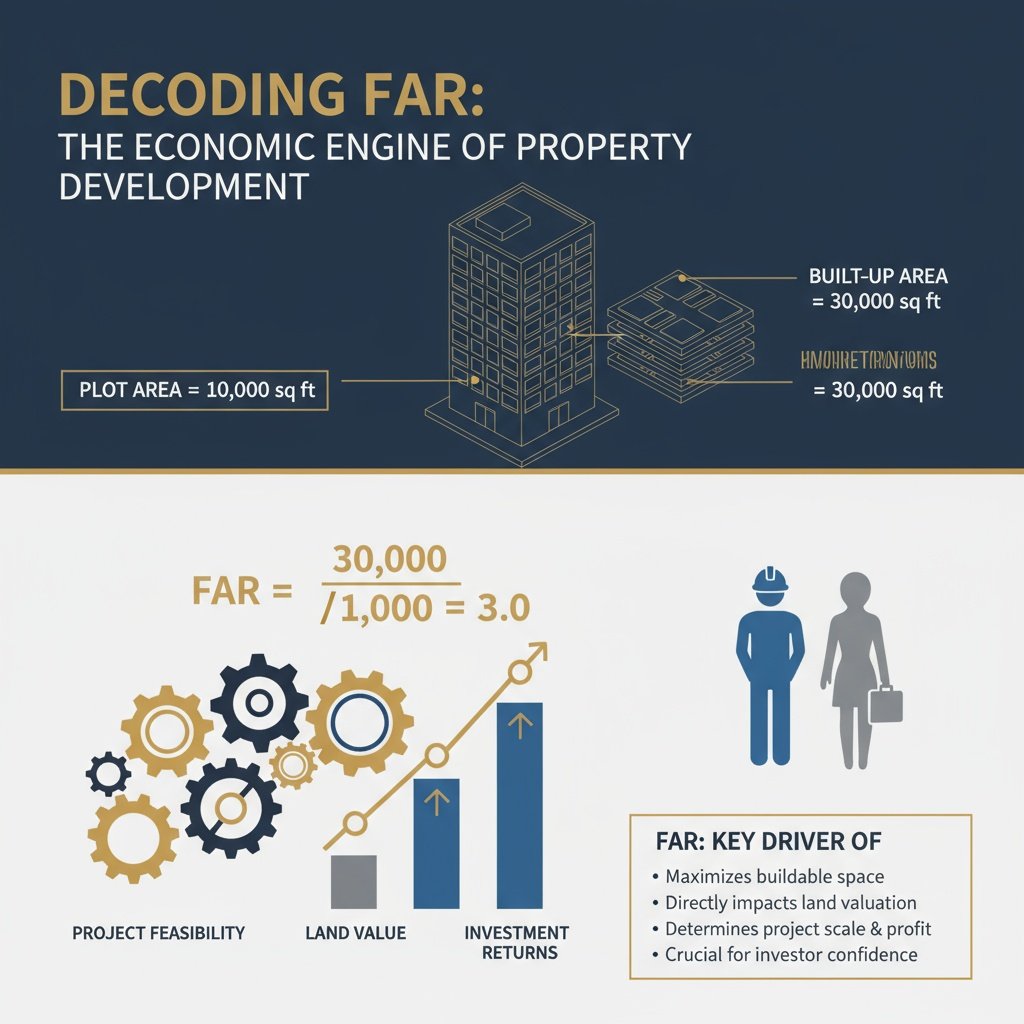
To truly grasp the impact on Noida property price, one must first understand the economic calculus of FAR. For a real estate developer, land cost is the single most significant factor. By increasing the FAR, the Noida Authority is essentially allowing the developer to create more saleable area on the same plot of land. This policy change directly affects the financial viability and profitability of every single project in the region.
The Developer’s Equation: Land Cost Amortization
Consider a scenario where a developer purchases a plot for a substantial price. If the original FAR was 2.0, every square foot of saleable area had to absorb the cost of the land divided by two. If the FAR is now increased to 3.0, the total construction area jumps by 50%. This immediately achieves a critical economic objective: it spreads the fixed, high cost of the underlying land over a much larger number of housing or commercial units.
- Reduced Per-Unit Land Cost: The cost component of the land per square foot of a flat decreases significantly. This margin can be used for three main purposes: absorbing construction cost inflation, increasing developer profit, or, most critically for the consumer, reducing the Basic Sale Price (BSP) of the unit.
- Increased Supply/Inventory: The higher FAR translates to a substantial increase in the overall inventory of residential and commercial properties. In theory, a greater supply should stabilize or even moderate the sharp rise in property price driven by scarcity.
- Encouraging Completion of Stalled Projects: Many projects were rendered unviable due to rising costs and limited saleable area. The option to purchase or utilize additional FAR provides a crucial lifeline, allowing developers to generate the necessary funds to complete construction and finally hand over possession, restoring confidence in the market.
However, the real-world impact is nuanced. While the per-unit land cost falls, the developers often have to pay a Premium FAR Charge to the Noida Authority for the additional area. This fee helps fund the necessary infrastructure development but also gets incorporated into the final cost, partially offsetting the benefit. This complex financial interplay determines the final Impact of FAR increase on Noida property price for the end-user.
The Immediate Market Reaction: Short-Term Price Dynamics
When a significant regulatory change like the Noida Authority FAR increase is announced, the market response is rarely uniform. It creates a dichotomy in short-term pricing between existing, ready-to-move-in properties and new, under-construction projects.
The Two-Sided Coin of Property Price Adjustment
- Impact on Under-Construction Projects (The Supply Effect):
- Developers with new or ongoing projects are the primary beneficiaries. They can amend their plans and launch new towers or floors. This injection of fresh inventory into the market acts as a downward pressure on the overall market price per square foot.
- In the short term, developers may introduce new, competitively priced units to liquidate the increased inventory quickly. This aims to secure cash flow for the now larger construction pipeline. For a smart investor, this period presents an opportunity for affordability in new launches, especially in micro-markets close to key infrastructure like the Noida-Greater Noida Expressway or the Jewar International Airport corridor.
- Impact on Ready-to-Move (RTM) and Secondary Market (The Premium Effect):
- Established, fully occupied projects with superior amenities and no construction risk often experience a pricing premium. Buyers seeking immediate occupancy and avoiding the disruption of new construction will flock to RTM projects.
- Furthermore, if the increased density leads to concerns about infrastructure (traffic, water, parking), properties in low-density, well-established sectors become even more desirable, commanding higher prices for the intangible benefit of space and peace. The market bifurcates: high-density, volume-driven projects versus low-density, premium-driven projects.
Ultimately, the short-term picture shows a stabilization of new launch prices due to increased supply, but a continued upward trend in prime, existing property price due to the scarcity of developed, low-density living environments. This shift is a crucial insight for real estate investment in Noida, favoring a selective approach based on the project’s completion status and location.
The Long-Term Forecast: Analyzing Property Price Appreciation in a Denser Noida
The long-term impact of FAR increase on Noida property price is inexorably linked to the city’s ability to evolve its infrastructure alongside its vertical growth. This is the sustainability test that separates a thriving, dense metropolis from a congested, unlivable concrete jungle.
Infrastructure: The Non-Negotiable Corollary to Density
A higher FAR fundamentally means higher population density. If a city’s Master Plan allows for more people, the civic amenities must proportionally increase. The sustainability of the new FAR norms hinges on the Noida Authority’s capacity to deliver on key infrastructural commitments:
- Enhanced Connectivity: The increased density necessitates a robust expansion of metro rail lines, peripheral roads, and flyovers to manage the traffic surge. Micro-markets that see this infrastructure upgrade first—such as those linked to the FNG Expressway or the extended metro corridor—will witness the highest and most sustained capital appreciation.
- Utility & Social Infrastructure: Water supply, sewage treatment, power grids, schools, and hospitals are services that operate on a per-capita basis. If the population doubles due to higher FAR, but the water treatment plant capacity remains the same, the quality of life—and thus the long-term property value—will suffer.
- The Role of Purchasable FAR Revenue: The revenue generated by the Noida Authority from selling premium/purchasable FAR is specifically intended to fund these infrastructure upgrades. The transparency and efficiency with which these funds are deployed will be the true determinant of Noida’s long-term success.
In the long run, the Noida Authority FAR increase acts as a catalyst for growth. It attracts more developers and institutional investors, leading to a vibrant and competitive market. However, the premium on a property will shift from being merely about location to being about a combination of location and demonstrable infrastructure support. Investors should prioritize areas where infrastructure development is already visibly progressing, ensuring their investment is secured against the risk of future congestion.
Segment-Specific Impacts: Residential, Commercial, and Plotted Development
The implications of increased density are not uniform across all real estate asset classes. The consequences of increased FAR manifest uniquely in residential, commercial, and traditional plotted segments, creating distinct investment opportunities and risks.
1. Residential Real Estate: Group Housing vs. Builder Floors
- Group Housing (High-Rise Apartments): This segment is the primary beneficiary. The increase allows for taller towers, generating more inventory and potentially a slight downward correction or stabilization in prices for the new launch segment, increasing affordability for first-time homebuyers. The downside is increased pressure on common areas like clubhouses, parking, and internal roads, which can lead to a decline in per-capita amenity space.
- Plotted Development & Builder Floors: The FAR increase for residential plots is often used to legalize or regularize previously unauthorized construction (e.g., adding an extra floor). This has a positive impact, as it enhances the legal built-up potential of the land, driving up the land value (the cost of the plot itself) more than the cost of the final unit. For investors, purchasing a plot with the potential for a higher FAR is an excellent long-term hedge against inflation, as the inherent land value appreciates sharply.
2. Commercial Real Estate (CRE): Vertical Integration & Density
Commercial properties, like offices and malls, typically already have a higher base FAR. An increase here is a massive boon:
- Increased Footprint & Revenue: Higher FAR allows for taller office buildings and larger retail centres, accommodating more businesses and attracting larger corporate tenants. This drives up the rental yield potential in the best-located commercial sectors.
- Mixed-Use Development: The new norms encourage integrated mixed-use projects, combining high-density housing with commercial space, creating walkable Live-Work-Play environments. Such integrated townships command a significant price premium due to the enhanced convenience and reduced commute times for residents.
For an astute investor, the Noida Authority FAR increase makes investment in premium commercial office space and high-street retail units—where footfall can be maximized—highly attractive due to the higher potential for capital appreciation and rental income.
Risk Factors and Mitigation: The Urban Planning Conundrum
While the economic benefits are clear, an increase in density is a double-edged sword. An expert SEO content creator must address the risks candidly to provide a complete, human-centric analysis that maintains credibility. The central risk is the potential for urban congestion and a deterioration of the living environment.
Addressing the Challenges of Vertical Growth
The Noida Master Plan must be meticulously followed and updated to address the population increase resulting from the new FAR norms. Key challenges include:
- Traffic and Mobility: More residents mean more vehicles. If the arterial roads remain the same width, the daily commute transforms into a nightmare. Buyers must look for projects located near existing or planned mass transit systems (Metro, Bus Rapid Transit) to mitigate this risk.
- Civic Service Strain: The increased density strains essential services. Developers must ensure that their project’s design includes adequate provisions for water recycling, solid waste management, and sufficient parking space (often a statutory requirement tied to the new FAR). A project that offers a sustainable living solution will be the one that retains its premium value.
- Impact on Sunlight and Open Space: Higher buildings reduce sunlight penetration and increase shadow areas, potentially diminishing the quality of life in ground-level units and public spaces. Savvy homebuyers should prioritize projects that maintain a healthy ground coverage to FAR ratio, ensuring sufficient landscaped open areas and recreational facilities.
Mitigation Strategy for Buyers: Due diligence is key. Don’t just check the Noida Authority FAR increase; verify the project-specific building plan approvals, the quality of the surrounding public infrastructure, and the builder’s track record in delivering functional amenities. Investing in quality infrastructure is a direct investment in the long-term value of the property.
The Humanization Layer: Stories of Scarcity and Opportunity
The FAR change, at its core, is a response to the human story of migration, ambition, and the relentless search for a home in a rapidly urbanizing environment. Noida is the city of opportunity for millions, and historically, restrictive FAR norms created an artificial scarcity, pushing property price beyond the reach of the common man.
For years, the NCR saw stories of young families forced to choose between a smaller apartment closer to work and a larger home far on the periphery. The Noida Authority FAR increase offers a compelling new narrative: The potential for more affordable homes closer to the city’s commercial and IT hubs.
Imagine a young tech professional, previously priced out of a 3BHK flat in Sector 137, now seeing a newer project in the same corridor launching units at a corrected price point due to the developer’s increased inventory and lower per-unit land cost. This is the positive societal outcome of the policy: increased vertical supply addresses the horizontal scarcity, offering a glimmer of hope for achieving the dream of homeownership.
This shift also encourages a move away from sprawling horizontal growth (which consumes agricultural land) towards a more sustainable vertical densification. By making the most of existing land parcels, Noida can preserve its surrounding green belt and agricultural areas, making the understanding Floor Area Ratio changes in Noida crucial not just for investment, but for conscious urban citizenship.
Strategic Real Estate Investment in Noida: Maximizing the FAR Advantage
For investors, the Noida Authority FAR increase presents a clear, actionable roadmap for superior returns. The focus must shift from simply buying land to buying the potential for value unlocked by density.
Actionable Takeaways for Smart Investors
- Prioritize Location Over Absolute Price: The highest property price appreciation will be seen in sectors that combine the new, high FAR potential with the city’s best existing infrastructure. The corridor along the expressways, especially those with proximity to the planned airport and the existing IT hubs (Sectors 62, 137, 142), will be the ultimate winners. The FAR increase in these areas will magnify their existing location advantage.
- Focus on Commercial and Mixed-Use: The profitability of commercial developments sky-rockets with higher FAR. Invest in commercial spaces within integrated mixed-use townships that benefit from the built-in customer base of the high-density residential towers. This minimizes vacancy risk and maximizes rental yield.
- Hedge with Plotted Development: For high-net-worth investors, acquiring residential plots in core areas whose purchasable FAR has been increased is a robust strategy. The value of the entitlement to build is the asset here, and it will appreciate faster than the built-up inventory, as it is a finite resource.
- Verify Builder’s Financial Health: With greater leverage and more construction, the builder’s financial stability becomes paramount. The FAR increase allows for larger loans and greater risks. Invest only with developers who have a proven track record and RERA compliance history, as a stalled high-rise is an exponentially larger liability.
Understanding Floor Area Ratio changes in Noida is essentially understanding the city’s future. It’s a bet on vertical growth, infrastructure development, and the eventual maturation of Noida into a true global metropolis.
Navigating Noida’s New Vertical Reality
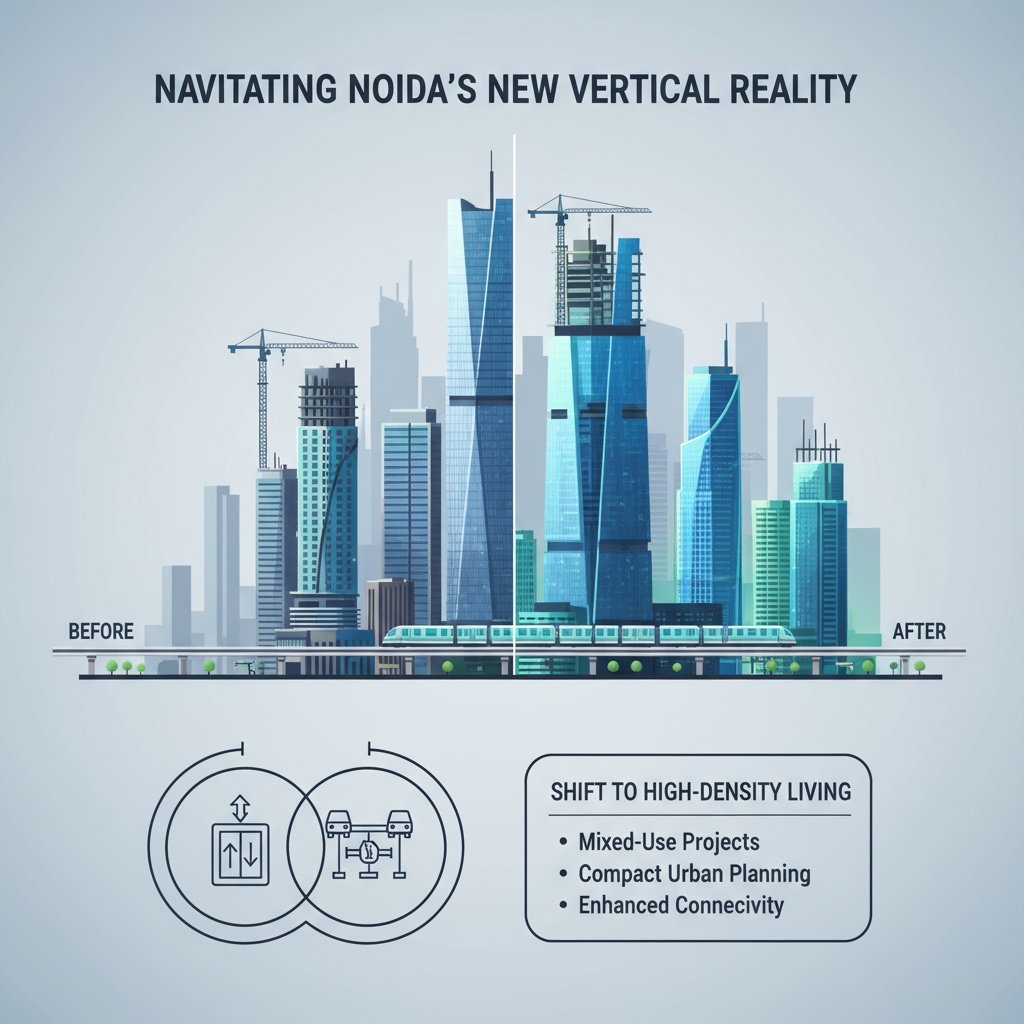
The Noida Authority FAR increase is arguably the most transformative policy lever pulled in recent years, signaling a decisive shift toward planned urban densification. The impact on property price is two-fold: a potential for stabilization or correction in new high-rise residential prices due to increased supply, and a sustained, high-premium appreciation in prime, well-connected areas where infrastructure can successfully support the new population density.
For developers, it’s a clear pathway to higher profitability and project viability. For investors, it’s a directive to focus on strategic locations and quality construction that can withstand the pressures of increased density. For the average homebuyer, it represents a crucial opportunity to enter the market at more accessible price points closer to their workplaces.
Noida is transforming from a sprawling satellite city into a dense, vertically-integrated urban centre. The success of this transition now rests on the vigilant and timely execution of infrastructure projects by the Noida Authority. The wise real estate decision-maker will move beyond the simple headline of “price impact” and focus on the deeper metrics of density-adjusted infrastructure, location, and the builder’s compliance with the new urban vision.
As Noida ascends to its new vertical reality, securing your position requires expert guidance. Consult a certified real estate advisor today to map out the best investment sectors under the new FAR regime and secure your future in this rapidly evolving market.
Why Knowledge park 5 will be the Best upcoming Real Estate Investment?
Knowledge Park 5 is in Greater Noida, which benefits from excellent connectivity via major expressways like the Yamuna Expressway, Noida-Greater Noida Expressway, and the Eastern Peripheral Expressway. This makes it incredibly accessible for businesses, commuters, and logistics, adding to its future growth prospects.
IT, Education, and Commercial Hub Synergy
The area is a planned zone for educational institutions, IT parks, and commercial complexes. This synergy creates a stable demand for commercial space, as companies and entrepreneurs are drawn to regions with a skilled, educated workforce residing and studying nearby. Such an environment ensures consistent rental yields and capital appreciation for investors.
FAQs on Noida Far Increase
1. What is the Noida Authority FAR Increase and how is it calculated?
The Noida Authority FAR increase refers to the official policy change raising the permissible Floor Area Ratio (FAR). FAR is calculated by dividing the total constructed floor area of all floors by the total area of the plot. An increase, for example from 2.0 to 3.0, means a developer can build 50% more floor space on the same land parcel, fundamentally boosting potential unit supply.
2. How will the new FAR norms affect the property price of existing flats in Noida?
Existing, ready-to-move-in flats, especially in low-density or prime sectors, may see their property price appreciate further. This is because they offer immediate occupancy and a guaranteed lower-density environment compared to the newer, denser projects built under the increased FAR norms. This creates a premium for the scarcity of finished, less-dense inventory.
3. Why is the Noida Authority increasing the Floor Area Ratio (FAR)?
The Noida Authority is increasing the FAR primarily to address the massive housing demand in the NCR, regularize and encourage the completion of stalled projects, and promote vertical growth. The policy also generates significant revenue from the sale of purchasable FAR, which is earmarked to fund essential infrastructure upgrades like metro extensions and road networks.
4. Can increasing the FAR lead to urban congestion in Noida?
Yes, increasing the FAR inherently leads to higher population density, which can cause urban congestion, traffic issues, and strain on utilities like water and sewage. The risk is mitigated only if the Noida Authority invests the premium collected from the extra FAR into robust, synchronized infrastructure development (roads, public transport, etc.) before or during the construction phase.
5. How should a homebuyer approach property investment in Noida after the FAR increase?
A homebuyer should focus on projects with demonstrably strong infrastructure support. Look for locations near the Metro or major expressways. While new projects may offer a better price due to increased supply, buyers must verify the project’s compliance with the new norms and ensure the developer has allocated ample parking, open space, and amenities to cope with the higher resulting density.
6. What are the consequences of increased FAR for developers and real estate investors?
For developers, the consequences of increased FAR are largely positive, offering higher profitability and financial viability by spreading the land cost over more units. For investors, it creates an opportunity for higher capital appreciation in land (plots) and commercial properties, but requires careful selection of projects that can successfully integrate the resulting higher density with quality living standards.