
The opening of the Noida International Airport, often referred to as Jewar Airport, is more than just a new launch for India’s aviation sector—it is a $40 billion economic magnet reshaping the entire socio-economic landscape of the National Capital Region (NCR). For the residential real estate market, this is a generational opportunity. The traditional property hotspots of Noida and Gurugram are now watching a new corridor emerge along the Yamuna Expressway, one where organized development meets massive infrastructural investment. This transformation is giving birth to a classic Aerotropolis—a city planned around an airport.
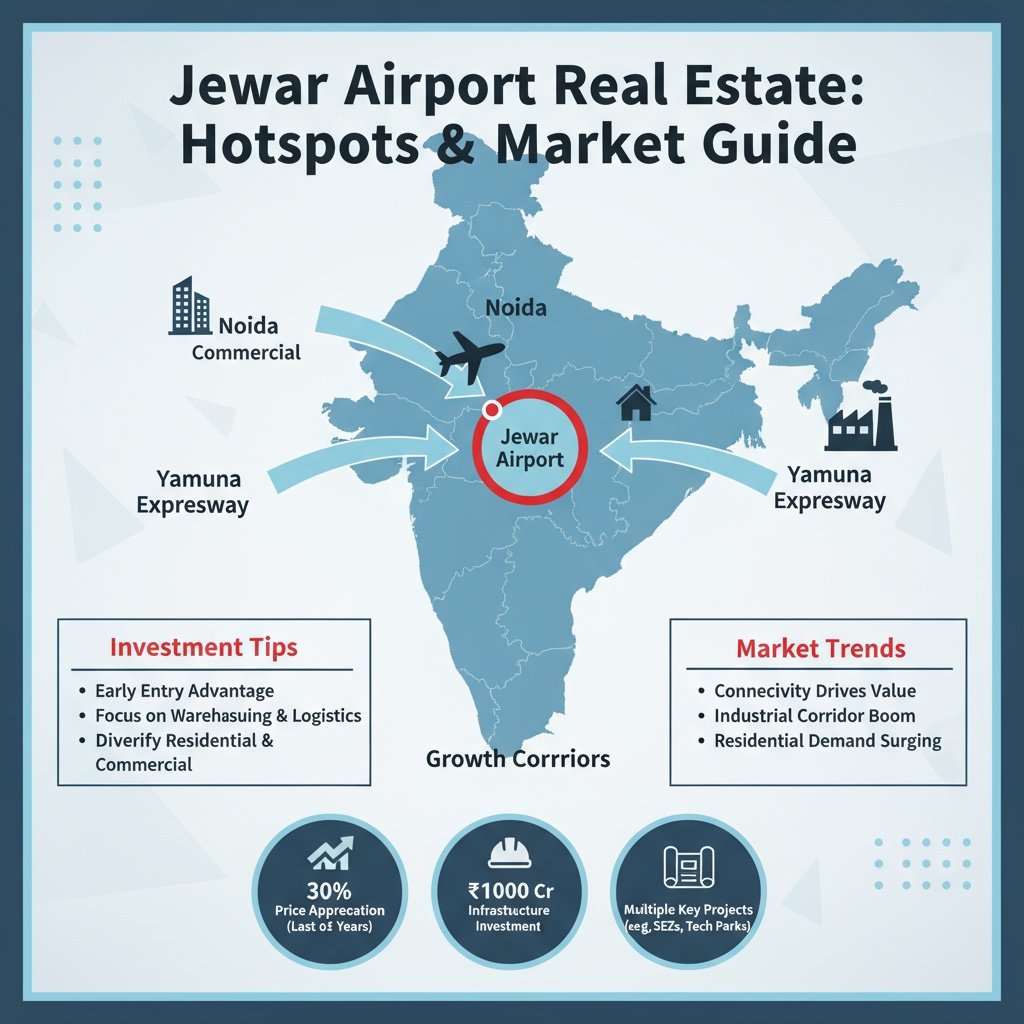
This massive scale of infrastructure is not just promising better connectivity; it is creating an entirely new ecosystem of logistics, manufacturing, and IT/electronics hubs, including the crucial Film City and Medical Device Park. When jobs and connectivity converge on such a scale, residential demand inevitably skyrockets. This comprehensive guide, authored from a perspective of deep market insight, will cut through the noise to highlight the precise residential investment hotspots and strategic sectors where the potential for capital appreciation is not just high, but structurally guaranteed by government master plans. Investing in the region now means participating in an urbanization wave built on a foundation of long-term government foresight.
2. The Core Investment Zones: Understanding the YEIDA Advantage
When discussing Jewar Airport’s residential investment hotspots, the conversation must begin and end with the Yamuna Expressway Industrial Development Authority (YEIDA) sectors. These are not private, speculative holdings; they are government-planned, meticulously structured residential zones designed to accommodate the influx of professionals, aviation staff, and ancillary workforce arriving with the airport and its related industrial corridors.
2.1. The Platinum Triangle: YEIDA Sectors 18, 20, and 22D
Sectors 18, 20, and 22D form the nucleus of residential investment nearest to the airport site. They represent the safest and most promising bet due to their governmental backing, clear titles, and strategic zoning:
- Sector 18: The Logistics Gateway: This sector is specifically positioned near the proposed cargo and logistics hub. This proximity makes it invaluable for professionals in the supply chain, warehousing, and air freight industries. While primarily residential, the adjacent commercial activity ensures high long-term rental demand, making it ideal for investors focused on both capital appreciation and future rental yield.
- Sector 20: The Pure Residential Hub: Sector 20 is often cited as the gold standard for pure residential investment. It is a well-planned zone featuring larger plot sizes, wider internal roads, and dedicated green spaces, attracting end-users seeking a high quality of life. The appreciation potential here is arguably the highest because it caters directly to the aspirational, upper-middle-class demographic drawn by the ‘airport city’ lifestyle. Plot sizes here typically range from 120 sq. m to 1000 sq. m.
- Sector 22D: The Integrated Township Corridor: Positioned slightly further out but with excellent connectivity via the Yamuna Expressway, Sector 22D is witnessing a surge in large, integrated township projects by prominent developers. These townships offer a self-sufficient ecosystem of schools, retail, and recreational facilities, appealing to families who want modern amenities with fast access to the airport’s job market.
Actionable Insight: The greatest growth in these sectors has already pushed plot prices up by 40% to 85% in the last five years. However, with the airport’s operational phase approaching, these prices are expected to stabilize at a much higher plateau, locking in the gains for early investors.
3. The Peripheral Power Play: Strategic Zones on the Yamuna Expressway
The real estate impact of the airport extends well beyond the 10-15 km primary radius. The entire 165 km Yamuna Expressway has transformed into a strategic growth corridor, providing diverse entry points for varying investor appetites—from ultra-premium integrated townships to affordable, early-stage land aggregation.
3.1. Greater Noida (Sectors like 150 & Pari Chowk)
While a 35-40 km distance from the airport, Greater Noida’s established sectors are experiencing a powerful ripple effect. The appeal here lies in established, ready-to-move (RTM) infrastructure, which the primary Jewar zone still lacks.
- Established Social Infrastructure: Areas around Pari Chowk already boast operational schools (like Gautam Buddha University, Galgotias University), hospitals, and shopping centers. For professionals taking up jobs at the airport who need to move their families immediately, these sectors offer a seamless transition.
- Sector 150: Already a low-density, sports-centric residential hub, Sector 150 is seeing renewed interest. Its location near the start of the Yamuna Expressway and its existing, modern housing stock position it as the premium “commuter community” for high-salaried airport executives.
This segment caters to the end-user market, providing immediate rental income potential as the workforce begins to relocate, contrasting with the pure land appreciation model of the closer YEIDA plots.
3.2. Emerging Micro-Markets: Tappal and Dankaur
For the more risk-tolerant, early-stage investor, micro-markets like Tappal and Dankaur represent a high-upside opportunity. These semi-urban zones are currently driven by land aggregators and small builders, making them the most affordable entry point for property near Jewar.
- Tappal: Located very close to the Yamuna Expressway, Tappal is rapidly transitioning from an agrarian area to a residential and small-scale commercial hub. While the development is less structured than the YEIDA sectors, the land prices are significantly lower, offering maximum percentage appreciation on initial investment.
- Dankaur: This area is benefiting from improved connectivity via the Eastern Peripheral Expressway (EPE) in addition to the Yamuna Expressway. Its proximity to the established Greater Noida Industrial Area provides an anchor of existing economic activity.
Key Distinction: Investing in these micro-markets requires rigorous due diligence on land titles and municipal approvals, but the reward is access to IT plots at a price point that has the potential for a 4x to 5x return over the long term, echoing the early days of Gurugram.
4. The Economic Multipliers: Anchor Projects Driving Residential Demand
The sheer scale of residential development is directly proportional to the volume of quality jobs being created. The Jewar Airport corridor is designed not just as an air hub, but as an integrated industrial and services ecosystem—a fact that solidifies the long-term residential demand forecast.
4.1. The Industrial and Logistics Corridors
The government’s plan allocates over 40% of the land for industrial use, a clear signal of the long-term job creation strategy. This industrial thrust is a primary driver for the residential market:
- Medical Device Park (Sector 28): The planned factory complex here, offering “plug-and-play” units, will attract hundreds of MSMEs and startups. The demand for affordable, high-quality worker housing will directly drive prices in adjacent residential sectors.
- Semiconductor & Electronics Manufacturing Clusters (EMC 2.0): The allocation of land for semiconductor and electronics industries (like the reported HCL-Foxconn interest) will attract highly specialized and well-paid technical staff. This influx will fuel demand for premium apartments and villas, particularly in established sectors like 150 and the aspirational plots of Sector 20.
- Multi-Modal Logistics Hubs (Dadri): The massive logistics parks enhance the region’s appeal as a transit and warehousing hub. Logistics staff, drivers, and supply chain managers will require housing, contributing to demand across all price points along the expressway.
4.2. The Cultural and Entertainment Hubs
Beyond industry, the social infrastructure components are designed to create a vibrant, liveable city, transforming “investment” property into “end-user” property:
- The Global Film City: Proposed to be a world-class center for media and entertainment, the Film City will attract a creative and highly mobile workforce—directors, actors, technicians, and production staff. This group requires high-end, lifestyle-centric housing, boosting the luxury segment.
- Heritage City (Raya, near Mathura): Though further afield, this massive cultural and tourism project, with YEIDA’s involvement in residential clusters, will integrate the entire Braj region into the economic sphere of the Aerotropolis, diversifying investment outside the immediate airport radius.
The Logic of Density: These combined projects are expected to generate millions of jobs and house over 3.7 million residents by 2041, according to the YEIDA Master Plan. This guaranteed population influx is the single most powerful factor supporting the current real estate prices and future appreciation.
5. Infrastructure: The Unbreakable Backbone of Real Estate Appreciation
In real estate, connectivity is capital. The appreciation witnessed in the Jewar corridor is a direct function of the planned, high-speed connectivity projects that are structurally linking the airport to the core economic centers of Delhi-NCR.
5.1. Road and Expressway Integration
The Yamuna Expressway remains the lifeline, but auxiliary projects are drastically improving accessibility:
- Delhi-Mumbai Industrial Corridor (DMIC) and Eastern Peripheral Expressway (EPE): These national corridors intersect near the Jewar zone, positioning it as a key node in India’s logistics network. This makes the location attractive for businesses that need to connect their manufacturing to a major airport while maintaining fast road links to Mumbai and the rest of NCR.
- Faridabad-Jewar Expressway (Under Construction): This new 31 km link will provide a direct, fast route to Haryana and Gurugram, bridging the divide between the two major NCR hubs. This improved commute will make Jewar an attractive option for those working in Gurugram’s corporate offices who want larger homes and better value.
5.2. Rapid Mass Transit Systems
The real game-changer for residential appreciation is the promise of fast, reliable public transport:
- Ghaziabad–Jewar RRTS (Rapid Rail Transit System): A project of immense significance, this line will connect the airport directly to Delhi, Noida, and Ghaziabad, potentially reducing travel times to under an hour. This development transforms the area from a distant outpost into a viable commuting suburb, unlocking the residential market for the millions of people who work in the NCR’s core.
- Metro Extension Plans: Proposed extensions of the Delhi Metro to the Airport Express line further solidify the future for mass transit, appealing to the general public and creating density.
Investor Takeaway: While you can’t buy the RRTS line, you can buy the land it serves. Real estate parcels located near the proposed RRTS and Metro stations will see the most aggressive capital appreciation as the projects near completion, a classic case of “location, location, future location.”
6. Navigating the Investment Landscape: Plots vs. Apartments vs. Villas
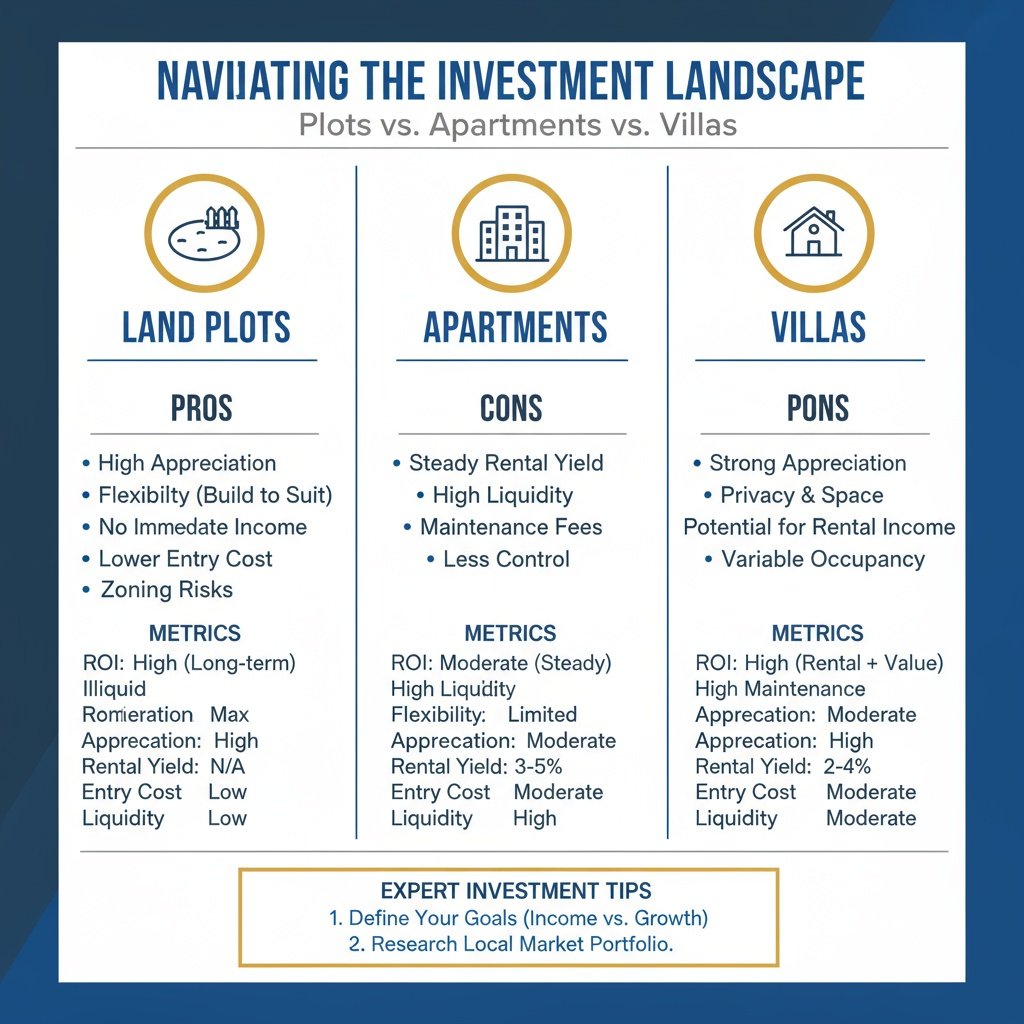
An expert investment strategy near Jewar requires segmenting the market based on risk appetite, holding period, and end goal. The market currently offers three primary asset classes in Jewar Airport’s residential investment hotspots.
| Asset Class | Primary Locations | Investment Goal | Risk Profile | Expected Holding Period |
| Plotted Land (YEIDA) | Sectors 18, 20, 22D | Pure Capital Appreciation | Medium (if YEIDA-approved) | 5–10 Years |
| Integrated Townships | Yamuna Expressway (Gaur, Supertech) | Lifestyle/End-Use & Appreciation | Medium-Low (Reputed Developers) | 3–7 Years |
| Ready-to-Move Apartments | Greater Noida (Sectors 150, Chi 5) | Immediate Rental Yield & Appreciation | Low (Established Market) | 3–5 Years |
6.1. The Allure of Plotted Land in YEIDA Sectors
Plotted land remains the most attractive investment vehicle for those seeking maximum percentage appreciation. The appeal stems from the limited supply of titled land offered directly by the authority (YEIDA) via lottery or e-auction schemes. This model ensures transparency and minimizes legal risk, making it a favorite for investors looking to hold and sell to builders or end-users later.
6.2. The Rise of Integrated Townships
For investors seeking a more developed asset with amenities, the integrated townships along the Yamuna Expressway are a strong choice. Developers like Gaur and Supertech have large projects that offer a diversified portfolio of apartments, villas, and commercial spaces. These projects provide a built-in lifestyle, which is essential for attracting high-paying tenants once the airport becomes fully operational.
Humanization Layer: I recall a senior pilot from a major carrier mentioning that when he relocates to a new airport city, he prioritizes “livability” over proximity. He looks for a secure, amenity-rich township—not just a raw plot. This is the market segment that Integrated Townships are designed to capture.
7. Strategic Optimization: Mitigating Risks and Maximizing Returns
Like any high-growth market, the Jewar corridor has risks, primarily centered on construction delays, market speculation, and legal title issues in unorganized land parcels. A seasoned investor must approach the market with a disciplined strategy.
7.1. Due Diligence and Title Verification
- Only Invest in Authority Allotments: Prioritize plots or projects directly approved by YEIDA or the Greater Noida Industrial Development Authority (GNIDA). Look for the RERA registration number for private projects. The recent High Court rulings upholding RERA compensation for YEIDA plot delays underline the legal framework protecting allottees.
- Avoid Unorganized Land (Khasra/Khatauni): While cheaper, the risk of illegal construction, land disputes, and lack of essential utilities is extremely high. Focus on developed, ‘A-Class’ land with proper urban planning.
7.2. Timing the Investment Cycle
The market is currently transitioning from an “anticipatory” phase to an “operational” phase.
- Anticipatory Phase (Current): High appreciation for land based on future potential. Strategy: Plot investment in YEIDA Sectors 18/20.
- Operational Phase (Post-2025): The airport is operational, jobs are created, and the influx of tenants begins. Strategy: Investing in ready-to-move apartments in nearby Greater Noida for rental income and buying built-up commercial spaces for services.
Transition Phrase: Moving from the promise of infrastructure to the reality of a functioning airport requires a shift in investment focus—from raw land appreciation to yield generation.
The Runway to Wealth Creation

The Jewar Airport (Noida International Airport) project is a powerful, government-backed infrastructure initiative that has fundamentally altered the NCR’s real estate investment map. The creation of a dedicated Aerotropolis, supported by a dense network of industrial clusters (Semiconductors, Medical Devices, Film City) and world-class transit systems (RRTS, EPE), provides an unparalleled structural guarantee for long-term capital appreciation.
The residential investment hotspots are clear: the organized, authority-backed plots of YEIDA Sectors 18, 20, and 22D for maximum long-term growth, and the established, amenity-rich communities of Greater Noida (like Sector 150) for immediate rental yield. This is a rare instance where you can still get in on the ground floor of an entirely new, fully planned economic city. The runway is clear.
Would you like to speak to our team of experts to secure your investment in a YEIDA-approved plot today?
Why Knowledge park 5 will be the Best upcoming Real Estate Investment?
Knowledge Park 5 is in Greater Noida, which benefits from excellent connectivity via major expressways like the Yamuna Expressway, Noida-Greater Noida Expressway, and the Eastern Peripheral Expressway. This makes it incredibly accessible for businesses, commuters, and logistics, adding to its future growth prospects.
IT, Education, and Commercial Hub Synergy
The area is a planned zone for educational institutions, IT parks, and commercial complexes. This synergy creates a stable demand for commercial space, as companies and entrepreneurs are drawn to regions with a skilled, educated workforce residing and studying nearby. Such an environment ensures consistent rental yields and capital appreciation for investors.
❓FAQs on Jewar Airport Real Estate
Q. What is the best sector near Jewar Airport for investment?
The best sectors for a high return on investment (ROI) near Jewar Airport are YEIDA Sectors 18 and 20. These are well-planned residential zones with clear governmental titles. Sector 20 is favored for pure residential value, while Sector 18 is strategically located near the upcoming cargo and logistics hub, ensuring both appreciation and future rental demand.
Q. How is Jewar Airport impacting property prices in Greater Noida?
Jewar Airport has driven a significant surge in property prices, particularly along the Yamuna Expressway and in established Greater Noida sectors like 150 and around Pari Chowk. Prices for apartments and raw land have seen appreciation ranging from 40% to over 85% in the last five years, with further growth projected as the airport nears its operational phase.
Q. Why should I consider a residential plot in the Jewar corridor instead of an apartment?
Investing in a residential plot in the Jewar corridor, particularly one allotted by YEIDA, offers higher percentage capital appreciation over a 5-10 year holding period. While apartments offer immediate rental yield, plots allow you to capitalize on the raw land value surge created by new infrastructure and industrial development.
Q. Can foreigners buy residential property near the Noida International Airport?
Yes, Non-Resident Indians (NRIs) and Persons of Indian Origin (PIOs) can generally buy both residential and commercial property near the Noida International Airport, subject to the Foreign Exchange Management Act (FEMA) regulations. Specific rules on repatriability of funds apply, making it a highly viable option for the Indian diaspora.
Q. What key infrastructure projects will boost residential values near Jewar Airport?
The key projects boosting residential values are the Ghaziabad-Jewar RRTS (Rapid Rail Transit System), which will link the area to Delhi-NCR’s core, and the establishment of industrial hubs like the Medical Device Park and Global Film City. These developments ensure job creation and seamless connectivity, which are the fundamental drivers of real estate demand.
Q. What is the current risk of investing in unapproved land near Jewar Airport?
The risk of investing in unapproved land (often called Khasra or Khatauni land) near Jewar Airport is extremely high. This land often lacks proper legal titles, approved building plans, and essential infrastructure like water and sewage, making it susceptible to demolition or long-term legal disputes. Stick to YEIDA-approved plots and RERA-registered projects.