
Imagine a nation where the built environment—from state-of-the-art office spaces and integrated industrial parks to world-class residential communities—becomes a $10 Trillion powerhouse. This is the ambitious yet achievable vision for India’s Real Estate Sector by 2047, the centenary of India’s independence. Currently valued at around $0.3 trillion, the projected multi-fold expansion represents one of the most significant economic transformations in modern history. This explosive growth isn’t a mere aspiration; it’s a detailed forecast rooted in powerful demographic shifts, consistent policy reforms, and an unprecedented push for infrastructure development.
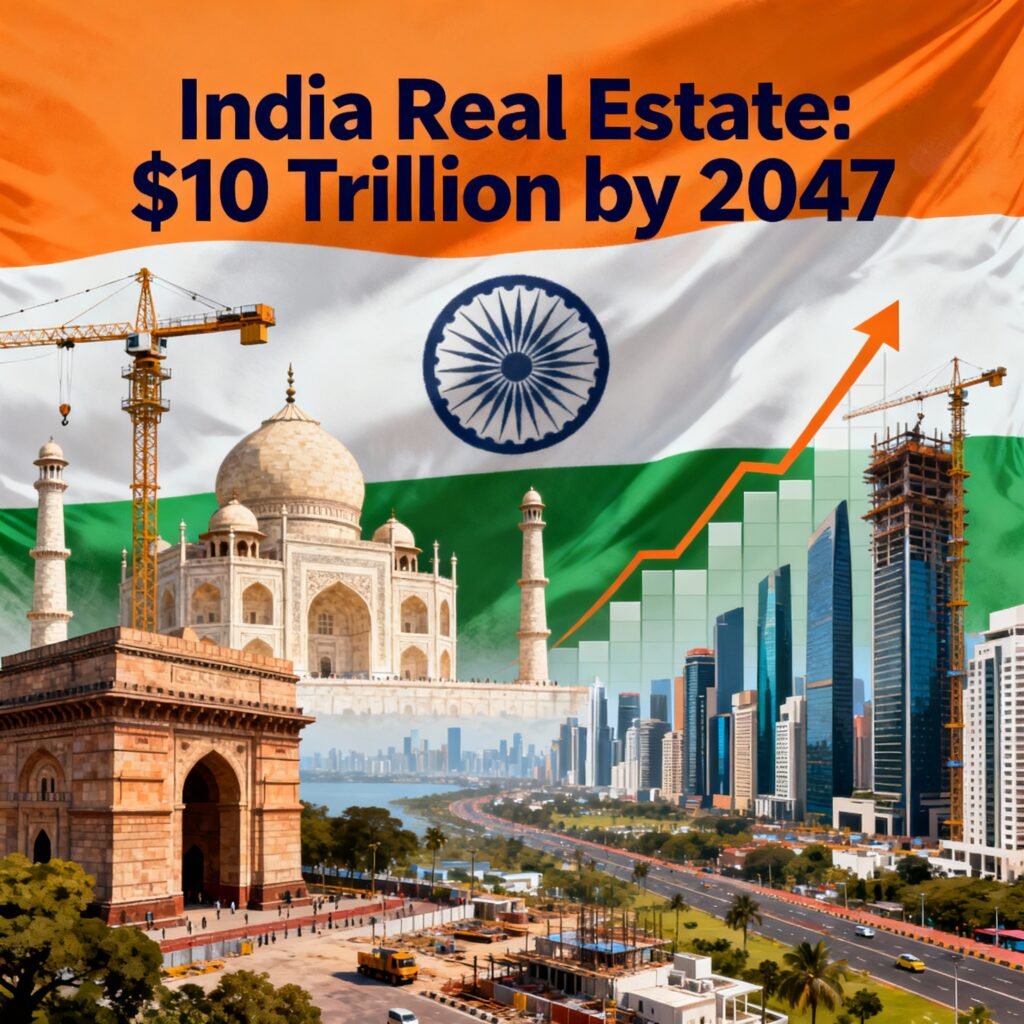
The journey toward a $10 Trillion real estate sector will see its contribution to the country’s Gross Domestic Product (GDP) potentially soar from the current 6-8% to a staggering 14-20%. This makes India’s Real Estate Sector a fundamental pillar of the nation’s economic ascent, critical to realizing the goal of a ‘Viksit Bharat’ or developed India. From accelerating urbanization to the rise of new asset classes like data centers and senior living, every facet of the market is poised for a quantum leap.
This in-depth, News unpacks the Colliers-CII report that highlights this remarkable projection. We will explore the primary growth engines, analyze the segment-wise impact on residential, commercial, and industrial markets, and provide unique insights into how investors and stakeholders can navigate and capitalize on the monumental trajectory of India’s Real Estate Sector toward the $10 Trillion mark by 2047.
The Anatomy of a $10 Trillion India’s Real Estate Sector
Understanding India’s Real Estate Sector’s Monumental Growth
The sheer scale of the projection—a nearly 33-fold increase from its current valuation—underscores the transformative era India is entering. To grasp how India’s Real Estate Sector will reach this $10 Trillion valuation, we must look beyond mere construction activity. This growth is driven by deep, structural economic forces that are reshaping the country’s urban landscape and consumption patterns. It’s an evolution from a fragmented, largely informal sector to a highly institutionalized, transparent, and globally competitive industry. The core understanding is that the growth of real estate is intrinsically linked to the overall economic development of India, acting as both a beneficiary and a key accelerator.
Why India’s Real Estate Sector is Important in Today’s Market
India’s Real Estate Sector is far more than bricks and mortar; it’s a colossal employment generator and a critical component of capital formation. In today’s market, its importance is amplified by its multiplier effect: investment in real estate stimulates demand across nearly 250 allied industries, from cement and steel to financial and legal services. A robust real estate market signals strong domestic demand and investor confidence. The move toward a $10 Trillion industry by 2047 signifies a monumental shift in national economic stability and global positioning. As a cornerstone of the ‘Viksit Bharat’ goal, a flourishing India’s Real Estate Sector is synonymous with national prosperity and infrastructural maturity.
Key Drivers and Advantages Powering the India’s Real Estate Sector $10 Trillion Trajectory
The projected growth of India’s Real Estate Sector is supported by a confluence of powerful, self-reinforcing drivers:
- Rapid Urbanization: With nearly 40% of the population expected to live in urban areas by 2047, the demand for housing, commercial spaces, and retail environments in a rapidly modernizing India is insatiable. This will create new real estate micro-markets and necessitate the development of almost 100 cities with a million-plus population.
- Favorable Demographics: India’s large, young, and increasingly affluent workforce—the demographic dividend—will enter peak income and consumption phases. This growing middle class drives homeownership aspirations and demand for quality office and retail experiences, directly fueling the expansion of India’s Real Estate Sector.
- Pro-active Policy Reforms: Landmark initiatives like the Real Estate (Regulation and Development) Act (RERA) have instilled unprecedented transparency and accountability, boosting consumer confidence and attracting institutional capital. Government housing schemes like the Pradhan Mantri Awas Yojana (PMAY) have also provided tailwinds to affordable housing within the larger India’s Real Estate Sector.
The Unprecedented Impact of Infrastructure Augmentation on India’s Real Estate Sector
Massive government investment in infrastructure is the single biggest enabler of the $10 Trillion vision. New expressways, industrial corridors, dedicated freight corridors, and metro rail networks are fundamentally reshaping India’s real estate landscape. These developments unlock new growth corridors, reducing travel times, improving connectivity, and transforming previously remote areas into commercially viable economic hotspots. This infrastructure-real estate synergy is driving the decentralization of growth, spreading development from Tier-I cities to Tier-II and Tier-III cities, diversifying the investment canvas of India’s Real Estate Sector.
Segment-Wise Insights into the Future of India’s Real Estate Sector
The path to $10 Trillion is paved by multi-fold growth across all asset classes, with each segment poised for a significant transformation:
- Residential Sector: Projected annual housing sales could double to one million units by 2047, driven by rising household incomes and favorable demographics. The focus is shifting towards affordable housing, senior living, and co-living spaces, reflecting evolving societal needs.
- Commercial Real Estate (Office): Driven by Global Capability Centers (GCCs) and domestic corporate expansion, annual office space leasing is expected to stabilize at a colossal 70-75 million sq ft. This demand is fueling the growth of Grade A office stock, which is likely to exceed one billion sq ft.
- Industrial & Warehousing: The ‘Make in India’ push, robust e-commerce growth, and logistics modernization will see annual warehousing demand reach 30-40 million sq ft. Grade A warehousing capacity is projected to hit 2 billion sq ft by 2047, essential for the supply chain backbone of the massive India’s Real Estate Sector.
The Rise of Alternative Assets: Diversifying the India’s Real Estate Sector $10 Trillion Portfolio
Beyond the core segments, the rise of alternative asset classes is providing new depth to the market. This diversification strengthens the resilience of India’s Real Estate Sector and presents novel investment opportunities:
- Data Centers: Fueled by rapid digitalization, AI adoption, and 5G rollout, data center capacity is projected to soar to nearly 10 GW by 2047. Data centers are emerging as crucial digital infrastructure, becoming a significant component of the $10 Trillion valuation.
- Senior Living and Co-living: Changing family structures and evolving lifestyles are driving demand for specialized residential segments. The senior living market caters to the needs of an aging population, while co-living addresses the housing requirements of the young, mobile workforce, integrating convenience and community within the evolving India’s Real Estate Sector.
Technological Innovation: The Digital Backbone of India Real Estate Sector
Technology is no longer an add-on; it is the enabler for the massive scalability required to achieve the $10 Trillion target. Digital transformation is streamlining the entire real estate value chain:
- PropTech: Technology adoption is improving efficiency in construction (e.g., modular building), project management, and property transactions.
- Smart Cities: The integration of AI, IoT, and data analytics in urban planning creates smart city infrastructure, leading to more efficient, sustainable, and better-managed urban environments. This sophisticated urban planning is fundamental to the expansion of India’s Real Estate Sector.
Investment and Financing Insights for the Future Real Estate Sector Giant
The journey to $10 Trillion is attracting significant institutional and foreign capital. The transparency brought by RERA and the stability of the economy have made Indian real estate a favored destination for global investors.
- REITs (Real Estate Investment Trusts): The market capitalization share of REITs is expected to surge from around 10% to 40-50% by 2047, democratizing real estate investment for retail investors and providing a stable, liquid investment avenue within India’s Real Estate Sector.
- Green Financing: A growing focus on sustainability is attracting capital into Green Buildings and eco-friendly projects, driving a fundamental shift towards environmentally responsible development practices and cementing the long-term viability of the India’s Real Estate Sector at the $10 Trillion mark.
Comparison with Global Real Estate Growth Trajectories
The projected growth of India’s Real Estate Sector is not unprecedented on the world stage, but its speed and structural drivers are unique. Unlike property booms in some developed markets, India’s growth is underpinned by genuine and massive domestic demand, driven by population size, demographics, and a strong government policy push. This makes the $10 Trillion growth a sustainable long-term trend, not a short-term bubble. The focus on affordable housing and infrastructure-led development ensures that the growth is more equitable and geographically diversified than typical global real estate booms.
Why You Should Invest and Participate in India’s Real Estate Sector Now
For investors, developers, and homebuyers, the projected trajectory to $10 Trillion represents a multi-generational opportunity. Investing in India’s Real Estate Sector now means positioning oneself in a market that is just beginning its exponential growth phase. The unique blend of structural drivers—urbanization, a massive young workforce, and government support—mitigates risk and maximizes long-term capital appreciation potential. Early movers in Tier-II/III cities, specialized alternative assets, and PropTech stand to gain the most from the transformative journey of India’s Real Estate Sector.
Expert Insights and Market Analysis on the Real Estate Sector $10 Trillion Milestone
Leading market analysts and industry experts unanimously agree that the $10 Trillion projection for India’s Real Estate Sector is achievable, provided the current momentum of policy and infrastructure spending is maintained. They highlight that the growth will be characterized by:
- Decentralization: Tier-II and Tier-III cities will be the next growth engines, offering better returns due to lower base prices and emerging commercial activity.
- Institutionalization: The market will become increasingly transparent, attracting more Foreign Direct Investment (FDI) and institutional funds.
- Sustainability: Green mandates and ESG (Environmental, Social, and Governance) compliance will be non-negotiable for large-scale projects, becoming a major differentiator in India’s Real Estate Sector.
Future Growth and Development Potential Across New Corridors
The future of India’s Real Estate Sector hinges on the development of new growth corridors. Massive projects like the Delhi-Mumbai Industrial Corridor (DMIC) and numerous new expressways are not just transport links; they are catalysts for new economic cities and clusters. These corridors will spur demand for integrated townships, logistics parks, and decentralized office hubs, further solidifying the path to the $10 Trillion valuation by 2047. The potential for development in these newly connected areas is virtually limitless, representing a fresh canvas for sustainable, large-scale urbanization within India’s Real Estate Sector.
Conclusion — The Final Word on India’s Real Estate Sector
The journey to a $10 Trillion real estate sector by 2047 is one of the most exciting economic stories of the 21st century. Fuelled by the structural demand from rapid urbanization, a robust demographic dividend, and an unwavering commitment to infrastructure-led growth, India’s Real Estate Sector is poised for an unprecedented transformation. This monumental growth will not only elevate the sector’s contribution to GDP to as much as 20% but also create millions of jobs, foster new cities, and fundamentally reshape the socio-economic landscape of the nation. The expansion spans every asset class—from doubling residential sales to a quantum leap in data center capacity. This is more than a forecast; it’s a blueprint for a developed India. For anyone seeking long-term growth and capital appreciation, engaging with this dynamic market is an imperative. India’s Real Estate Sector offers a unique opportunity to invest in the nation’s future, one built on a foundation of reform, transparency, and relentless progress.
Why Contact Best Real Estate Advisory byVivek Singh?

Author
Vivek Singh is a real estate expert with 22+ years of experience, Specialized in investment, residential & commercial properties, and market trends. He is the Experienced author of byviveksingh.in, a platform sharing practical insights on real estate/Investment/Lifestyle & Stocks . With Education background in Bachelor of Commerce, Master’s in Marketing & Finance, and PG Diploma in Advertising/Public Relations, Vivek Singh blends industry expertise with strategic vision.
Vivek Singh
Serve as Director Sales at
Sumiram Sai Realtors (SSR)
FAQ on India’s Real Estate Sector
Q1. What specific factors are driving the projected growth of India’s Real Estate Sector to $10 Trillion?
A1. The primary drivers for India’s Real Estate Sector’s projected growth to $10 Trillion are rapid urbanization (with 40% of the population expected to be urban by 2047), a massive young demographic dividend, and sustained infrastructure-led development (expressways and metros). These three factors create structural, long-term demand across all segments of the real estate sector.
Q2. How will the residential segment in India’s Real Estate Sector change on the way to $10 Trillion?
A2. The residential segment of India’s Real Estate Sector is expected to double its annual sales to one million units by 2047. Key changes include a surge in demand for affordable housing, the rise of specialized housing like senior living and co-living spaces, and a stronger focus on transparency due to RERA, benefiting the overall real estate sector.
Q3. Is the $10 Trillion projection for India’s Real Estate Sector reliant solely on metropolitan growth?
A3. No, the $10 Trillion projection for India’s Real Estate Sector is heavily driven by the decentralization of growth. Infrastructure projects are opening up new growth corridors, transforming Tier-II and Tier-III cities into economic and real estate hubs. This diversification across nearly 100 million-plus cities is essential for the expansive growth of the real estate sector.
Q4. What role will technology and alternative assets play in achieving the $10 Trillion valuation for India’s Real Estate Sector?
A4. Technology, or PropTech, will enhance efficiency and transparency. Alternative assets like data centers (projected to hit nearly 10 GW capacity) and specialized co-living spaces will be major contributors to the $10 Trillion valuation. These emerging segments are critical for diversifying and modernizing India’s Real Estate Sector.
Q5. How does the rise of REITs and institutional investment affect India’s Real Estate Sector’s long-term stability?
A5. The projected surge in REITs (Real Estate Investment Trusts) market share to 40-50% will significantly institutionalize and professionalize India’s Real Estate Sector. This increased institutional and foreign investment brings greater liquidity, transparency, and corporate governance, thereby bolstering the long-term stability and resilience of the real estate sector.
Q6. What are the key challenges that could impact India’s Real Estate Sector’s journey to $10 Trillion?
A6. While the outlook is strong, maintaining affordable housing supply, ensuring swift regulatory approvals, managing land acquisition complexities, and continuous improvement in urban infrastructure are essential. Addressing these challenges is vital for sustained, equitable growth of India’s Real Estate Sector toward the $10 Trillion milestone.
Q7. How does the projected growth of India’s Real Estate Sector connect to India’s broader economic goals for 2047?
A7. The $10 Trillion real estate sector is a cornerstone of the ‘Viksit Bharat’ vision for 2047. It is projected to contribute up to 20% of India’s GDP, acting as a powerful multiplier for job creation and capital formation. The growth of India’s Real Estate Sector is inextricably linked to the goal of becoming a developed and inclusive global economy.