
The landscape of Indian urban centers is undergoing a seismic shift, and at the heart of this transformation is a singular powerhouse: the Global Capability Center (GCC). As we look at how GCCs are changing India’s commercial real estate market, it becomes clear that these entities are no longer just “back-office” support units. They have evolved into the strategic nerve centers of global multinational corporations (MNCs), driving innovation in AI, R&D, and digital transformation. This evolution has triggered a record-breaking surge in demand for high-quality, sustainable, and technologically advanced workspaces across India.
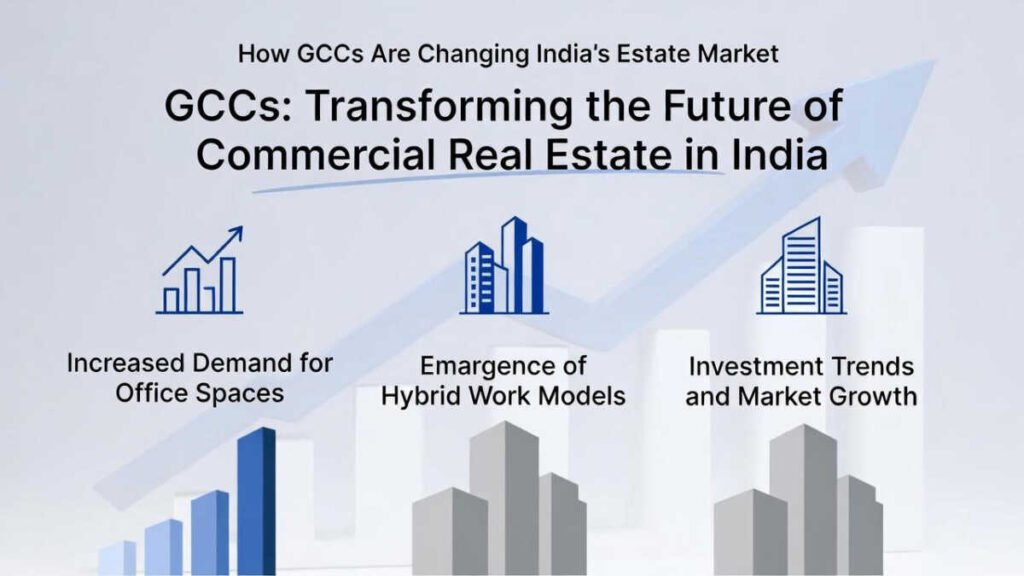
Understanding how GCCs are changing India’s commercial real estate market requires looking at the sheer scale of operations. In 2024 and 2025, GCCs accounted for nearly 40% of all office leasing activity in India’s top seven cities. From the silicon plateaus of Bengaluru to the emerging tech corridors of Hyderabad and Pune, the footprint of these global hubs is expanding at an unprecedented rate. Developers are no longer just building offices; they are creating “innovation ecosystems” specifically designed to house thousands of high-skilled professionals.
The relevance of this topic cannot be overstated for investors, developers, and corporate leaders. As India moves toward a $1 trillion real estate market size by 2030, the influence of these centers remains the most critical variable. This article provides a comprehensive analysis of how GCCs are changing India’s commercial real estate market, exploring why they are choosing India, the shift toward Grade A and managed spaces, and the rise of Tier-2 cities as the next frontier for global growth.
Understanding How GCCs are Changing India’s Commercial Real Estate Market
To truly grasp how GCCs are changing India’s commercial real estate market, one must first understand the transition from the “BPO era” to the “GCC era.” Previously, Indian commercial real estate was driven by third-party IT service providers looking for cost-effective, high-density seating. Today, Global Capability Centers (GCCs) prioritize quality over quantity. They are leasing massive “Grade A” office spaces that mirror the headquarters of their parent companies in Silicon Valley or London.
The way how GCCs are changing India’s commercial real estate market is visible in the leasing structures. We are seeing a move toward long-term commitments, with 9-to-15-year lease terms becoming the standard for major GCCs. This stability is providing developers with the “bankable” rental income needed to secure massive institutional funding, further fueling the construction of premium commercial hubs.
Why How GCCs are Changing India’s Commercial Real Estate Market Matters Today
The timing of this shift is critical. While global commercial real estate markets in the US and Europe have faced headwinds due to remote work trends, India’s market is thriving. This resilience is a direct result of how GCCs are changing India’s commercial real estate market. MNCs are finding that having a physical presence in India is essential for talent retention and high-value innovation.
Moreover, how GCCs are changing India’s commercial real estate market matters because it is a barometer for India’s economic maturity. When a Global 500 company sets up a 500,000-square-foot R&D center in Bengaluru, it signifies a long-term bet on India’s talent and infrastructure. This “sticky” demand is what keeps the Indian commercial real estate (CRE) sector insulated from global volatility, making it a “safe haven” for international real estate investment trusts (REITs).
Key Features of How GCCs are Changing India’s Commercial Real Estate Market
When analyzing how GCCs are changing India’s commercial real estate market, several distinct features emerge that separate GCC-driven demand from traditional IT leasing:
- Grade A Dominance: GCCs exclusively target Grade A buildings that offer LEED or IGBC green certifications, high-speed fiber connectivity, and superior safety protocols.
- Built-to-Suit (BTS) Models: A significant trend in how GCCs are changing India’s commercial real estate market is the rise of BTS projects, where developers customize every aspect of the building—from the HVAC system to the laboratory spaces—to meet the specific needs of the MNC.
- Sustainability Focus: ESG (Environmental, Social, and Governance) goals are non-negotiable for modern GCCs. This has forced Indian developers to pivot toward “net-zero” ready buildings.
- Employee Wellness Amenities: Modern GCC offices now include gyms, crèches, high-end cafeterias, and “breakout zones,” reflecting a shift toward experience-first workplaces.
The Geographic Shift: From Metros to Tier-2 Cities
A fascinating aspect of how GCCs are changing India’s commercial real estate market is the geographical diversification of office demand. While Bengaluru and Hyderabad remain the “Big Two,” accounting for over 60% of GCC leasing, there is a visible move toward Tier-2 cities.
Cities like Pune, Chennai, and increasingly Ahmedabad, Kochi, and Coimbatore are seeing an influx of GCCs. This is driven by the “reverse brain drain” and the search for lower operational costs. In these smaller cities, how GCCs are changing India’s commercial real estate market is even more profound, as a single large GCC entry can revitalize an entire local economy, driving up property values and encouraging the development of secondary infrastructure like retail and residential complexes.
How GCCs are Changing India’s Commercial Real Estate Market Through Flex Spaces
The “Core + Flex” model is a defining trend in how GCCs are changing India’s commercial real estate market. Global companies are no longer putting all their employees in one massive owned building. Instead, they take a large “core” office and supplement it with “flex” or managed office spaces for specific projects or departments.
Managed office operators are thriving because of how GCCs are changing India’s commercial real estate market. These operators provide “plug-and-play” environments that allow a US-based firm to go from zero to 500 employees in India within weeks rather than months. This agility is a key competitive advantage that India offers over other global hubs.
Investment Insights: How GCCs are Changing India’s Commercial Real Estate Market for Investors
For institutional investors, the story of how GCCs are changing India’s commercial real estate market is one of yield and stability. Office assets backed by GCC tenants are highly prized. Because these centers perform mission-critical work—such as global cybersecurity or AI modeling—they are less likely to vacate during economic downturns.
The rise of REITs in India is also intrinsically linked to how GCCs are changing India’s commercial real estate market. The portfolios of major Indian REITs are heavily weighted toward GCC-occupied assets. As these centers expand, the underlying asset value increases, providing steady dividends to retail and institutional investors alike.
The Role of Technology and AI in GCC Real Estate
We cannot discuss how GCCs are changing India’s commercial real estate market without mentioning the technological integration within the buildings themselves. Modern GCCs are “Smart Buildings.” They utilize Internet of Things (IoT) sensors to monitor occupancy, optimize lighting and cooling, and enhance security.
Because many of these centers are focused on AI development, the real estate must accommodate massive data requirements. The way how GCCs are changing India’s commercial real estate market includes a demand for high-tier data centers and edge computing facilities located either within or adjacent to the primary office space to ensure zero-latency operations.
Comparison: GCCs vs. Traditional IT Services in CRE
To illustrate how GCCs are changing India’s commercial real estate market, consider the following comparison:
| Feature | Traditional IT Services | Global Capability Centers (GCCs) |
| Space Utilization | High-density (more seats per sq. ft.) | Low-density (collaborative & open) |
| Lease Duration | 3 to 5 years | 9 to 15 years |
| Design Focus | Functional / Standardized | Brand-aligned / Experiential |
| Building Grade | Grade B or A- | Strictly Grade A+ / ESG Compliant |
| Location | Suburban IT Parks | Central Business Districts & Premium Tech Hubs |
This table highlights how GCCs are changing India’s commercial real estate market by shifting the focus from “cost-saving” to “value-creation.”
Market Trends and Future Growth Potential
The future of how GCCs are changing India’s commercial real estate market looks exceptionally bright. Industry reports suggest that by 2030, India will host over 2,500 GCCs, up from approximately 1,700 today. This will require an additional 150 to 200 million square feet of Grade A office space.
A major upcoming trend in how GCCs are changing India’s commercial real estate market is the “verticalization” of centers. We are seeing industry-specific GCCs—such as those focused exclusively on “Retail Tech,” “FinTech,” or “BioTech”—moving into specialized parks that offer industry-specific infrastructure (e.g., wet labs for pharma GCCs or high-security vaults for banking GCCs).
Expert Insights on the Impact of GCCs
Real estate analysts consistently point to the “Multiplier Effect” when discussing how GCCs are changing India’s commercial real estate market. One dollar spent on GCC office leasing typically generates several dollars of economic activity in the surrounding area, including demand for luxury housing, premium retail, and high-end hospitality.
Experts also note that how GCCs are changing India’s commercial real estate market is forcing local developers to professionalize. To attract a Fortune 100 tenant, a developer must maintain international standards of facility management, transparency, and legal compliance. This is raising the bar for the entire Indian real estate industry.
Why Developers Should Pivot Toward the GCC Model
If you are a developer, understanding how GCCs are changing India’s commercial real estate market is the key to future-proofing your portfolio. The “old way” of building generic office blocks is over. To succeed, developers must focus on:
- ESG Compliance: You cannot attract a GCC today without a green building certification.
- Scalability: Buildings must be designed to allow a tenant to expand from 50,000 to 200,000 square feet seamlessly.
- Connectivity: Reliable, redundant high-speed internet is the lifeblood of how GCCs are changing India’s commercial real estate market.
Conclusion – Final Thoughts on How GCCs are Changing India’s Commercial Real Estate Market
In summary, the narrative of how GCCs are changing India’s commercial real estate market is one of evolution and resilience. These centers have transformed India from a “back-office” destination into a “global nerve center,” and the commercial real estate sector has risen to the occasion. By demanding higher standards, longer leases, and sustainable designs, GCCs have institutionalized the Indian office market, making it one of the most attractive investment destinations globally.
As we move toward 2030, the question isn’t whether how GCCs are changing India’s commercial real estate market will continue, but rather how fast the secondary and tertiary cities can catch up to the demand. For anyone involved in the Indian property market, the GCC is the most important acronym to know.
Why You Should Choose Cyber Arch IT Park Studio Apartment Greater Noida Over Others
The decision to invest in a Cyber Arch IT Park Studio Apartment Greater Noida is a vote for stability and growth in a dynamic market. The unique combination of factors makes it a top-tier choice:
- Dual-Purpose Demand: Catering to both commercial (IT Park) and residential (Studio Apartment) demand simultaneously.
- Strategic Pinpoint Location: Its address in Knowledge Park 5, next to Delhi World Public School, is superior for both rental yield and accessibility.
- Low-Ticket Investment, High-Yield Potential: The studio apartment format offers an accessible entry point to the high-growth Greater Noida West market, maximizing the ROI potential from a single Cyber Arch IT Park Studio Apartment Greater Noida.
FAQs
Q1. Why is how GCCs are changing India’s commercial real estate market such a hot topic in 2025?
A1. The discussion around how GCCs are changing India’s commercial real estate market is popular because GCCs now account for nearly 40% of all office leasing. Their shift toward high-value work like AI and R&D has created a massive demand for Grade A office spaces, fundamentally altering the stability and growth trajectory of the Indian real estate sector.
Q2. How do GCCs influence the rental rates in Indian cities?
A2. One way how GCCs are changing India’s commercial real estate market is by driving up rentals for premium properties. Because GCCs prioritize “Grade A+” buildings with ESG certifications and top-tier amenities, they are willing to pay a premium, which in turn sets new benchmarks for commercial rents in micro-markets like Bengaluru’s Outer Ring Road or Hyderabad’s HITEC City.
Q3. Is the impact of how GCCs are changing India’s commercial real estate market limited to big cities?
A3. No, a significant trend in how GCCs are changing India’s commercial real estate market is the expansion into Tier-2 cities. Cities like Pune, Ahmedabad, and Kochi are seeing record leasing as GCCs look for diverse talent pools and lower operational costs, spreading the commercial real estate boom beyond just the major metros.
Q4. What role does sustainability play in how GCCs are changing India’s commercial real estate market?
A4. Sustainability is central to how GCCs are changing India’s commercial real estate market. Most global MNCs have strict net-zero targets, meaning they will only lease buildings with LEED or IGBC certifications. This has forced Indian developers to prioritize green building practices, effectively “greening” the entire commercial real estate pipeline.
Q5. How has the rise of GCCs affected the growth of REITs in India?
A5. The growth of Indian REITs is a direct byproduct of how GCCs are changing India’s commercial real estate market. GCCs provide high-quality, long-term tenants that ensure steady cash flows. This makes the underlying office assets highly attractive for REIT portfolios, providing investors with reliable yields backed by some of the world’s largest corporations.
Q6. What is the future outlook for how GCCs are changing India’s commercial real estate market?
A6. The outlook for how GCCs are changing India’s commercial real estate market is incredibly positive. With the number of GCCs expected to cross 2,500 by 2030, the demand for sophisticated, “intelligent” office spaces will continue to grow, potentially requiring an additional 200 million square feet of office stock over the next five years.